
Reap What You Sow Mondays with Tony™: Don’t Confuse Being Needed With Being Assigned— Every Problem You Can Solve Is Not Automatically Your Responsibility

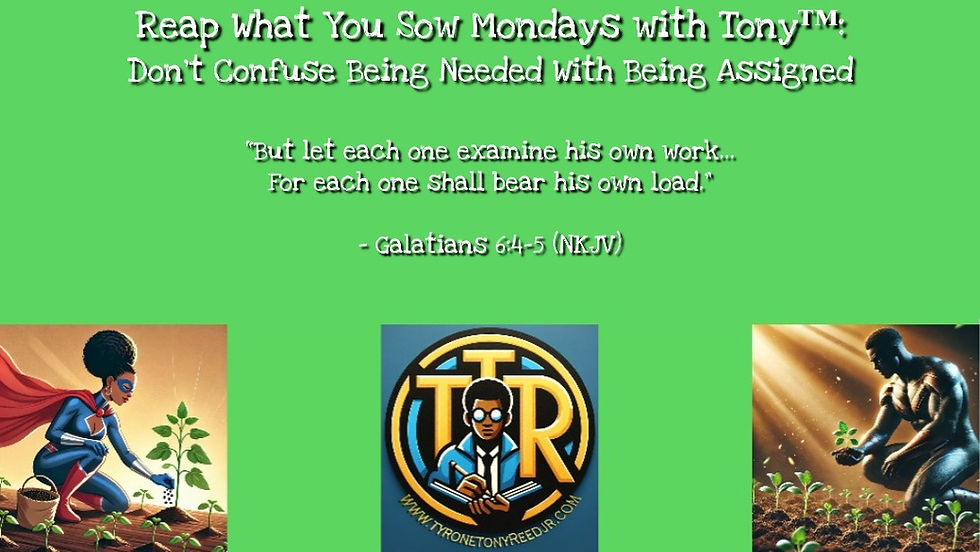
Being needed can feel good. There is something affirming about knowing people trust you, depend on you, call you when something goes wrong, ask for your advice, need your help, and believe you can fix what they cannot. Being dependable is a beautiful quality. Serving others matters. Compassion matters. Generosity matters. Scripture repeatedly calls us to love, help, encourage, and bear with one another.
But there is a dangerous place where helpfulness can turn into overextension. You become the person everybody calls. The emergency contact. The problem solver. The rescuer.
The one expected to rearrange your schedule, spend your money, sacrifice your peace, postpone your plans, carry somebody else’s responsibilities, and somehow make everything work.
Eventually, you can become so busy tending everybody else’s field that you neglect the one God actually assigned to you. That is why one of the most important questions you can learn to ask is not simply, “Can I help?”
It is: “Is this mine to carry?” Because being needed and being assigned are not the same thing.
Every Need Is Not Your Assignment
Galatians 6:4–5 (NKJV) says, “But let each one examine his own work… For each one shall bear his own load.” That passage sits alongside the biblical instruction to help bear one another’s burdens. Those truths are not contradictory. They reveal balance.
There are burdens people genuinely need help carrying. And there are loads people are responsible for carrying themselves. Discernment helps us know the difference.
Sometimes love says, “Let me help you.” Sometimes wisdom says, “You can do this, and I believe you need to.”
If you constantly carry what someone else is supposed to carry, you may think you are helping when you are actually preventing growth. You can unintentionally teach people that they never have to develop discipline, solve problems, accept consequences, make difficult decisions, or take responsibility because you will always arrive to rescue them.
Compassion should help people become stronger. It should not make irresponsibility more comfortable.
Your Ability Does Not Automatically Create Your Obligation
This is where dependable people often struggle.
You see the problem.
You know how to fix it.
You have the experience.
You have the resources.
You could make the call.
You could lend the money.
You could take over the project.
You could rearrange your day.
You could step in.
And because you can, you start believing you should. But ability does not automatically equal assignment.
Jesus had the power to meet every need around Him, yet He did not allow every demand to dictate His movements. There were crowds looking for Him, people wanting His attention, and endless needs around Him. Still, He withdrew to pray. He moved according to His Father’s purpose rather than allowing urgency alone to determine His direction.
That matters. If Jesus did not allow every need to become His immediate assignment, why do we believe faithfulness requires us to answer every request?
Sometimes saying no is not selfish. Sometimes saying no is stewardship.
Being Needed Can Become Addictive
There is another side of this conversation that requires honesty. Sometimes we keep rescuing people because being needed makes us feel important.
We like being the strong one. We like being the reliable one. We like hearing, “I do not know what I would do without you.”
That can quietly become part of our identity. Then boundaries feel like abandonment. Rest feels selfish. Letting people solve their own problems feels cruel. We start measuring our value by how much everybody depends on us.
But God did not create you merely to become indispensable to other people. Your identity cannot be built on everybody needing you. Because eventually, you may begin keeping people dependent simply because their dependence makes you feel valuable.
Healthy love does not need someone else to remain helpless. Healthy love serves when serving is right, steps back when stepping back is wise, and understands that God is the Savior.
You are not.
Stop Spending Your Best Seed Everywhere Else
Think about your life as a field. You have limited seed.
Limited time.
Limited energy.
Limited attention.
Limited emotional capacity.
Limited financial resources.
Even your physical body has limits. Now imagine scattering your seed everywhere. A little goes toward this person’s emergency. A little goes toward somebody else’s drama. A little goes toward fixing something another adult refuses to handle. A little goes toward obligations you accepted out of guilt. A little goes toward situations you were never called to manage.
Then you arrive at your own field and discover you have nothing left.
No energy for your marriage.
No time for your children.
No focus for your purpose.
No strength for your health.
No attention for your dream.
No quiet for prayer.
No consistency for the assignment God placed in your hands.
Then you wonder why your field is not producing. Maybe the problem is not that you had no seed. Maybe you planted your best seed everywhere except where God told you to plant it.
Guilt Is a Terrible Assignment Manager
Some people do not need your help. They need your guilt. They know if they sound disappointed enough, desperate enough, angry enough, or offended enough, you will eventually surrender your boundary.
So you say yes because you do not want them upset. You say yes because they remind you of everything they have done for you. You say yes because somebody calls you selfish. You say yes because you fear what people will think. You say yes while resentment is already growing inside you.That is not healthy service.
Second Corinthians 9:7 reminds us that giving should not come from compulsion. While that passage specifically concerns generosity, the principle speaks powerfully to our motives: God cares not only about what we give, but how we give it.
A guilt-driven yes can eventually produce a bitter harvest. Sometimes the honest, loving answer is no.
Some People Need Consequences More Than Rescue
This is difficult when you love somebody. You see them making a bad decision. You warn them. They ignore you. The consequences arrive, and suddenly they need you to remove every uncomfortable result of the choice they made.
Your heart wants to rescue them. But sometimes consequences are teachers. If you continually remove every consequence, the lesson may never take root.
This does not mean abandoning people in genuine crisis or refusing mercy. It means recognizing that mercy and rescue are not always identical. Sometimes mercy provides support while still allowing responsibility.
You can love someone without paying every bill they created.
You can love someone without fixing every conflict they started.
You can love someone without lying for them.
You can love someone without becoming responsible for choices they continue making.
You can pray for them.
Encourage them. Offer wisdom. Stand beside them. But you do not always have to stand in front of the consequence.
Discernment Asks Better Questions
Before automatically saying yes, learn to pause.
Ask yourself: Did God actually assign this to me, or did somebody simply ask me because they know I usually say yes?
Ask: Will helping strengthen this person, or keep them dependent?
Ask: What will I have to neglect in order to take this on?
Ask: Am I responding from love, obedience, guilt, fear, ego, or the need to be needed?
And perhaps most importantly: What has God already placed in my hands that deserves my attention?
Not every opportunity to help is wrong. Not every sacrifice is unhealthy. Not every interruption is a distraction. But discernment keeps compassion from becoming chaos.
Boundaries Protect the Assignment
Boundaries are not walls against love. They are fences around stewardship. A farmer does not fence a field because he hates everything outside it. He protects the field because something valuable is growing inside it.
Your time deserves stewardship.
Your marriage deserves stewardship.
Your family deserves stewardship.
Your health deserves stewardship.
Your finances deserve stewardship.
Your peace deserves stewardship.
Your calling deserves stewardship.
Your relationship with God deserves stewardship.
If everybody has unlimited access to all of you, eventually there may be very little of you left for what God actually assigned. You do not have to apologize for protecting what God trusted you to cultivate.
The S.O.L.A.D.™ Connection
In S.O.L.A.D.™: Soldiers of Light Against Darkness™, Angelo™ and Angeline™ face enormous battles, but being heroes does not mean chasing every possible conflict without wisdom. A mission requires focus. An assignment requires discernment. Strength must be directed toward the battle that actually matters.
Imagine a soldier abandoning the mission every time someone shouted for attention from another direction. Eventually, the real objective would be lost. That same principle matters in everyday life.
You can be compassionate without becoming distracted.
You can be generous without becoming depleted.
You can serve people without surrendering your entire assignment.
A Soldier of Light Against Darkness™ has to know not only how to fight, but which battle is theirs to fight. So do we.
Stop Rescuing Everybody and Start Stewarding Your Assignment
There are people you should help. Help them. There are burdens you should help carry. Carry them.
There are sacrifices God will call you to make. Make them. But there are also responsibilities you need to return to the people who own them.
There are problems you do not have to solve.
There are emergencies you did not create.
There are battles you were never assigned.
There are expectations you are allowed to disappoint.
And there are fields God entrusted specifically to you that deserve better than the leftovers of your time, energy, attention, and strength.
This week, ask yourself: Am I sowing my best seed into responsibilities God never actually gave me?
If the answer is yes, it may be time to reclaim some seed.
Plant it where God assigned you.
Water what He entrusted to you.
Protect the field.
Help people from a place of love rather than guilt.
And stop confusing being needed with being assigned.
A Closing Prayer
Heavenly Father, thank You for giving us hearts that desire to love, serve, encourage, and help others. Teach us to remain compassionate without becoming consumed, generous without becoming depleted, and available without neglecting the assignments You have placed in our hands.
Give us discernment to recognize the difference between a burden You are calling us to help carry and a responsibility someone else must learn to carry for themselves. Deliver us from guilt-driven decisions, unhealthy people-pleasing, and the belief that our value depends on how much other people need us.
Lord, show us where we have been sowing our time, energy, money, attention, and emotional strength into fields You never assigned to us. Give us courage to establish healthy boundaries without bitterness, cruelty, or guilt.
Help us faithfully steward our families, our health, our finances, our gifts, our calling, our peace, our relationship with You, and every responsibility You have truly entrusted to us.
Teach us to recognize our assignment, protect our seed, cultivate our field, and trust You to be God in the lives of the people we love.
In Jesus’ name, Amen.
Order your autographed copies of S.O.L.A.D.™: Soldiers of Light Against Darkness™ today:

You do not have enough seed for every field. Stop planting everywhere you are needed. Start stewarding where you are assigned. And you will reap what you sow.


Comments