
Reap What You Sow Mondays with Tony™: Sowing Truth in Hostile Soil: The Holy Boldness of Sojourner Truth

There are some lives that feel less like biographies and more like blueprints.
Blueprints for courage.Blueprints for spiritual endurance.Blueprints for kingdom agriculture.
On this 2nd day of Women’s History Month, we honor Sojourner Truth, a woman who did not just speak truth — she planted it.
And when you understand her life through the lens of “Reap What You Sow Mondays with Tony,” you begin to see something powerful:
Truth is a seed. Obedience is a seed. Identity is a seed. And even suffering, when surrendered to God, becomes fertile ground.
Sojourner Truth’s life was not accidental. It was agricultural.
The Soil She Was Planted In
Born Isabella Baumfree around 1797 in Ulster County, New York, she entered a world that legally declared her property. Enslaved from birth, she experienced trauma that many could not endure.
She was bought and sold multiple times before the age of 13. She was beaten. She was forced into labor. She was separated from family.
The soil was brutal.
And yet, Scripture tells us something about soil.
In Matthew 13, Jesus explains the Parable of the Sower. Some seeds fall on rocky ground. Some fall among thorns. Some fall on good soil.
But what we often forget is this: the seed does not choose the soil.
God chooses where we are planted.
Sojourner Truth was planted in one of the harshest social climates in American history — chattel slavery. And yet what grew from her life would eventually challenge the entire nation.
That is not coincidence. That is divine economy.
Escape as an Act of Sowing
In 1826, one year before New York’s emancipation law would take full effect, Isabella walked away from slavery with her infant daughter.
Notice something important.
She did not wait for systems to catch up to justice.She stepped into freedom by faith.
Hebrews 11:1 says:
“Now faith is the substance of things hoped for, the evidence of things not seen.”
Freedom was not yet visible. But she moved as if it were promised.
And then she did something even more extraordinary: she sued a white man in court to recover her illegally sold son — and she won.
A formerly enslaved Black woman winning a legal case against a white man in the early 1800s was not just a personal victory. It was prophetic.
She planted a legal seed.
She demonstrated that even within unjust systems, truth can pierce through.
That is reaping what you sow.
She sowed courage.She reaped justice.
But more than that — she planted expectation for generations to come.
The Theology of Renaming
In 1843, she changed her name to Sojourner Truth.
Let us sit with that.
Names in Scripture matter.
Abram becomes Abraham. Sarai becomes Sarah. Jacob becomes Israel. Simon becomes Peter.
When God shifts destiny, He often shifts identity first.
“Sojourner” means traveler — someone who journeys with purpose.
“Truth” means exactly what it says — unfiltered, unbending, uncompromising reality.
She did not choose a soft name.She chose a confrontational one.
In a nation built on economic lies about race, humanity, and hierarchy, she renamed herself Truth.
That was not branding.
That was prophecy.
Reap What You Sow Mondays with Tony teaches us that what you call yourself determines what you plant into the world.
If you call yourself defeated, you sow limitation. If you call yourself chosen, you sow authority. If you call yourself called, you sow mission.
Sojourner Truth sowed identity before she sowed speeches.
“Ain’t I a Woman?” — Confronting a Divided Movement
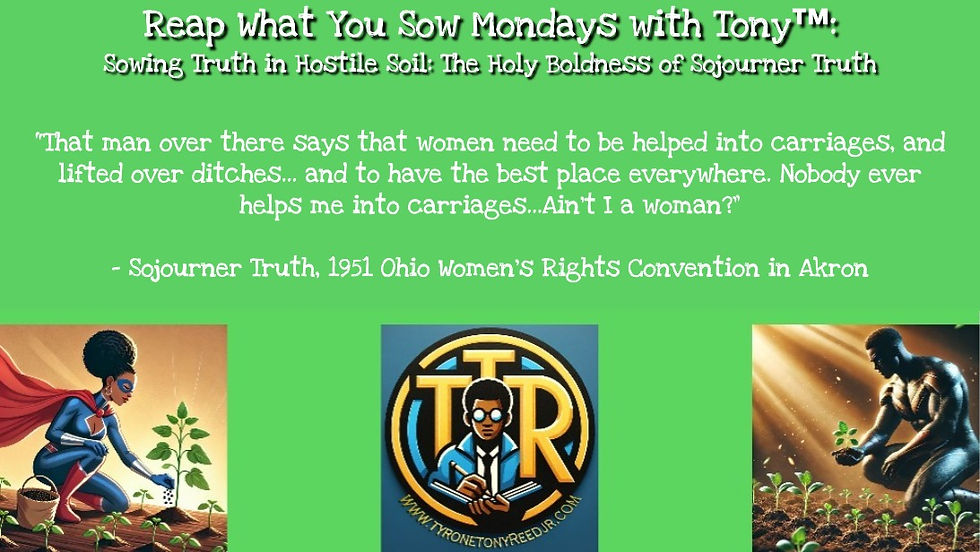
In 1851, at the Ohio Women’s Rights Convention in Akron, she delivered the speech that would echo across centuries.
While historians debate the exact phrasing — particularly the repeated line “Ain’t I a Woman?” — the spirit of the moment remains undeniable.
White suffragists were arguing for women’s rights based on fragility and delicacy. They described women as needing protection, gentleness, assistance.
Sojourner stood and disrupted that narrative.
She spoke about plowing fields.About bearing whippings.About enduring pain.And then she asked the piercing question:
“Ain’t I a woman?”
She exposed the hypocrisy of a movement that demanded equality while excluding Black women from its definition of womanhood.
This is theological territory.
James 2:1 warns against favoritism in the body of believers.
Sojourner Truth understood that liberation theology cannot be selective.
Justice that excludes is not justice.
She sowed confrontation into comfort.
And every modern intersectional movement reaps from that seed.
Faith as Fuel, Not Decoration
It is important to understand that Sojourner Truth was not merely political.
She was deeply spiritual.
She believed she heard from God. She believed she was sent. She preached as an itinerant evangelist. She sang hymns. She quoted Scripture.
Her activism was not separate from her theology.
It flowed from it.
Romans 8:19 says:
“For the earnest expectation of the creation eagerly waits for the revealing of the sons of God.”
Creation groans for justice.
Sojourner believed God was not neutral about oppression.
She believed truth was not optional.
And she lived as if heaven was watching.
Reap What You Sow Mondays is not hustle culture. It is kingdom agriculture.
You sow righteousness. You sow obedience. You sow conviction.
And whether applause comes or not, heaven records it.
Meeting Power Without Bowing to It
In 1864, Sojourner Truth met President Abraham Lincoln at the White House.
Let that image settle.
A formerly enslaved Black woman in conversation with the President during the Civil War.
History often highlights Lincoln’s Emancipation Proclamation. But it is equally powerful to recognize that women like Sojourner Truth were spiritual pressure points on the conscience of the nation.
She did not dilute her message in proximity to power.
She did not soften her tone because she entered elite rooms.
That is a word for leaders today.
When influence tempts compromise, remember:
You reap integrity when you sow it consistently.
Economic Empowerment: The Forgotten Seed
After the Civil War, Sojourner Truth advocated for land redistribution to formerly enslaved people.
She believed freedom without land, without economic structure, without ownership, would remain fragile.
This is deeply biblical.
In the Old Testament, land was covenantal. Inheritance was tied to territory.Jubilee (Leviticus 25) restored property to prevent generational poverty.
She understood that emancipation without empowerment would lead to dependency.
And history shows us she was right.
Reap What You Sow Mondays challenges us to ask:
Are we planting economic wisdom? Are we building generational wealth? Are we investing in legacy?
Freedom must be funded.
Truth must be sustained.
Seeds require stewardship.
The Cost of Planting in Hostile Soil
Let us not romanticize her courage.
Sowing truth cost her safety. It cost her comfort. It cost her reputation among some audiences.
John 15:20 reminds us:
“If they persecuted Me, they will also persecute you.”
Truth often provokes backlash before it produces harvest.
But Sojourner understood something profound:
Silence also has consequences.
When you do not sow truth, lies grow unchecked.
When you do not sow courage, fear multiplies.
When you do not sow identity, insecurity spreads.
She chose planting over preservation.
And that choice echoes.
The Generational Harvest
Sojourner Truth died in 1883.
She did not live to see:
The 19th Amendment (1920) granting women the right to vote.
The Civil Rights Act (1964).
The Voting Rights Act (1965).
The rise of Black women in Congress, academia, media, business, and ministry.
But she planted for it.
That is the beauty of kingdom sowing.
Ecclesiastes 11:6 says:
“In the morning sow your seed, and in the evening do not withhold your hand, for you do not know which will prosper.”
You may not see the harvest. But the harvest will see you.
Every time a Black woman stands in authority today, there is a root system beneath her.
And some of those roots are named Sojourner Truth.
What Are You Planting?
On this 2nd day of Women’s History Month, I want you to pause and ask yourself something deeper than a surface-level reflection:
What are you sowing with your voice?
What are you planting with your influence?
What are you cultivating with your time, your discipline, your convictions?
Sojourner Truth did not have social media.She did not have a publishing deal.She did not have a marketing machine.
She had obedience.
And she used her voice as seed.
Every time she stood up in a room that did not fully value her and spoke anyway, she planted something eternal.
And here’s the truth:
You don’t always see harvest immediately.
Sometimes you plant in tears.Sometimes you plant in resistance. Sometimes you plant in rooms where people don’t clap.
But Scripture is clear.
Galatians 6:9 reminds us:
“Let us not grow weary in doing good, for at the proper time we will reap a harvest if we do not give up.”
The harvest is tied to perseverance.
Sojourner Truth did not quit.
And because she did not quit, generations reaped.
Three Seeds to Plant This Week
In honor of Sojourner Truth and the spirit of Reap What You Sow Mondays, here are three seeds I challenge you to plant this week:
1. Sow Identity
Stop allowing culture to define you. Speak what God says about you. Walk in that authority.
2. Sow Courage
Say the necessary thing — not the comfortable thing. Truth may cost you in the short term, but it multiplies in the long term.
3. Sow Consistency
Keep building. Keep praying. Keep writing. Keep showing up.
Harvest responds to faithfulness.
From Sojourner to Soldiers
When I study the life of Sojourner Truth, I don’t just see an activist.
I see a spiritual warrior.
I see someone who stood in the face of darkness and planted light.
I see someone who refused to allow injustice to have the final word.
And that’s exactly why her story resonates so deeply with the themes I explore in Soldiers of Light Against Darkness™.
Because at its core, that series is about this:
What happens when ordinary people choose to stand against extraordinary evil?
What happens when light refuses to bow to darkness?
What happens when truth becomes a weapon instead of a whisper?
The characters in Soldiers of Light Against Darkness™ fight spiritual battles in a world overrun by demonic forces — but the heart of the story is the same principle Sojourner Truth lived:
You reap what you sow.
Sow fear, and darkness spreads.
Sow compromise, and corruption multiplies.
But sow truth? Sow faith? Sow courage?
Light grows.
If this message stirred something in you — if the idea of spiritual warfare, moral courage, and legacy planting resonates — then I invite you to step deeper into that world.
Order your copies of Soldiers of Light Against Darkness™ today.
This is more than a book series.
It’s Black heroism rooted in faith. It’s spiritual warfare layered with purpose. It’s a declaration that darkness does not win.
Visit:
Get your autographed copies. Plant the seeds. Join the mission.
Because the soil is always listening.
And history always remembers who had the courage to plant.


Comments