
Tony’s Timeless Thursdays™: Mortal Kombat: Why the 1995 MK Movie Still Hits Like a Fatality Nearly 30 Years Later


There are movies… and then there are experiences.
The kind of films that don’t just entertain you for two hours, but completely consume a moment in your life and become forever tied to a generation’s memories. Mortal Kombat was one of those movies.
Back in 1995, before superhero films ruled the box office, before comic book movies became prestige cinema and before Hollywood finally figured out how to adapt video games correctly, Mortal Kombat walked into theaters with fireballs, flying kicks, techno music and absolutely ZERO shame about what it was. It was loud. It was stylish. It was over-the-top. It was unapologetically fun. And somehow, against all odds, it worked.
Not only did it work…It became legendary.
Now, with Mortal Kombat II arriving tomorrow as the continuation of the reboot era, fans everywhere are revisiting the movie that helped define an entire generation of gamers and action fans. And honestly? The 1995 film still has an energy that many modern blockbuster movies struggle to capture.
Because the truth is, Mortal Kombat wasn’t just a movie adaptation. It was an event.

The Video Game That Changed Pop Culture Forever
Before the movie exploded into theaters, Mortal Kombat had already become one of the most controversial and influential video games ever created.
Developed by Ed Boon and John Tobias, the game didn’t merely compete with other fighting games in arcades — it practically declared war on the industry. While other games leaned colorful and cartoonish, Mortal Kombat embraced danger, darkness and brutality. The digitized actors made the characters feel strangely real for the time, while the gore, Fatalities and supernatural mythology immediately separated it from everything else on the market.
Kids crowded around arcade cabinets in shock and amazement while parents and politicians panicked over the violence. The controversy became so massive that it eventually contributed to the creation of the ESRB rating system. But underneath the blood and sensationalism was something far more important: world-building.
This wasn’t just a fighting game where random characters punched each other for no reason. There were realms. Ancient tournaments. Rivalries. Betrayals. Prophecies. Gods. Demons. Sorcerers. Warriors fighting for the fate of Earth itself. Characters like Liu Kang, Scorpion, Sub-Zero, Raiden and Shang Tsung instantly felt larger than life.
That mythology is exactly why the franchise survived. And it’s exactly why Hollywood came calling.

Nobody Expected the Movie to Be THIS Good
Let’s be honest for a second.
Video game movies had a terrible reputation in the 1990s. Most studios didn’t understand the source material and many adaptations felt embarrassed to even BE video game movies. Fans were used to disappointment.
Then came director Paul W. S. Anderson, who understood something critical: Mortal Kombat didn’t need to be realistic. It needed to FEEL like Mortal Kombat.
And from the second that legendary theme song screamed “MORTAL KOMBAT!” over the opening titles, audiences knew they were about to witness something special.
The movie immediately throws viewers into a world of martial arts tournaments, mystical realms, shadowy sorcerers and ancient warriors with complete confidence. It never pauses to apologize for its mythology. It simply commits to the bit and dares the audience to come along for the ride.
And audiences absolutely did.
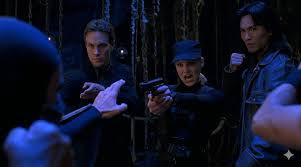
That Cast Was Lightning in a Bottle
One of the biggest reasons the movie still works today is because the cast fully committed to the material instead of treating it like a joke.
Robin Shou as Liu Kang
Robin Shou gave the movie heart. His Liu Kang carried grief, honor and determination without ever becoming boring. He felt believable as a reluctant hero forced into destiny. His final battle against Shang Tsung still remains one of the strongest moments in the entire film.
And when he finally declares:
“I am the chosen one!”
…it genuinely lands emotionally.

Linden Ashby as Johnny Cage
Perfect casting. No notes.
Ashby completely understood Johnny Cage’s swagger, arrogance and humor. He gave the movie personality and some of its funniest moments.
His response to Scorpion’s challenge remains iconic:
“Those were $500 sunglasses, a#$hole.”
That line STILL gets quoted nearly 30 years later because it perfectly captures the energy of the movie. It’s ridiculous, cool and unforgettable all at once.
Bridgette Wilson as Sonya Blade
Wilson brought toughness and confidence to Sonya in a time when female action characters often weren’t given much depth. She didn’t feel like a side character tagging along with the men. She felt capable, dangerous and fully involved in the fight.

Christopher Lambert as Raiden
Was he comic-accurate? Maybe not entirely.
Did he become iconic anyway? Absolutely.
Lambert played Raiden with this strange mixture of cosmic wisdom, awkward humor and mysterious energy that somehow made him endlessly entertaining. His delivery of lines like:
“The fate of billions will depend upon you.”
felt genuinely epic.

Cary-Hiroyuki Tagawa as Shang Tsung
This performance deserves its own standing ovation. Tagawa didn’t just play Shang Tsung. He BECAME Shang Tsung.
The sinister smile. The voice. The arrogance. The way he seemed to enjoy every second of tormenting the heroes. To this day, many fans still hear HIS voice when they think about the character.
And when he says:
“Your soul is mine!”
…it instantly transports an entire generation back to the 1990s.
That’s cultural immortality.

The Soundtrack Wasn’t Music — It Was Adrenaline
There are very few movie soundtracks that immediately trigger nostalgia the way Mortal Kombat does.
The techno soundtrack wasn’t just background noise. It WAS the movie’s heartbeat.
The moment “Techno Syndrome” (Mortal Kombat) by The Immortals kicked in, theaters erupted. Arcades erupted. Living rooms erupted. That soundtrack turned every fight scene into a full-blown event.
But the crazy thing is… That soundtrack was FULL of musical bangers beyond just the main theme.
Tracks like “Halcyon + On + On” by Orbital during Liu Kang and Kitana’s scene gave the movie a strange emotional beauty and atmosphere that fans still remember. Songs like “Burn” by Sister Machine Gun and “Blood & Fire” by Type O Negative helped give the movie its edgy, aggressive 1990s identity. Even the heavy techno and industrial energy throughout the soundtrack made the entire film feel dangerous, rebellious and larger than life.
That soundtrack wasn’t just popular… It became part of the CULTURE. People bought the CD. People blasted it in cars .People worked out to it. People played video games with it in the background.
And honestly, the music is a huge reason why the movie still feels energetic today. Even people who haven’t watched the film in years instantly recognize that iconic beat.
That’s timeless branding.
That’s cultural impact.

Modern Mortal Kombat Is STILL Celebrating the 1995 Film
And one of the coolest things about the franchise is that it has NEVER forgotten how important the 1995 movie was to fans.
Even modern games continue honoring it.
One of the most exciting examples is the Klassic MK Movie Skin Pack featured in Mortal Kombat 11, allowing players to use the likenesses and voices inspired by the original movie cast. Seeing characters modeled after Linden Ashby’s Johnny Cage, Bridgette Wilson’s Sonya Blade and Christopher Lambert’s Raiden instantly sent longtime fans into nostalgia overload.
Cary-Hiroyuki Tagawa as Shang Tsung had already been included in an early MK 11 pack.
And honestly? That kind of respect for legacy matters.
It shows the creators understand that the 1995 movie wasn’t just another adaptation. It became part of the DNA of Mortal Kombat itself.
For older fans, it felt like reconnecting with old friends. For younger fans, it became a doorway into discovering why that original movie still means so much to so many people.
That’s the mark of a true classic.

The Movie Gave Fans Incredible Moments
One reason the film has endured is because it delivered moments fans actually WANTED to see.
Liu Kang fighting Shang Tsung. Johnny Cage defeating Scorpion. Sub-Zero freezing weapons mid-fight. Reptile transforming from a CGI creature into a ninja warrior. Goro towering over everybody. Raiden appearing in flashes of lightning. The island reveal. The throne room scenes. The final victory pose.
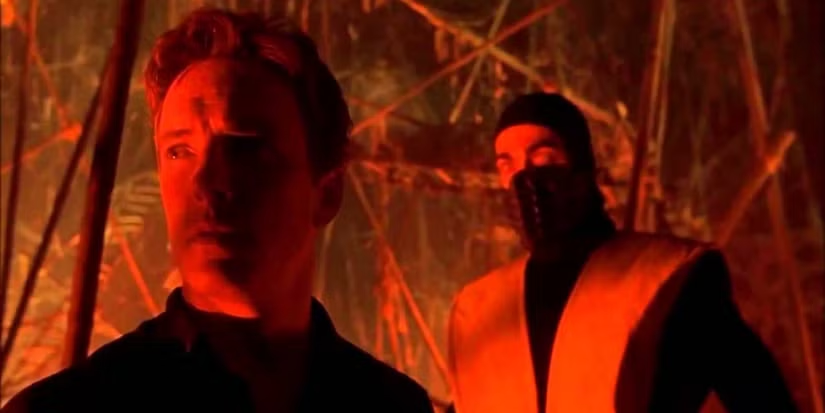
And perhaps most importantly… The movie respected the source material enough to understand that fans came to SEE these characters do cool things. That sounds simple, but many adaptations still fail at that today.
Then Came the Animated Series
After the film’s success, the franchise exploded even further into mainstream pop culture, including the animated television series Mortal Kombat: Defenders of the Realm, which debuted in 1996 on USA Network.
For many kids, myself included, growing up in the late 1990s, the cartoon became another gateway into the mythology of the franchise, which appeared to be loosely linked to the first movie. It toned down the violence for television audiences but expanded the world in fascinating ways by treating the heroes almost like a supernatural strike team defending Earthrealm.
Seeing characters like Liu Kang, Sonya Blade, Jax, Kitana, Raiden, Nightwolf, Sub-Zero and Kurtis Stryker operating together weekly made the universe feel massive. It reinforced the idea that Mortal Kombat wasn’t just a game anymore. It was a franchise.
We'll dive more into this underrated, ended way too soon animated masterpiece in this week's Tony's Superhero Saturdays™.
Why the 1995 Film Still Matters Today
What makes the 1995 Mortal Kombat movie special is that it understood entertainment value better than many modern blockbusters. It wasn’t trying to be overly grounded. It wasn’t trying to deconstruct itself. It wasn’t embarrassed by fantasy. It wasn’t trying to wink at the audience every five seconds.
It simply embraced what it was and gave fans a larger-than-life experience filled with mythology, action, humor and spectacle.
And in today’s world, where so many films feel overly manufactured and algorithm-driven, there’s something refreshing about a movie that just wants to entertain the audience at maximum volume.
That sincerity matters.

The Spiritual Bridge to S.O.L.A.D.™: Soldiers of Light Against Darkness™
One thing I’ve always respected about Mortal Kombat is that beneath the fights, powers and spectacle is a larger battle about corruption, temptation, fear and destiny. The characters are constantly forced to confront darkness both around them and within themselves.
That’s one of the reasons stories like this resonate across generations.
Because even when the setting is supernatural…
The emotional struggles are deeply human.
That same battle between light and darkness, purpose and fear, hope and corruption can also be found throughout my S.O.L.A.D.™ universe.
If you enjoy stories with epic stakes, heroes pushed to their emotional limits, supernatural warfare and unforgettable battles, I truly believe you’ll enjoy S.O.L.A.D.™: Soldiers of Light Against Darkness™.
Signed copies are available here: www.tyronetonyreedjr.com/the-shop
And tomorrow, whether you’re revisiting the 1995 classic or heading into theaters for the new reboot sequel…
Just know this: Very few movies can still make an entire room smile the second someone yells…
“MORTAL KOMBAT!”


Comments