
Tony's Timeless Thursdays™: Sam Raimi's Spider-Man: Heart, Tragedy & Heroism—Why Tobey Maguire, Sam Raimi, and a Trilogy Born in 2002 Still Define the Soul of Spider-Man — and Why Their Legacy Matters


Every generation has its hero. Every era has its myth. But for millions of us who walked into a movie theater in 2002, the moment Tobey Maguire whispered, “Who am I? You sure you want to know?” — a new kind of cinematic legend was born.
Before the MCU dominated the world…before superhero movies became billion-dollar universes…there was a shy kid from Queens with a camera, a crush, and a destiny he didn’t ask for.
Sam Raimi’s Spider-Man trilogy wasn’t just entertainment. It was emotional. It was spiritual. It was personal.
It taught us that heroism is born from heartbreak, refined by sacrifice, and sustained by love. And more than two decades later, the trilogy still resonates — not because of nostalgia, but because it speaks to the human heart.
With Tobey Maguire’s triumphant return in Spider-Man: No Way Home, the world was reminded of something we already knew:
He is the Spider-Man of our souls.
Today, we honor the trilogy that shaped a generation.

WHEN A HERO IS BORN
There are moments in cinema that feel less like scenes and more like awakenings — moments where something in the audience shifts, where something bigger than the movie itself plants its flag in our hearts. In 2002, when Sam Raimi’s Spider-Man swung into theaters, that’s exactly what happened.
To understand why this film hit so deeply, you must remember the landscape it entered. The superhero genre was not the juggernaut it is today. It was unstable, inconsistent, often mocked. Batman had fallen into neon camp. Superman had no cinematic direction. The industry believed comic book movies were for children, or worse, for no one.
But then came a story about a lonely, awkward, kind-hearted kid from Queens. A story about responsibility, destiny, family, love, loss, sacrifice, and a calling no ordinary teenager wants — but one that chose him anyway.
It wasn’t just a movie. It was an emotional initiation. A rite of passage. A cinematic baptism into the idea that even the smallest among us can rise to greatness.
Sam Raimi understood something the industry had forgotten: Superheroes work not because of their powers… but because of their pain.
And pain is where we meet Peter Parker.
Before the webs, before the costume, before the legend — there was a boy chasing a school bus, tripping over his own feet, holding a camera like it was a shield against the world. A boy who loved from afar, who cared too much, who blended into the wallpaper of life until destiny pulled him forward.
That opening narration — “Who am I? You sure you want to know?” — was not just an introduction. It was a confession. An invitation into a life shaped by heartbreak and hope in equal measure.
And with that, Peter Parker stepped out of the margins of a comic book and became human.

TOBEY MAGUIRE: THE SOUL OF PETER PARKER
When Tobey Maguire was cast, many doubted the choice. He wasn’t a traditional leading man. He didn’t look like a quip-slinging comic-book hero. He looked like… us. And that was exactly the point.
Maguire’s performance is understated, vulnerable, tender, and deeply emotional. He plays Peter not as a cool underdog, but as a painfully sincere outsider who feels everything too strongly.
He gave Spider-Man something no actor has achieved since: a quiet, unshakeable innocence.
There is a softness in Maguire’s eyes — a gentleness when he speaks to Aunt May, an ache when he looks at Mary Jane, a genuine fear in moments of danger. He brought gravity to the line “Uncle Ben was murdered” in a way that felt like it came from his bones.
His transformation is not about newfound strength. It’s about newfound purpose.
And that purpose is born from tragedy.

THE DEATH OF UNCLE BEN: A SPIRITUAL EARTHQUAKE
Few cinematic deaths have shaped a character — and a genre — the way Uncle Ben’s death did. Cliff Robertson brought a warmth and moral clarity to Ben that made him feel like the grandfather every viewer wished they had.
His final words, “With great power comes great responsibility,” are not just a lesson. They are a scripture — the moral spine of the entire trilogy, the heartbeat of Peter’s identity, the compass by which he navigates the chaos of his life.
Raimi treats this moment with biblical weight. The quiet kindness of Ben. The argument with Peter — raw and relatable. The decision that led Peter down a dark alley, chasing a man who stole more than money… he stole innocence.
The rain falls like judgment. The world shrinks to the pulse of Peter’s grief. And when he holds Uncle Ben’s lifeless hand, something inside him shatters.
This is the moment the hero is born.
Not in triumph — in sorrow.

GREEN GOBLIN: THE PSYCHOLOGICAL MIRROR
Willem Dafoe’s Norman Osborn remains one of the greatest comic-book villains ever put to film. His performance is operatic, volatile, chilling, and strangely sympathetic.
Norman is a man driven by ambition, haunted by inadequacy, and consumed by the fear of losing everything he built. His descent into the Goblin persona is not a sudden turn — it is the unmasking of the darkness already within.
The infamous mirror scene — Dafoe arguing with his own reflection — is a masterclass in divided identity. Raimi, a horror director at heart, brings a sinister intimacy to the transformation. Every distorted grin, every tremble, every shift from calm to maniacal is unsettling in the best way.
But what makes Norman compelling is not his madness — it’s his loneliness. His hunger for connection. His desire for Peter to join him, not because he needs a partner… but because he sees in Peter the son he wished he had.
His final words, “Don’t tell Harry,” are a dagger to the heart — the closing of a wound that would shape the next two films.
Norman is not just a villain. He is Peter’s first lesson in the cost of heroism.

MARY JANE WATSON: THE GIRL WHO WANTED TO BE SEEN
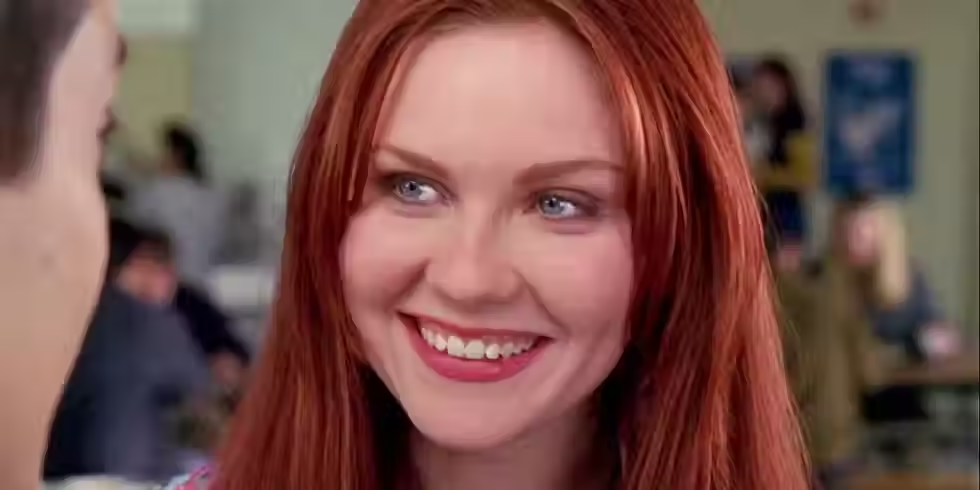
Kirsten Dunst’s Mary Jane Watson is often debated, but rarely understood. She is not the confident supermodel of the comics. She is something far more grounded: a young woman searching desperately for validation, affection, and escape.
She grows up in a house where love is absent and cruelty is familiar. Acting is her lifeline, a way to step into worlds where she can control the narrative. Her relationships reflect her longing for stability — first Flash, then Harry — but she is drawn, always, to Peter, who sees her in a way no one else does.
Their chemistry is not fiery or flirtatious — it is tender. Subtle. Earnest. A connection between two people who hide their pain behind quiet smiles.
Her kiss with Spider-Man in the rain is iconic, but her deeper moment comes when she touches Peter’s bruised cheek at the cemetery. She senses something in him — heroism, compassion, sacrifice — long before she knows the truth.

Mary Jane is not a prize to be won. She is a mirror reflecting Peter’s inner turmoil and longing.
SAM RAIMI’S CAMERA: HORROR ROOTS & VISUAL POETRY
Raimi’s style is unmistakable: whip-pans, Dutch angles, POV shots, sudden zooms, frenetic energy.
His horror roots — from Evil Dead to Darkman — give Spider-Man a visceral urgency. The wrestling match, the fire rescue, the rooftop confrontation, the Thanksgiving dinner — each scene feels alive with movement and tension.
He uses reflections as symbols:
Norman arguing with his other self
Peter seeing his dual identity in windows
The Goblin mask staring back at Osborn
He uses shadows to echo conflict:
Peter’s silhouette as he becomes Spider-Man
Osborn’s shadow during his fall
He uses color as emotion:
MJ’s red hair against New York gray
The Goblin’s green reflecting envy, greed, fear
Raimi didn’t just make a comic-book movie.He created a visual language for the superhero genre.

THE CULTURAL IMPACT OF 2002
Spider-Man arrived at a moment when the world needed a symbol of hope. Post-9/11 America was raw, shaken, searching for stories of resilience.
New Yorkers cheering Spider-Man —“We’ll take you on!” —was not just a scene. It was a cultural embrace.
Spider-Man became:
the hero of everyday people
the symbol of courage in the face of tragedy
the champion of the underdog
The film’s success reshaped Hollywood. Without Spider-Man:
there is no MCU
there is no Dark Knight Trilogy as we know it
superhero cinema does not rise to dominance
Spider-Man swung across the screen and rewrote the future.

THE WEIGHT OF THE MASK: SPIDER-MAN 2
If Spider-Man (2002) is the birth of a hero, then Spider-Man 2 (2004) is the test of the soul.
Sam Raimi didn’t just make a sequel. He made a confession — an intimate portrait of what it means to be overwhelmed, exhausted, and quietly breaking under the weight of everyone’s expectations.
Before the film even introduces Doctor Octopus, before the tentacles, before the train fight, we’re already watching a young man being crushed by the world.
Peter Parker is late to class. Late to work. Late paying rent. Late in life. Late in love.
And in every failure, you feel his heart cracking a little bit more.
Tobey Maguire’s performance deepens here. Peter’s optimism is dimmer. His smile is heavier. His eyes carry a sadness that wasn’t in the first film. He isn’t wide-eyed anymore — he’s weary.
In many ways, Spider-Man 2 is the first superhero film to confront depression head-on.
No powers. No villains. No quips. Just a young man trying to survive another day.

THE BURNOUT OF A HERO
Peter’s powers begin to fade not because of a spell or poison, but because of emotional exhaustion.
Raimi makes a bold statement:
Even heroes break.
When Peter falls from the rooftop and crashes into a Ford sedan, the thud is more than physical — it is symbolic. He is crashing under the weight of responsibility. His heart is overloaded. His spirit is drained. He is empty.
The world asks him to give, and give, and give — with no promise of rest.
Spider-Man is New York’s hero……but Peter Parker is forgotten by everyone.
His landlord demands rent. His professor demands excellence. His boss demands photos. MJ demands honesty. Aunt May demands reassurance.
And still, Peter tries his best. He keeps smiling. He keeps pushing. He keeps serving.
Until his powers flicker like a dying flame.
There is a scene where Peter sits in the doctor’s office, not as Spider-Man, but as a young man admitting:
“Lately, I’ve been… exhausted.”
That single line is one of the most emotionally honest moments in superhero cinema.
It is the cost of being dependable.

OTTO OCTAVIUS: A MAN MADE OF HOPE, BROKEN BY LOSS
Alfred Molina’s Otto Octavius enters the film with warmth in his voice, kindness in his smile, and brilliance in his hands. His charm is effortless. His mentorship of Peter is tender, almost fatherly. His love for his wife Rosalie is gentle and real.
Before he is Doctor Octopus…he is a good man.
And that is what makes his fall heartbreaking.
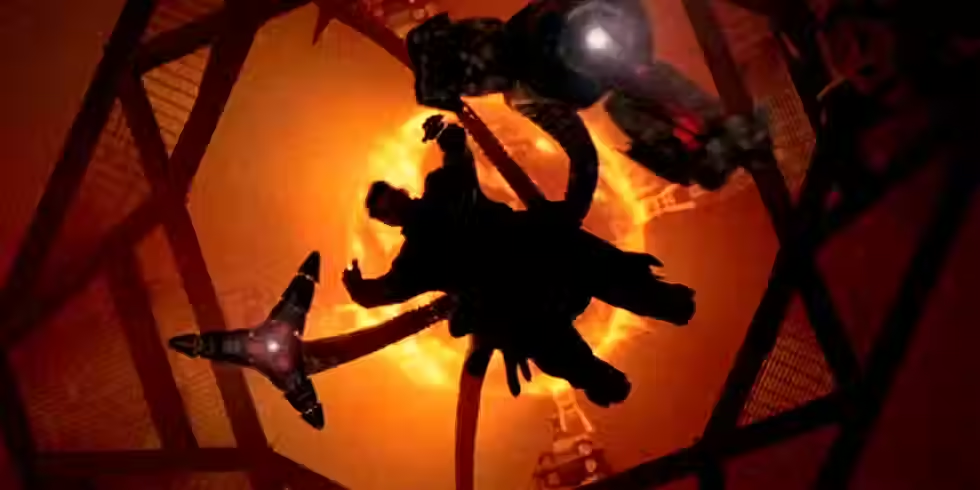
When his experiment goes wrong, when Rosalie is killed, when the tentacles fuse to his spine and whisper into his mind like demonic serpents, Otto becomes a tragic reflection of what Peter could become:
A brilliant man ruined by grief.
Molina’s portrayal is Shakespearean — a blend of madness, intelligence, sorrow, and stubborn pride. His villainy is not born of malice; it is born of refusal to accept failure.
His mantra —
“The power of the sun… in the palm of my hand.”— is the anthem of ambition turned addiction.
Otto is not a monster. He is a warning.

THE TRAIN FIGHT: A CHRIST-LIKE MOMENT OF SACRIFICE
There are action scenes…and then there are moments that transcend cinema.
The train battle is the latter.
Raimi crafts it as a visual symphony — web-swinging, aerial choreography, electrified rails, metal grinding under impossible force. The stakes escalate with every frame. But the emotional climax is what makes the scene immortal.

Spider-Man stands between a speeding train and death.
Arms outstretched. Body trembling. Face contorted in pain.
It is unmistakably symbolic — a Christ pose — the image of a hero bearing the weight of the world.
The soundtrack drops. The metal strains. Peter screams in agony…… and he stops the train with everything he has.
He collapses afterward, not as Spider-Man…… but as Peter. Mask removed. Body limp. Human. The people lift him up with reverence, whispering:
“He’s just a kid…no older than my son.”
They protect him. They honor him. They return his mask with trust.
A New York congregation witnessing the vulnerability of their savior.

AUNT MAY’S SPEECH: THE THEOLOGY OF HEROISM
No speech in superhero history is more spiritually resonant than Aunt May’s quiet monologue:
“I believe there’s a hero in all of us…that keeps us honest, gives us strength, makes us noble…”
This is more than a pep talk. It is the thesis of the trilogy — a gentle sermon about the dignity of sacrifice.
Rosemary Harris plays May not as a frail elder, but as a spiritual anchor. Her grief, her perseverance, and her unwavering belief in goodness give Peter the strength to rise.
She is the film’s moral compass. Its heart. Its prayer.

THE CHOICE: PETER PUTS DOWN THE MASK
In one of the most iconic sequences, Peter walks away from the Spider-Man life as “Raindrops Keep Fallin’ on My Head” plays. For a moment, he chooses normalcy.
He smiles. He sleeps. He studies. He watches MJ from afar.
But deep down, the world feels… wrong.
Peter learns a painful truth:
Running from your calling does not free you — it empties you.
Spider-Man 2 is a meditation on purpose. You can try to escape responsibility……but destiny always finds you.

THE FINAL CONFRONTATION: “I WILL NOT DIE A MONSTER.”
The ending is a Greek tragedy wrapped in a blockbuster.
Otto sees his reflection. Sees the man he once was. Realizes the horror of what he has become.
And he chooses the hardest path: Repentance.
“I will not die a monster.”
He destroys his own creation, sacrifices himself, and saves the city. His death is not defeat — it is redemption.
A villain returns to humanity. A hero returns to purpose.A city returns to safety.
And Peter returns to MJ — but broken, afraid, and uncertain.
MARY JANE’S CHOICE & THE COST OF LOVE
Mary Jane running from her wedding to be with Peter is not a fairy-tale ending — it is a prayer for honesty.
She chooses the difficult road: loving a man who will never be fully hers.
“Go get ’em, Tiger.”
Her smile is brave.Her voice is steady.Her heart is open.
But the final shot — her face falling as sirens echo — reveals the truth:
Mary Jane understands the cost. She just doesn’t know how heavy it will become.

SPIDER-MAN 3 (2007): WHEN HEROES BREAK
If Spider-Man 2 is the story of a hero worn down emotionally, then Spider-Man 3 is the story of a hero blinded spiritually. It is the darkest chapter of the Raimi trilogy — not because of the symbiote Venom, not because of multiple villains, but because it forces Peter to confront the one enemy he has never truly faced:
Himself.
Sam Raimi leans deeply into themes of grief, ego, pride, temptation, and the consequences of holding onto unresolved pain. Even with studio interference (which we’ll address shortly), the beating heart of this film is raw and human.
Spider-Man 3 is not the story of a hero fighting villains. It’s the story of a hero losing himself.
And that is why it matters.

THE FALL FROM GRACE: WHEN PRAISE BECOMES POISON
At the beginning of the film, Peter Parker is finally… happy.
People love Spider-Man. Children cheer for him. The city embraces him. His relationship with MJ is thriving. His life is finally aligning.
And that is exactly the problem.

Praise becomes poison. Adoration becomes distraction. Confidence becomes arrogance.
This is the Peter Parker we’ve never seen — one who feels invincible, validated, and unstoppable.
When he swings past a billboard of Spider-Man, admiring his own image, it is not played for laughs. It is a warning.
For the first time in his life, Peter begins to believe that maybe — just maybe — he deserves to be adored.
The tragedy is not that he feels good. The tragedy is that he forgets to stay humble.
HARRY OSBORN: A SON SEEKING JUSTICE, A FRIEND CRAVING LOVE
James Franco’s Harry Osborn completes one of the most heartbreaking arcs in superhero cinema.
He is not a villain. He is not a monster. He is a wounded son trying to make sense of trauma.
He loved Peter like a brother. He admired him. He trusted him.
But grief twists the heart. And pain poisons perspective.
Norman Osborn’s last words — “Don’t tell Harry” — created a void where truth should have been. Harry filled that void with bitterness, revenge, and betrayal.
The first fight between Peter and Harry is not a hero-vs-villain battle. It is two brothers tearing each other apart.
When Peter says, “I don’t want to fight you,”and Harry answers, “I wouldn’t want to fight me neither,”the emotional weight is enormous.

Harry’s injury — the loss of memory — is Raimi’s way of delaying the inevitable. You cannot outrun pain forever. Eventually, it returns. And when it does… you must face it.
FLINT MARKO: A FATHER WHO MADE A BAD CHOICE FOR GOOD REASONS
Thomas Haden Church brings quiet grief to the role of Flint Marko — a man who has done terrible things…but not out of malice.
He escapes prison not to commit crimes, but to save his daughter Penny, who is dying of a disease the film never names, making her suffering universal.
From the moment we meet him, Marko carries guilt in his shoulders, sorrow in his voice, pain in his eyes. He is a criminal who hates that he has become one.
The birth of Sandman is a silent opera —one of the most poetic sequences Raimi ever directed.
A man dissolving into particles,trying desperately to re-form, clawing through sand not to harm others, but to touch a picture of his daughter.
His tears mix with the sand. His grief becomes his body. His love becomes his reason to live.
Sandman is not a villain. He is a parent doing the wrong things for the right reasons.

And Peter will not understand that lesson until it is almost too late.
THE SYMBIOTE: GRIEF GIVEN FORM
The black suit is not simply a cool costume. It is a metaphor.
For grief. For anger. For jealousy. For resentment. For every unspoken wound Peter carries.
It slithers onto his body like a whisper from the dark —the emotional shadow he has never dealt with.
The moment Peter wakes up in the black suit…the world feels different.
He feels stronger. Faster. Sharper. More confident. More bold. More reckless. More cruel.
This is not a power-up. This is a spiritual infection.

The suit amplifies his darkest instincts —the pain he never processed from Uncle Ben’s death, the jealousy he feels toward Harry, the insecurity with MJ, the pride swelling from the city’s admiration.
Raimi’s intention is clear: The symbiote is sin. The symbiote is ego. The symbiote is temptation.The symbiote is the voice that tells you: “You deserve to take what you want.”
And Peter listens.

PETER & MJ: LOVE COLLAPSING UNDER THE WEIGHT OF UNMET NEEDS
Peter and MJ’s relationship in Spider-Man 3 is messy, painful, and painfully realistic.
MJ is experiencing:
career insecurity
emotional neglect
fear of being overshadowed
self-doubt
a need for reassurance
And Peter, blinded by his own rising ego, cannot see her pain.
When she tries to confide in him about being replaced in her Broadway role, Peter responds:
“You’ll get ’em next time.”
He means well. But that is not what she needs.
She needs presence. She needs understanding. She needs empathy.
Instead, she sees Peter drifting away — not by malice, but by distraction.
Peter wants to propose. MJ wants to be heard. Both want love…but they are breaking apart under unspoken pressure.
This is the most “adult” relationship in the trilogy —two people who love each other deeply,but whose internal struggles begin to collide.

EDDIE BROCK: A SHADOW OF PETER’S WORST SELF
Topher Grace’s Eddie Brock is often criticized,but his portrayal is thematically perfect.
He is the anti-Peter:
deceitful where Peter is honest
jealous where Peter is insecure
arrogant where Peter is humble
selfish where Peter is sacrificial
Eddie is what Peter could become if he surrendered fully to the symbiote.
His prayer in the church —
“Please… kill Peter Parker.”— reveals his desperation, resentment, and spiritual rot.

It is a powerful contrast with Peter’s remorseful entrance moments later, begging forgiveness from God as the church bells toll.
This is Raimi at his most symbolic —a hero wrestling himself free from darkness in a literal house of worship.
The symbiote shrieking in the bell tower, Peter ripping it off with anguished screams, black goo dripping like sin refusing to release—
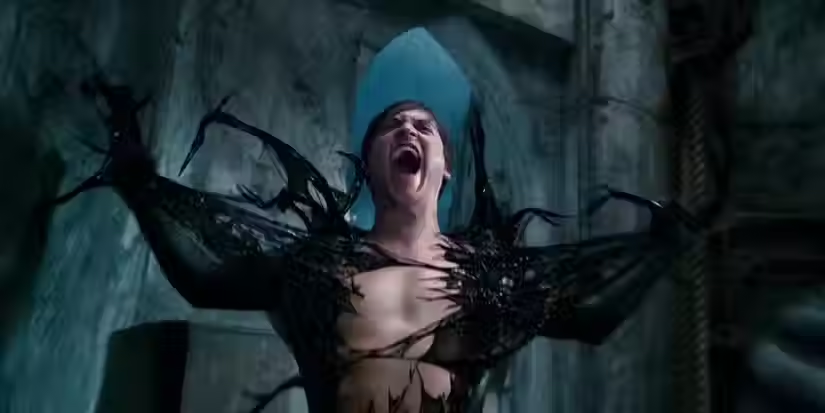
This is not action. This is salvation.
And salvation always has consequences.
THE FINAL BATTLE: WHEN FORGIVENESS SAVES THE HERO
The climax of Spider-Man 3 is often misunderstood. It is not about explosions. It is not about spectacle. It is not about punching the villain.
It is about forgiveness.
Sandman reveals the truth about Uncle Ben —that the shot was an accident, that fear guided his hand, that regret has been his prison for years.
Peter’s eyes soften. His breathing steadies. His heart breaks open.
He hears Uncle Ben’s voice. He feels the weight of his own rage. And in a moment of spiritual maturity, Peter says the words that complete his arc:
“I forgive you.”
Three films of trauma…three films of guilt…three films of drowning in self-blame…resolve in that single moment.
Forgiveness frees Peter. It frees Marko. It frees the trilogy itself.
Then Harry arrives —scarred, broken, but choosing love over vengeance. His sacrifice is a mirror to Otto’s in Spider-Man 2.
“I would die for them,” his father once mocked him.
And Harry proves him wrong.
His final breath — “You’re my friend” —restores everything their broken family lost.

This is not superhero cinema. This is biblical storytelling.
THE FINAL DANCE: LOVE WITHOUT EASY ANSWERS
The trilogy ends not with triumph,but with humility.
Peter and MJ meet in a quiet jazz club, both battered by their own mistakes, both grieving Harry, both unsure of the future.
He holds out his hand. She accepts it.

They sway in silence —two souls trying again.

The ending is bittersweet, because life is bittersweet.
And Raimi refuses to lie to us: Love requires forgiveness. Healing requires time. Heroes are not invincible. Relationships are not easy. People are not perfect.
The trilogy ends exactly the way it began —with honesty.
THE PORTAL OPENS: A RETURN TWENTY YEARS IN THE MAKING
When Spider-Man: No Way Home was first announced, the rumors started as whispers. Maybe villains from old movies would return. Maybe Alfred Molina’s tentacles would clank across the screen again. Maybe Jamie Foxx would reprise Electro in a new light. Maybe—just maybe—the multiverse was cracking open.
But no one dared believe the impossible.
Not until it happened.
The sling ring portal sparked alive. A silhouette appeared in an alleyway — lean, tall, familiar but older. Fans leaned forward. Eyes widened. Hearts stopped beating.
Then the mask came off.
ANDREW GARFIELD.

Cheers erupted.
But the second portal…the one where a figure stepped through with quiet confidence…with a familiar hunched posture…and a warmth that could be felt through the screen even before his face was visible…
That was different.
That was sacred.
And when he pulled down his mask, revealing a gentle smile and those unmistakable blue eyes—
TOBEY MAGUIRE RETURNED.

Not as a cameo. Not as a stunt. Not as nostalgia fodder. But as the elder statesman of Spider-Man cinema. The original. The blueprint. The heart.
He entered, not swinging in with bravado, but strolling in like a man who has lived a life. Calm. Peaceful. Seasoned. Soft-spoken. Radiating warmth.
He didn’t need to say a word.The audience already knew:
The first Spider-Man had come home.
TOBEY MAGUIRE: THE AGED, HEALED, WISER PETER PARKER
One of the most remarkable choices Marvel made was not portraying Tobey as a broken man. Not as a recluse. Not as a bitter warrior. But as a gentle, healed, emotionally mature hero who radiates empathy and compassion.
Tobey’s Peter Parker has lived through pain…and come out the other side with grace.
He speaks softly, calmly, with the tone of someone who has made peace with his past. He carries himself like someone who has forgiven:
himself
his villains
his failures
his regrets
His smile is nostalgic. His presence is comforting. His energy is paternal.
He becomes, instantly, the anchor of the trio —the steadying heartbeat of the Spider-Men.
When he says:
“We’re gonna get through this. We’ll do it together.”
—it isn’t just dialogue. It’s spiritual reassurance.
Tobey becomes the Peter who’s walked through the valley and emerged with empathy as his superpower.

THREE SPIDER-MEN: A MULTIVERSE OF BROTHERSHIP
The interactions between the three Spider-Men feel like a therapy session wrapped in superhero spectacle.
Each represents:
Tobey — forgiveness
Andrew — healing
Tom — becoming
Tobey’s Peter serves as the wise mentor. Andrew’s Peter serves as the vulnerable soul. Tom’s Peter serves as the active learner.
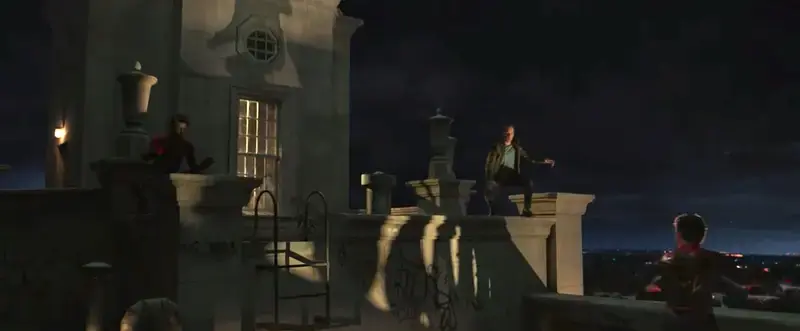
Their rooftop scene after Aunt May’s death is one of the most spiritually resonant moments in the film. Tom’s Peter is consumed by rage and grief, ready to kill Norman Osborn.
Tobey's Peter steps forward and says the words he once heard himself:
“With great power, there must also come great responsibility.”
This moment binds the trilogy and the MCU together emotionally and philosophically.
It is the soul of Spider-Man.
THE REDEMPTION MOMENT: TOBEY SAVES THE GOBLIN
During the final battle, Tom’s Peter raises the glider. Rage consumes him. Vengeance blinds him. He is seconds away from repeating the tragedy that defined Tobey’s Peter's life.
And then… Tobey's Peter steps in.

No dialogue. No monologue. Just presence.
He places himself between Tom's Peter and Osborn —a literal barrier between vengeance and murder.
His eyes say everything:
“I’ve been where you are.”
“Don’t become what you hate.”
“This is not who you are.”

It is the most powerful moment in the film.
And when Norman stabs Tobey's Peter…we collectively felt our hearts stop.
Fans screamed. Fans cried. Fans panicked.
Because for a moment, it felt like Raimi’s Peter Parker was going to die saving another Spider-Man’s soul.
But Tobey's Peter smiles — gently, reassuringly — and says:
“I’ve been stabbed before.”
Classic.
Humble. Human. Heartfelt.
The perfect Tobey-ism.
THE MULTIVERSE & SPIDER-MAN’S CULTURAL LEGACY
The Raimi trilogy’s return in No Way Home generated something no studio could manufacture:
generational healing.
Three generations of Spider-Man fans sat together in theaters:
Parents who grew up with Tobey
Young adults who grew up with Andrew
Kids who grew up with Tom
And for one night, they cheered as a family.
The internet exploded. Memes erupted. Legacy actors trended for weeks.

For the first time: the fandom united.
Tobey’s entrance became a cultural moment. Andrew’s redemption became a viral phenomenon. Tom’s maturity became a defining chapter.
Spider-Man didn’t just save the multiverse. Spider-Man saved the audience, too.

THE FUTURE: RUMORS, WHISPERS, AND POSSIBILITIES
Now we explore the part fans LOVE —the rumors, leaks, and possibilities.
All presented responsibly, of course, as rumors, not facts.
But the industry whispers are worth discussing.
Tobey Maguire in Avengers: Secret Wars (2027)
Marvel insiders suggest that Secret Wars will bring:
Tobey
Hugh Jackman
Andrew Garfield
Fox X-Men
Raimi characters
Tobey is rumored to serve as:
“The emotional anchor of the multiverse.”
Fans want it. Marvel wants it. And Raimi’s involvement makes it plausible.
Tobey in Beyond the Spider-Verse
Even a brief cameo would break the internet.
THE THEMES THAT MADE THE RAIMI TRILOGY TIMELESS
The Raimi trilogy endures not because of nostalgia,but because of soul.
It is built on:
forgiveness
redemption
responsibility
moral struggle
sacrifice
grief
humility
love
It treats heroism not as spectacle…but as spiritual discipline.
Sam Raimi made three films about a boy becoming a man, a man becoming a hero, and a hero learning to become human again.
Spider-Man is not just a superhero. He is a parable.

FROM SPIDER-MAN'S WEBS TO S.O.L.A.D.™'S POWERS OF LIGHT
As I look back over the Raimi Spider-Man trilogy, I can’t help but see echoes of the story God led me to write in S.O.L.A.D.™: Soldiers of Light Against Darkness™. On the surface, they’re different worlds — one filled with webs and skyscrapers, the other with angels, demons, and spiritual battles. But at the core, they share the same heartbeat.
Both stories are about battles between light and darkness. Both follow characters who are transformed by trauma. Both show destinies that aren’t handed out like trophies, but chosen through sacrifice. Both center on heroes defined more by love and moral duty than by raw power.
Both make spiritual warfare visible — in ways that you can feel, not just watch.
Peter Parker isn’t chosen because he’s the strongest or the most put-together. He’s chosen because of his heart — because when faced with great power, he chooses responsibility over comfort, compassion over selfishness, and sacrifice over ease.

Kevin and Juanita are the same way.
In S.O.L.A.D.™, they’re not selected because they’re flawless or fearless. They’re not perfect.
They’re willing. Willing to answer a call they don’t fully understand. Willing to carry light into dark places. Willing to keep fighting when their hearts are breaking. Like Peter, they face:
inner demons and doubts,
external threats that want to break them,
spiritual forces that don’t play fair,
generational pain that tries to define them,
personal loss that could easily make them give up.
And like Peter Parker… they rise.
If Spider-Man’s journey speaks to you—if you connect with stories where heroes bleed, break, get back up, and choose the light anyway—then I truly believe you’ll connect with S.O.L.A.D.™: Soldiers of Light Against Darkness™.
These books blend heart, purpose, destiny, and spiritual warfare in a way that’s meant to encourage you, challenge you, and remind you that even in the darkest hour, light still has the last word.
If you’re ready to step into that world with me…
👉🏾 You can order autographed copies of my S.O.L.A.D.™ novels at: www.tyronetonyreedjr.com/the-shop
The world still needs heroes who will stand, fight, love, and shine. In my heart, that’s what Kevin, Juanita, and the Soldiers of Light Against Darkness™ were created to be.


Comments