
Tony’s Timeless Thursdays™: The Legend of Zelda: Ocarina of Time: The Video Game That Made Hyrule Feel Like a Real Place


There are video games you remember playing, and then there are video games whose worlds somehow remain in your memory like places you actually visited. This one has a very special place in my mind and heart!
For generations of gamers, The Legend of Zelda: Ocarina of Time is one of those places. Hyrule Field stretching toward the horizon. Kokiri Forest hidden beneath the trees. The mystery of the Lost Woods. Castle Town bustling beneath Hyrule Castle. Death Mountain towering in the distance. Lake Hylia shimmering beneath the sky. The eerie darkness that eventually consumes places that once felt safe.
And somewhere in the middle of it all was a boy in green, a fairy shouting for his attention and a destiny much larger than either of them initially understood.
Today, November 5, 2026, Nintendo has brought that adventure back with a full Nintendo Switch 2 remake, giving a new generation the opportunity to become the Hero of Time while longtime fans walk across Hyrule again with very different eyes.
Nearly three decades after its original Nintendo 64 release, Ocarina of Time is still calling us home.
When Zelda Entered the Third Dimension
When the original Ocarina of Time arrived for Nintendo 64 in North America on November 23, 1998, it represented a massive transition for The Legend of Zelda. Previous adventures had allowed players to explore Hyrule from above, but now Link could stand inside that world, look toward a distant mountain and actually travel there.
That shift changed everything. Nintendo had to figure out how sword combat, exploration, puzzles and navigation could work naturally in three dimensions. One of its answers was Z-targeting, which allowed players to lock onto enemies and move around them while keeping the camera focused on the action. It sounds ordinary today because variations of that idea became standard across 3D action games.
Back then, it helped teach players how to fight in an entirely new kind of gaming space.
But technology alone is not why people still love Ocarina of Time. What mattered was what Nintendo built with it.
Hyrule suddenly felt enormous.

Link’s Childhood Made the Adventure Personal
The story begins simply enough. Young Link grows up among the Kokiri, but something about him is different. Every Kokiri has a fairy companion except him until the Great Deku Tree sends Navi to find him.
Yes, Navi. “Hey! Listen!” If you know, you know.
What begins as a journey beyond Kokiri Forest eventually brings Link to Princess Zelda, who suspects the Gerudo king Ganondorf has plans for the Triforce. Link gathers the Spiritual Stones and reaches the Temple of Time, believing he can stop Ganondorf before his plan succeeds.

Instead, Link unknowingly helps open the door Ganondorf needs. When Link pulls the Master Sword from its pedestal, he is sealed away until he is old enough to wield it properly. He awakens seven years later as an adult and discovers that the beautiful kingdom he knew as a child has fallen under Ganondorf’s rule.
That revelation gave Ocarina of Time emotional weight. You were not merely traveling between two time periods. You were seeing what had been lost.
Hyrule Felt Like Somewhere Worth Saving
This is where Ocarina of Time became magical. Hyrule was not simply a collection of levels waiting to be completed. It felt interconnected. Characters had routines. Places changed over time. A friendly location from Link’s childhood might become frightening when he returned as an adult.
You rode Epona across Hyrule Field. You visited Gorons on Death Mountain and Zoras in their domain. You went fishing, chased Cuccos, explored graveyards, discovered Great Fairies, hunted Gold Skulltulas and wandered into places simply because you wondered what might be there.
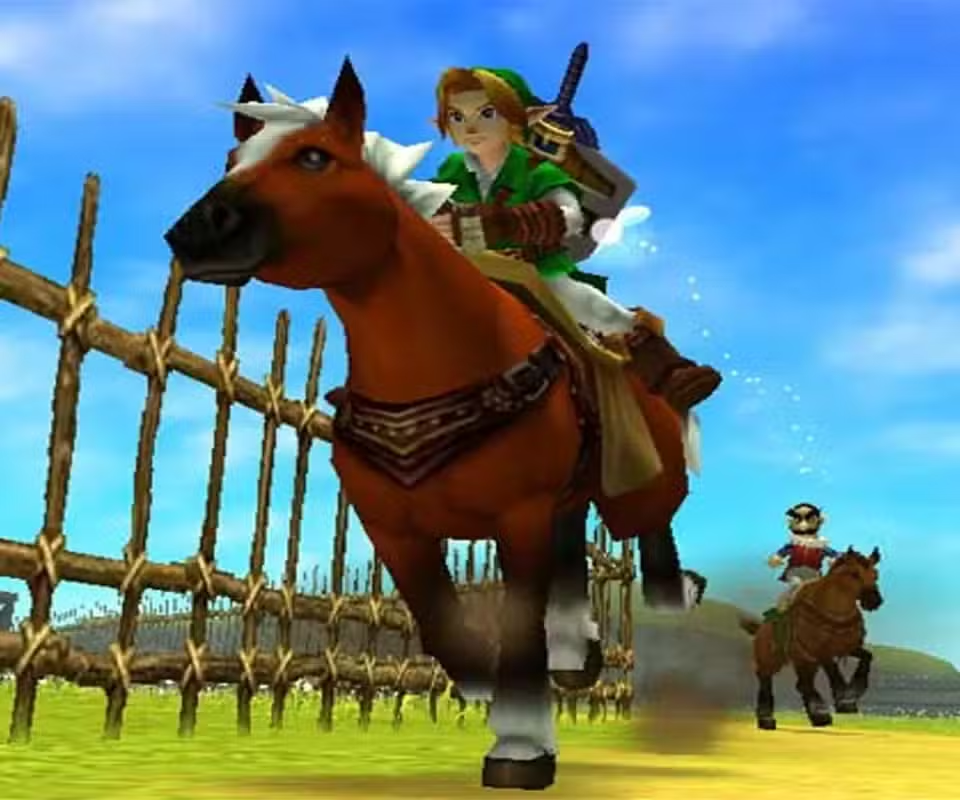
Sometimes the game rewarded you.
Sometimes it gave you another mystery.
Sometimes a giant skeletal creature tried to kill you after sunset.
That sense of discovery became one of Zelda’s defining strengths. Nintendo’s own developers still describe Ocarina of Time as a major turning point because it proved the series’ core ideas of exploration and discovery could survive the move into three dimensions.
Hyrule was not scenery. It was the adventure.
The Ocarina Turned Music Into Magic
Then there was the instrument in the title. The Ocarina of Time was not simply another item in Link’s inventory. Music became part of how you interacted with the world. Melodies could change the time of day, summon Epona, open pathways, transport Link across Hyrule and connect him to characters and places.
Players learned songs instead of merely selecting commands from a menu. The “Song of Time.” “Zelda’s Lullaby.” “Epona’s Song.” “Saria’s Song.” The “Song of Storms.” Those melodies became part of the memory of playing.

That is one reason Ocarina of Time remains such an emotional game for longtime fans. Sometimes hearing only a few notes is enough to bring back an entire location.
The Dungeons Became Legends of Their Own
A Zelda adventure needs great dungeons, and Ocarina of Time gave us some unforgettable ones.
The Forest Temple had a haunting atmosphere that made Link’s adult adventure immediately feel different from his childhood quest. The Fire Temple took us deep into Death Mountain. The Shadow Temple leaned surprisingly far into horror.
And then there was the Water Temple. Gamers who played the original version probably just felt a chill. The Water Temple became infamous for its multi-level design, changing water levels and constant need to manage Link’s equipment. Whether you loved the challenge or spent hours wondering where you had gone wrong, you remembered it.

The best Zelda dungeons made players feel clever when the solution finally clicked. They required observation, experimentation and an understanding that the tool you just acquired probably changed how you should look at the entire environment.
Zelda, Sheik and Ganondorf Made the Story Bigger
Link may be the Hero of Time, but Ocarina of Time belongs to a larger trio.
Princess Zelda begins as a young girl trying to stop a threat the adults around her do not fully recognize. Years later, she secretly guides Link as the mysterious Sheik before revealing her identity and role as the seventh Sage.

Ganondorf, meanwhile, became something much more imposing in three dimensions. Here was the Gerudo king whose hunger for the Triforce transformed an entire kingdom.
Power, wisdom and courage were no longer simply symbols on the screen.
They had faces.

And when Link finally stood against Ganondorf, the game made the confrontation feel like the culmination of a journey that had begun with a child leaving his forest.
The New Remake Brings the Hero of Time Into 2026
That is what makes today so exciting. Nintendo has not simply increased the resolution of the old Nintendo 64 game. The new Switch 2 version has been rebuilt with completely overhauled visuals, fully voiced cutscenes, expanded character dialogue, symphonic orchestral music, modern camera movement and enhanced controls.
Nintendo has also added features such as expanded lore, enemy information and new ways to interact with the ocarina. The Switch 2 microphone can even recognize melodies hummed or played on a real instrument and have Link respond with his ocarina in the game.

That is a wonderfully modern twist on one of the original game’s most memorable ideas. At the same time, Nintendo’s developers have emphasized preserving what made the original special rather than stuffing the remake with changes simply because modern technology allows them.
That may be exactly the right approach. You can rebuild Hyrule. You should not rebuild its soul.

Why Ocarina of Time Still Matters
The original game helped establish ideas that later became normal in 3D adventure games, but its greatest achievement may be simpler.
It made players care about the world they were exploring.
When Link returned to familiar places seven years later and discovered what Ganondorf had done, the threat felt personal because we remembered those places differently.
That is great storytelling. The game understood that saving the kingdom matters more when the player has already fallen in love with it.

The Spiritual Bridge to S.O.L.A.D.™: Soldiers of Light Against Darkness™
That struggle between darkness and light naturally connects with S.O.L.A.D.™: Soldiers of Light Against Darkness™.
Link begins as someone who does not completely understand the calling placed upon him. He grows into the responsibility, discovers allies along the journey and eventually learns that courage is not the absence of fear. It is choosing to move forward when the darkness ahead is greater than anything you have faced before.
Angelo™, Angeline™ and the other Soldiers of Light Against Darkness™ understand that journey too. Power alone is never enough. A weapon does not determine whether someone is a hero. What matters is the heart, faith and purpose of the person holding it.
The Master Sword may choose the Hero of Time. But Link still has to choose to stand.

Final Thoughts: It’s Time to Return to Hyrule
The Legend of Zelda: Ocarina of Time arrived in 1998 during a moment when video games were discovering what three-dimensional worlds could become.
It gave players Hyrule Field, the Master Sword, Navi, Epona, Zelda, Sheik, Ganondorf, unforgettable dungeons and melodies that remain lodged inside gaming memories nearly three decades later.
Most importantly, it made an imaginary kingdom feel worth saving. Today, the doors to the Temple of Time open again.
A new generation can pull the Master Sword from its pedestal for the first time, while longtime players can return to Kokiri Forest and discover whether Hyrule still feels the way they remember it.
The graphics have changed.
The voices are new.
The orchestra is bigger.
But somewhere beyond the forest, destiny is still waiting.
Pick up the sword.
Listen for the ocarina.
Hyrule needs its Hero of Time again.
And if adventures involving courage, purpose, darkness and heroes answering a calling speak to you, those same themes live at the heart of my own S.O.L.A.D.™: Soldiers of Light Against Darkness™ book series. Explore the books and begin another journey at www.tyronetonyreedjr.com/the-shop.


Comments