
Tony’s Timeless Thursdays™: “What’s Happening!!” & “What’s Happening Now!!”— Black Boyhood, Black Womanhood, and the Power of Everyday Representation


Some shows are famous because they were “important.” Some shows are famous because they were “groundbreaking.” And then there are shows that don’t always get the big speeches written about them… but they still raised whole generations.
This 12th day of Black History Month, I’m shining the spotlight on What’s Happening!! and What’s Happening Now!! — two series that did something absolutely radical: They let Black people be funny, awkward, ambitious, stubborn, tender, and regular… on national television.
No constant trauma soundtrack. No “very special episode” energy every week. No forced message wrapped in shame.
Just life.
And when Black folks are allowed to be fully human on screen, that is history too.

The Original Run: What’s Happening!! (1976–1979)
What’s Happening!! drops you right into Los Angeles — the kind of neighborhood where everybody knows everybody, where your business can get to your mama before you even make it home, where the corner hangout feels like a second living room.
At the center of the show are three friends:
Roger "Raj" Thomas (Ernest Lee Thomas)
Dwayne Nelson (Haywood Nelson)
Freddie “Rerun” Stubbs (Fred Berry)
And the show’s power is that it doesn’t pretend adolescence is glamorous. It’s embarrassing. It’s emotional. It’s full of schemes that make sense only to teenagers. It’s crushes and jealousy and bad decisions you swear you’ll never repeat—until next week.
But what made this show special is how it framed Black teen boyhood: not as a threat, not as a statistic, not as a cautionary tale.
As a phase of life.
As something tender.

The Boys: Three Ways Black Youth Was Allowed to Be Human
Raj — The Thinker With the Fast Mouth
Raj is the type who has an opinion on everything and the sarcasm to match. He’s smart, a little anxious, always trying to stay ahead of trouble… even though trouble has a reserved seat at his table.
And the quiet revolution of Raj is that he’s a Black teenage boy who gets to be brainy without being mocked into submission. He’s not forced to “prove” he’s Black enough. He’s allowed to be himself.

Dwayne — The Loyal Optimist
Dwayne is heart. He’s loyalty. He’s the friend who’s going to show up even if he doesn’t understand the plan. He’s the one who smiles through hard times. The glue.

Rerun — The Performer Who Just Wanted to Belong
Rerun became iconic because Fred Berry had that rare gift: physical comedy that feels natural, not forced. The suspenders, the dancing, the timing — all classic.
But Rerun’s humor also reads like armor. He wants to be liked. He wants to be included. He wants to matter. And that’s why, even now, he doesn’t just feel “funny.” He feels familiar.

The Women: The Show’s Backbone and Balance
This is where people undersell What’s Happening!! if they only remember the boys.
Because the women were not background props.
They were pillars.
Mama Thomas — The Household Authority (Mabel King)
Mama Thomas is the kind of TV mother who feels like she walked out of somebody’s actual living room. Strong, tired, funny, loving, strict, principled. She’s not a cartoon. She’s a parent doing the job.
She represents Black motherhood with dignity: the kind of strength that doesn’t announce itself—it simply holds the house together.

Dee Thomas — The Sister Who Wasn’t Here to Play (Danielle Spencer)
Dee’s mouth was sharp, and her brain was sharper. She didn’t “look up” to her brother and his friends like they were kings of the neighborhood. She treated them like what they were: boys trying to act grown.
Dee mattered because she represented young Black girls who weren’t waiting for permission to speak.

And then…
Shirley Wilson — The Queen of Rob’s Place (Shirley Hemphill)
Now let’s be clear:
You cannot talk about the cultural fabric of this show and not honor Shirley.
Shirley Wilson, played by Shirley Hemphill, wasn’t “just a waitress” at Rob’s Place. She was a whole institution. The way she could shut down a conversation with one look, the way she could slice through nonsense with one sentence, the way she carried herself like she owned the air around her — that’s not “supporting character” energy. That’s main character presence.
Shirley represented Black womanhood in a way television often refused to:
confident
independent
emotionally self-possessed
not desperate for validation
not written to be softened
not written to be saved
She didn’t mother Raj, Dwayne, and Rerun — she read them, corrected them, and made sure they knew Rob’s Place wasn’t their playground unless she said so.
And what I love most about Shirley is this:
She was funny without being foolish. Tough without being cruel. Feminine without performing for anyone.
That’s power.

Rob’s Place: More Than a Diner
Rob’s Place wasn’t just where you ate.
It was where you got checked. Where you got humbled. Where you got your plans roasted. Where you got life advice you didn’t ask for but needed anyway.
And Shirley was part of why Rob’s Place felt real. Every neighborhood has somebody like her — the person who’s seen your generation come through, watched y’all try the same schemes, and still loves you enough to tell you the truth with a straight face.

The Doobie Brothers Episode: A Sneaky Cultural Milestone
One of the most famous storylines involves the boys trying to get into a Doobie Brothers concert and record it.

On the surface, it’s comedy.
Underneath, it’s representation.
Because it quietly expands what Black teenagers were allowed to like on TV. No speeches. No debate. No “but why do y’all like that?” Just a Black teenage obsession with music like any other teen.

That’s the kind of normalization that reshapes culture.

The Sequel Era: What’s Happening Now!! (1985–1988)
Here’s what I respect about the sequel:
It doesn’t pretend adulthood is cute.
It brings Raj, Dwayne, and Rerun back as grown men—still friends, still flawed, still trying to figure it out.
And yes: Shirley is still part of this world, still bringing that grounded “I’m not impressed” energy that keeps the room honest. That continuity matters, because it says something: some people aren’t just “funny characters.” They’re the soul of the environment.
The sequel leans into adult problems:
money stress
career uncertainty
relationship tension
the pressure of responsibility
the fear of not becoming what you thought you’d become
It’s a different flavor, but the same DNA: community and friendship.

Nadine Hudson (Anne-Marie Johnson): The Grown-Woman Balance
The sequel also added Nadine Hudson, played by Anne-Marie Johnson, and Nadine brings an adult steadiness that helps the sequel breathe.
Where the boys can still be impulsive, Nadine represents composure, clarity, and grown-woman boundaries. She’s not there to be a gimmick. She’s there to remind you: adulthood requires adults in the room.
And what I like is how her energy sits alongside Shirley’s — two different kinds of Black woman authority: Nadine’s calm competence and Shirley’s sharp, seasoned command.
Both necessary.

Why These Shows Matter on Day 12 of Black History Month
Black history isn’t only what happened in government buildings.
It’s what happened in living rooms.
It’s what happened in the way Black youth were allowed to see themselves.
What’s Happening!! gave Black boys room to be:
goofy
nerdy
curious
insecure
hopeful
harmless
That matters. Because representation is not just about being visible — it’s about being visible in a way that doesn’t reduce you.
And with Mama, Dee, and Shirley, the show gave Black women different lanes of power:
parental authority
sisterly fire
and that unmatched Shirley Hemphill “I will read you and keep it moving” energy
That’s cultural wealth.
Why It Still Holds Up
People still remember Rerun’s dance because it’s joy. People still remember Dee because she never backed down. People still remember Mama because she felt real. And people still remember Shirley because—let’s be honest—Shirley could steal a scene with silence.
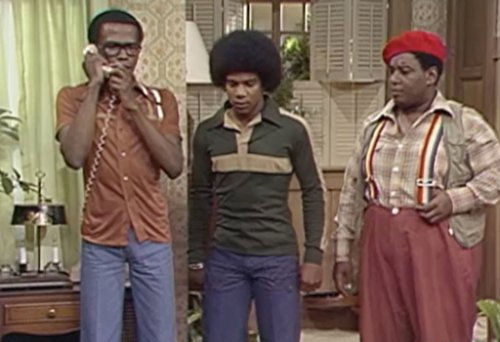
Those aren’t just characters.
Those are types of people we know.
That’s why it lasts.
Tony’s Final Reflection
When I look at these shows now, I don’t just laugh.
I appreciate how rare it was to see Black life portrayed with lightness that still had dignity. To see a neighborhood vibe where the kids could be kids, the adults could be adults, and the women — especially Shirley — could be powerful without being punished for it.
That is a legacy.
A Spiritual Bridge to S.O.L.A.D.™: Soldiers of Light Against Darkness™
And you know I’m going to connect this, because I believe stories are supposed to do more than pass time.
When I think about Raj, Dwayne, Rerun, Mama, Dee, Shirley, Nadine — I see a truth:
People don’t become who they’re meant to be alone.
They become it in community.
They become it through correction. Through laughter. Through relationships that keep you grounded. Through people who tell you the truth even when you don’t want it.
That same principle lives inside S.O.L.A.D.™: Soldiers of Light Against Darkness™.
Kevin and Juanita don’t start as heroes. They grow into purpose. They become what they must become because destiny has weight—and community is part of how they survive it.
If you believe stories should uplift, reflect, and strengthen the spirit…
👉🏾 Order autographed copies of S.O.L.A.D.™: Soldiers of Light Against Darkness™ at: www.tyronetonyreedjr.com/the-shop
Because sometimes “What’s happening?” is the beginning of transformation.


Comments