
Tony’s Timeless Thursdays™X-Men: The Animated Series: The Cartoon That Raised a Generation of Outsiders


Some cartoons were made to sell toys, fill Saturday morning time slots and keep kids entertained between bowls of cereal. Then there were cartoons that reached through the television screen, grabbed children by the heart and told them something they might not have heard anywhere else: you are not broken just because the world does not understand you.
X-Men: The Animated Series was one of those cartoons. When it premiered in 1992 as part of Fox Kids, it did not feel like ordinary children’s television. It felt dramatic, emotional, dangerous and urgent. The music hit like a warning siren. The characters argued like family. The villains had reasons. The heroes had trauma. The world feared them, hated them, hunted them and still expected them to save it. For a generation of children who felt different, awkward, rejected, misunderstood or unseen, the X-Men were not just superheroes. They were a mirror.
That is why the show still matters. Long before superhero movies dominated theaters and streaming services turned comic book characters into billion-dollar brands, X-Men: The Animated Series helped millions of viewers understand that powers can be gifts and burdens at the same time. It taught us that being different can make people afraid of you, but it can also prepare you to protect others. It taught us that family is not always about blood. Sometimes family is the group of people who chooses you when the rest of the world does not know what to do with you.

That Theme Song Was an Alarm Bell for Greatness
There are television theme songs, and then there is the X-Men theme. The second those guitars, synths and drums exploded through the speakers, every child in the room knew something serious was about to happen. You could be in the kitchen, halfway down the hallway or still half-asleep on the couch, but when that theme hit, you moved. That intro did not politely invite you into the show. It kicked the door open and announced that mutant business was underway.
The genius of the opening sequence was that it introduced the characters like legends. Wolverine slashing the screen. Cyclops firing optic blasts. Storm commanding the weather. Rogue flying with strength and attitude. Gambit charging cards. Beast flipping with intelligence and power. Jubilee bringing youthful energy. Jean Grey using telekinesis. Professor Xavier leading with calm authority. Magneto hovering like a god of judgment. Even before many kids fully understood the comics, that intro made them understand the stakes.
Marvel knew how important that music was, too. When X-Men ’97 was first announced, one of the biggest questions was whether the iconic theme would return, and Entertainment Weekly reported that the revival would bring the beloved theme music back with a modern twist. That decision mattered because the theme is not just music. It is emotional memory.
The Voice Cast Gave the X-Men Their Souls
A major reason the series became unforgettable was its voice cast. These actors did not treat the show like simple cartoon work. They gave the characters pain, humor, ego, grief, desire and conviction. Entertainment Weekly’s look at the show’s legacy identified the core animated lineup as Cyclops, Jean Grey, Wolverine, Storm, Rogue, Gambit, Beast, Jubilee, Professor X and Morph, with many of those voices becoming definitive for fans.
Cal Dodd’s Wolverine sounded like gravel, rage and wounded loyalty all rolled into one. His voice had that perfect mix of menace and pain, making Logan feel like a man who could tear through Sentinels one minute and quietly mourn the people he failed the next. When many fans read Wolverine comics today, they still hear Dodd’s voice in their heads.

Lenore Zann’s Rogue brought fire, sadness and Southern charm to one of the show’s most emotionally layered characters. Rogue was powerful enough to knock enemies through walls, but she could not touch another person without hurting them. Zann captured that contradiction beautifully, making Rogue funny, flirtatious, tough and heartbreaking all at once.

Norm Spencer gave Cyclops a voice that sounded disciplined, serious and sometimes painfully burdened by responsibility. Scott Summers often gets treated unfairly by fans who prefer flashier characters, but the animated series showed why leadership is heavy. Spencer played Cyclops as a man constantly trying to hold the team together while carrying his own emotional storms.

Catherine Disher gave Jean Grey warmth, intelligence and vulnerability, especially as the series moved into the Phoenix and Dark Phoenix stories. Jean was not just the love interest or the psychic powerhouse. She was the emotional center of the team, and Disher helped make her transformation into something cosmic feel both grand and tragic.
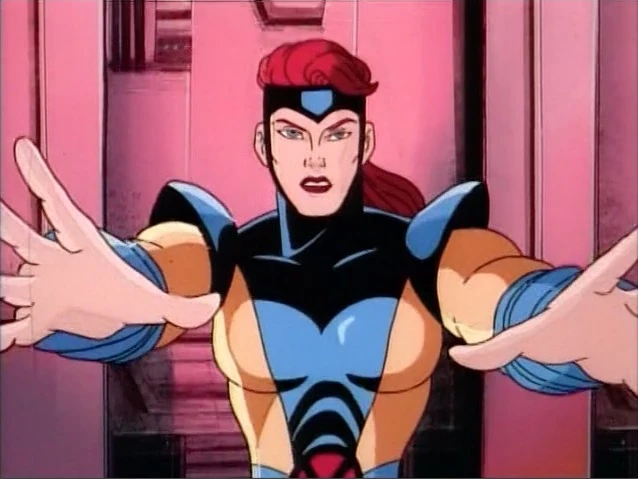
Alison Sealy-Smith’s Storm became iconic because she made every weather command sound like scripture, poetry and judgment at the same time. Storm did not just call lightning. She declared it. Her voice gave Ororo Munroe a regal presence that made her feel like a queen, a warrior and a woman of deep spiritual strength.

Chris Potter’s Gambit gave the show swagger, mystery and romantic danger. His Cajun charm made Remy LeBeau instantly memorable, but the performance also carried hints of pain and secrecy. Gambit always felt like someone smiling through the weight of things he did not want to explain.

George Buza made Beast sound like the most compassionate professor you ever wanted to have. Hank McCoy was brilliant, strong and philosophical, but Buza never let him become cold. Beast’s intelligence came with warmth, making him one of the show’s clearest reminders that gentleness and strength can live in the same body.

Alyson Court’s Jubilee gave young viewers an entry point into the world of the X-Men. She was scared, excited, funny and overwhelmed, which is exactly how many kids would have felt if they suddenly discovered mutants, Sentinels and a mansion full of superheroes. Through Jubilee, the audience got to be amazed by the X-Men before fully understanding how much pain came with being one of them.

Cedric Smith’s Professor Xavier brought dignity, patience and moral conviction to Charles Xavier. He made Xavier feel like a man who believed in peace not because he was naïve, but because he understood the cost of war. That made his philosophical conflict with Magneto even more powerful.

Magneto Was Not Just a Villain. He Was a Warning.
One of the greatest strengths of X-Men: The Animated Series was its treatment of Magneto. The show understood that Magneto should never be written as a simple villain who wants power for power’s sake. He is far more compelling than that. Magneto is dangerous because his pain makes sense. His anger is not random. His hatred of human oppression is rooted in trauma, survival and the belief that history keeps repeating itself.
That complexity is why Magneto remains one of the greatest characters in comic book history. He looks at humanity and sees the pattern: fear, registration, imprisonment, experimentation and extermination. Professor Xavier looks at humanity and still sees the possibility of peace. The tragedy is that both men understand something true. Xavier is right that hope matters. Magneto is right that oppressed people cannot ignore danger.
That tension gave the animated series a moral richness that children may not have fully understood at first but absolutely felt. Magneto was not frightening simply because he could control metal. He was frightening because the show made viewers understand how someone could become him. That is powerful storytelling.

The Civil Rights Allegory Gave the Cartoon Its Heart
The X-Men have always worked as an allegory for prejudice, discrimination and fear of difference, but the animated series put that theme directly in front of children every week. Mutants were feared because of how they were born. They were registered, hunted, blamed, experimented on and treated as threats before they ever committed a crime. The show used superhero storytelling to ask young viewers some very grown-up questions.
What does society do to people it fears? Who gets labeled dangerous? Who gets asked to hide themselves to make others comfortable? What happens when political systems turn human beings into categories? How do people keep loving a world that keeps rejecting them?

Those questions gave the show emotional power. For children who felt rejected because of race, disability, poverty, personality, family background, faith, appearance or simply being different, the X-Men offered a language for pain. The show did not tell kids that being different would be easy. It told them that being different did not make them worthless.
That message was life-giving.
The Show Brought Comic Book Storytelling to Saturday Morning Television
One reason X-Men: The Animated Series stood out is that it embraced long-form storytelling when many cartoons still reset everything at the end of each episode. The series adapted and remixed major comic book storylines, including The Dark Phoenix Saga, Days of Future Past, the Legacy Virus and the Phalanx Covenant. A series episode guide notes that the show’s early episodes were especially notable for flowing into one another as a continuing narrative, something the creative team fought hard to do.
That mattered because it taught young viewers how comic books felt. Stories had consequences. Characters remembered pain. Relationships changed. Villains returned. Decisions mattered. This was not just “villain of the week” television. This was serialized drama with laser blasts, psychic battles, mutant politics and emotional fallout.
For many kids, the cartoon was their first comic book. Even if they had never stepped into a comic shop, they were learning the language of Marvel storytelling every Saturday morning. They learned about Sentinels, Genosha, the Shi’ar, the Savage Land, Apocalypse, Cable, Bishop, Mr. Sinister, the Hellfire Club and the Phoenix Force. That is a lot for a children’s show, and the wild thing is that it worked.

The Phoenix Saga and The Dark Phoenix Saga Were Saturday Morning Opera
When the animated series adapted The Phoenix Saga and The Dark Phoenix Saga, it gave children cosmic tragedy before many of them even knew what cosmic tragedy was. Jean Grey becoming Phoenix was not just a power upgrade. It was transformation, temptation and terror wrapped inside one of Marvel’s most famous stories.

The brilliance of those episodes is that they understood the emotional stakes. Jean is loved by the team. Scott loves her deeply. Wolverine cares for her in his own complicated way. Professor Xavier understands the danger. The Phoenix Force is beautiful and terrifying because it magnifies Jean beyond human limits. Then the Dark Phoenix storyline asks what happens when power overwhelms identity.

That is not light storytelling. That is mythic storytelling. For children watching at home, it was unforgettable because it made superhero animation feel enormous. The fate of planets, hearts and souls all seemed to collide at once.
Days of Future Past Made the Future Feel Terrifying
The animated version of Days of Future Past gave young viewers one of the show’s clearest warnings about fear becoming policy. A dark future ruled by Sentinels showed what happens when society allows prejudice to harden into machinery. The message was simple but chilling: if people allow fear to justify cruelty long enough, the future becomes a prison.
Bishop’s arrival from the future brought urgency to the show. He was not warning the X-Men about a small mistake. He was warning them about a world that had already lost its soul. That kind of time-travel storytelling worked because it made the present feel morally important. The future was not fixed. Choices mattered. Courage mattered. Standing up early mattered.
That is still relevant.

Apocalypse Made Evil Feel Biblical
Apocalypse gave the animated series one of its most intimidating villains. He did not feel like a bank robber, a mad scientist or a standard supervillain. He felt ancient, inevitable and almost spiritual in his arrogance. His voice, design and language made him feel like a force of judgment moving through history.
The show used Apocalypse to explore survival, evolution and domination. He believed strength determined worth, and that belief made him a terrifying contrast to Xavier’s dream. Where Xavier believed different people could coexist, Apocalypse believed the weak should fall and the powerful should rule.

That philosophy is evil dressed up as destiny, and the series made it frightening.
The Toys, Trading Cards and Comics Made the X-Men a Full Childhood Universe
The cartoon did not exist by itself. It arrived during a massive X-Men boom. The early 1990s were filled with action figures, comic books, trading cards, posters, video games and schoolyard arguments over who had the best powers. Kids were not just watching the X-Men. They were collecting them, drawing them, pretending to be them and debating them.
Those Toy Biz figures were everywhere. Wolverine with retractable claws. Cyclops with optic blast features. Gambit with his staff and cards. Storm with dramatic capes. Magneto looking like he walked straight out of a comic panel. The toys helped children take the stories off the screen and continue them on bedroom floors, playgrounds and kitchen tables.

The comics mattered too. The cartoon sent many viewers hunting for the source material, and suddenly names like Chris Claremont, Jim Lee, John Byrne and Dave Cockrum became part of the larger X-Men conversation. The animated series was a gateway, and for many fans, once that gate opened, they never left.
X-Men ’97 Proved the Love Never Died
When X-Men ’97 arrived on Disney+, it proved something longtime fans already knew: the world was still hungry for these mutants. The revival continued the emotional energy, visual style and soap-opera intensity of the original series while updating the storytelling for a new era. Entertainment Weekly reported that the revival was designed to honor the drama, music and themes of the original, including acceptance, discrimination and found family.
That is why X-Men ’97 hit so hard. It was not simply nostalgia wearing a new coat. It understood why the original series mattered. It understood that fans did not just miss the costumes and theme song. They missed the emotional intensity. They missed the arguments. They missed Rogue’s pain, Magneto’s rage, Cyclops’ burden, Storm’s majesty, Wolverine’s grief and the constant feeling that the X-Men were fighting for survival on multiple fronts at once.

Now Season 2 is set to return on July 1, 2026, with Marvel’s official overview saying the X-Men are divided across different eras of time while mutant intolerance rises again in their absence. That premise sounds exactly like the kind of bold, emotional, time-bending chaos that made this franchise unforgettable in the first place.
Why This Cartoon Still Hits So Hard
The reason X-Men: The Animated Series still hits so hard is because its central message never stopped being relevant. The world still fears what it does not understand. People are still pressured to hide parts of themselves to survive. Communities are still targeted, labeled and misunderstood. Families are still built out of people who find each other in the middle of pain.
That is why the X-Men endure. They are not perfect heroes standing above humanity. They are wounded heroes standing in front of humanity, protecting people who may never fully accept them. That kind of love is complicated. That kind of heroism is costly. That kind of storytelling stays with you.

For many of us, the X-Men made being different feel powerful before the world made it feel acceptable. They gave outsiders a team, a mansion, a mission and a theme song. They made children feel like their pain could become purpose.
That is timeless.
The Spiritual Bridge to S.O.L.A.D.™: Soldiers of Light Against Darkness™
One reason X-Men: The Animated Series resonates so deeply with me is because underneath the mutations, battles, costumes and cosmic threats is a story about identity, calling and standing for what is right even when the world misunderstands you. The X-Men do not fight because the world loves them. They fight because protecting others is still the right thing to do.
That same struggle between light and darkness, rejection and purpose, fear and calling can also be found throughout my S.O.L.A.D.™: Soldiers of Light Against Darkness™ universe. In S.O.L.A.D.™, ordinary people are called into extraordinary battles and forced to discover whether they have the faith, courage and strength to stand against darkness when their world needs them most.
If you enjoy stories about chosen heroes, found family, supernatural battles, emotional courage and standing for light when darkness pushes back, I truly believe you’ll enjoy S.O.L.A.D.™: Soldiers of Light Against Darkness™.
Signed copies are available through the S.O.L.A.D.™ shop on my website.
At the end of the day, X-Men: The Animated Series remains timeless because it understood what every outsider needs to hear: being different does not mean you are defective. Being misunderstood does not mean you are alone. And sometimes the very thing the world fears about you is the thing God can use to help you stand, fight and protect others when darkness comes.


Comments