
Tony’s Superhero Saturdays™: Scott Summers a.k.a. Cyclops — The Burden of Leadership


The Man Who Never Looks Away
The battlefield is quiet now.
Smoke drifts where chaos once roared. Broken Sentinels lie scattered like fallen monuments. The X-Men stand behind him — bruised, exhausted, alive.
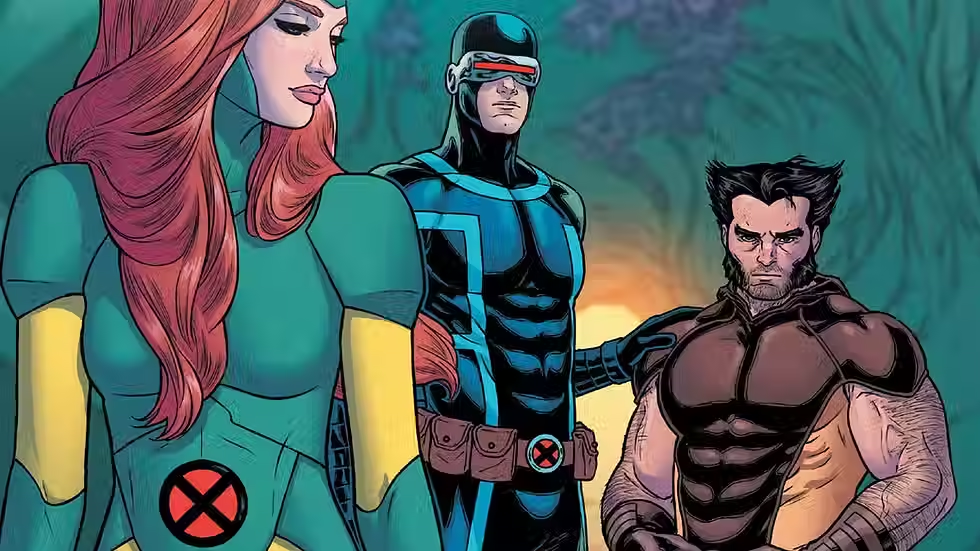
At the front stands a man in a blue-and-gold suit, visor glowing faintly red.
Scott Summers doesn’t celebrate. He doesn’t boast. He doesn’t smile.
He simply lowers his head for a moment — counting the living, remembering the fallen — then lifts his chin and moves forward.
Because leaders don’t stop when the fight ends. They prepare for the next one.
This is Cyclops. Not just the first X-Man. But the spine of the X-Men.

The Creation of Cyclops: Marvel’s First X-Man
Cyclops debuted in X-Men #1 (1963), created by Stan Lee and Jack Kirby.
He was introduced not as the strongest, flashiest, or most charismatic mutant — but as the most disciplined.
From the beginning, Scott Summers was different:
A tactician, not a brawler
A planner, not a showboat
A leader burdened by responsibility rather than ego
While others questioned authority, Cyclops embodied it — even when it cost him personally.
Stan Lee once said the X-Men were about outsiders learning to survive in a world that feared them. Cyclops became the embodiment of that survival.

Origins: A Childhood Shaped by Loss and Control
Scott Summers’ life was marked by trauma early.
His parents were presumed dead after a plane crash (later revealed to involve cosmic forces).
Scott suffered a head injury during the crash that damaged the part of his brain controlling his optic blasts.
Orphaned, separated from his brother Alex, and bounced between institutions, Scott learned one lesson quickly:
Control is survival.
His optic blasts — concussive beams of pure kinetic force — are always active. Without his ruby-quartz visor or glasses, he cannot stop them.
This constant danger shaped Scott into someone who must think ahead — always.

Professor X: Mentor, Father Figure, and Moral Shadow
Charles Xavier shaped Scott Summers more than anyone else.
Scott was Xavier’s first student, his greatest success, and — eventually — his greatest challenge.
Professor X taught Scott restraint, strategy, and the dream of peaceful coexistence. But he also placed unbearable responsibility on a traumatized child, grooming him to lead before he ever had a chance to simply live.

As Scott grew older, he began questioning Xavier’s methods — especially his secrecy, manipulation, and willingness to sacrifice individuals for the “greater good.”
Their relationship ultimately fractured during Avengers vs. X-Men, when Scott — possessed by the Phoenix Force — killed Xavier.
That moment forever defined Scott Summers.
Cyclops became the man who inherited Xavier’s dream…and was forced to reinterpret it for a harsher world.
Powers and Abilities: Precision Over Power
Cyclops’ optic blasts are often misunderstood.
They are not heat beams.They are dimensional kinetic force, drawing energy from a punch-dimension.
Abilities
Continuous concussive optic blasts
Precision targeting and control
Expert hand-to-hand combat
Master tactician and strategist
Exceptional battlefield awareness
Natural leadership instincts
Cyclops doesn’t overpower enemies — he outthinks them.
As Captain America once admitted:
“If Cyclops ever called the shots for the Avengers, I’d listen.”
Cyclops as Leader: The X-Men’s Backbone
Cyclops has led the X-Men through:
Sentinel genocides
Government persecution
Internal schisms
Phoenix catastrophes
Mutant extinction events
He doesn’t lead because he wants to. He leads because someone has to make the hard calls.
And Scott Summers makes them — even when they cost him friendships, love, and public approval.

Jean Grey: Love, Loss, and the Weight of the Phoenix
Scott Summers’ defining relationship is with Jean Grey.
Their love is:
Deep
Complicated
Repeatedly shattered by cosmic forces
Jean’s transformations into Phoenix and Dark Phoenix left scars on Scott that never healed cleanly.
He loved her — and lost her — again and again.
Cyclops’ grief shaped many of his later, harder decisions.
He is a man who has seen love burn worlds.

Wolverine: Respect Forged Through Conflict
The tension between Cyclops and Wolverine is legendary.
Where Scott is discipline and planning, Logan is instinct and rage. They clashed over leadership, philosophy, and Jean Grey — yet beneath the rivalry was deep respect.
Wolverine follows Cyclops in battle because Scott’s plans work.Cyclops trusts Wolverine because Logan always gets the job done.
They represent two types of warriors:
the soldier who thinks ten moves ahead, and
the warrior who charges into the fire.
When Cyclops makes the call, Wolverine listens — even if he doesn’t like it.
That respect is earned, not given.

Greatest Victories
Leading the X-Men against Magneto and Apocalypse
Surviving and rebuilding after Days of Future Past timelines
Standing firm during House of M and mutant depowering
Protecting the last remaining mutants after Decimation
Training multiple generations of X-Men
Refusing to let mutantkind disappear quietly
Cyclops doesn’t save the day with speeches.He saves it by holding the line.
Greatest Controversies and Failures
Cyclops is one of Marvel’s most debated heroes — because leadership is messy.
Avengers vs. X-Men
While possessed by the Phoenix Force, Scott killed Professor X.
It broke him — and redefined him.
But even before that, Scott had already crossed moral lines in defense of mutant survival.
Was he wrong? Or was he doing what no one else would?
Cyclops represents the uncomfortable truth:
Sometimes survival requires decisions no one wants to make.
Cyclops vs. Magneto: Two Paths, One Goal
Cyclops and Magneto are often framed as opposites — but they share a goal: mutant survival.
Magneto uses force and fear. Cyclops uses structure and preparation.
Over time, the line between them blurred — forcing readers to question whether Cyclops was becoming what he once opposed… or simply adapting to reality.

Media Appearances: Film, TV, Animation
Live-Action Films
James Marsden (X-Men films) — earnest, restrained, often underused
Tye Sheridan (younger Cyclops) — explored Scott’s early trauma
Animation
X-Men: The Animated Series — definitive Cyclops for many fans
X-Men: Evolution — growth-focused interpretation
Wolverine and the X-Men — commanding, hardened leader
Video Games
Marvel vs. Capcom
X-Men Legends
Marvel Ultimate Alliance
Numerous arcade and console titles
Cyclops is consistently portrayed as the tactician — the one who sees the whole board.

Why Cyclops Matters
Cyclops matters because he represents:
Leadership without glory
Discipline without applause
Responsibility without escape
Morality under pressure
A hero who stays when others walk away
He is proof that heroes don’t have to be flashy — they have to be reliable.
S.O.L.A.D.™ Tie-In: Cyclops and the Burden of Light
Cyclops stands as a powerful reflection of the heroes found in the superhero novel series S.O.L.A.D.™: Soldiers of Light Against Darkness™.
Like Scott Summers, the Soldiers of Light Against Darkness™ do not seek power —they answer responsibility.
They lead when others hesitate. They make impossible choices so others don’t have to. They stand in the space between hope and annihilation. They are often misunderstood, criticized, or blamed —yet they endure.
Cyclops teaches us a truth that echoes throughout S.O.L.A.D.™:
Being a hero is not about being right all the time —it’s about refusing to abandon those you’re sworn to protect.
Scott Summers carries the burden of leadership the same way the Soldiers of Light Against Darkness™ do — quietly, relentlessly, and without expectation of praise.
And because of heroes like that…the world survives.


Comments