
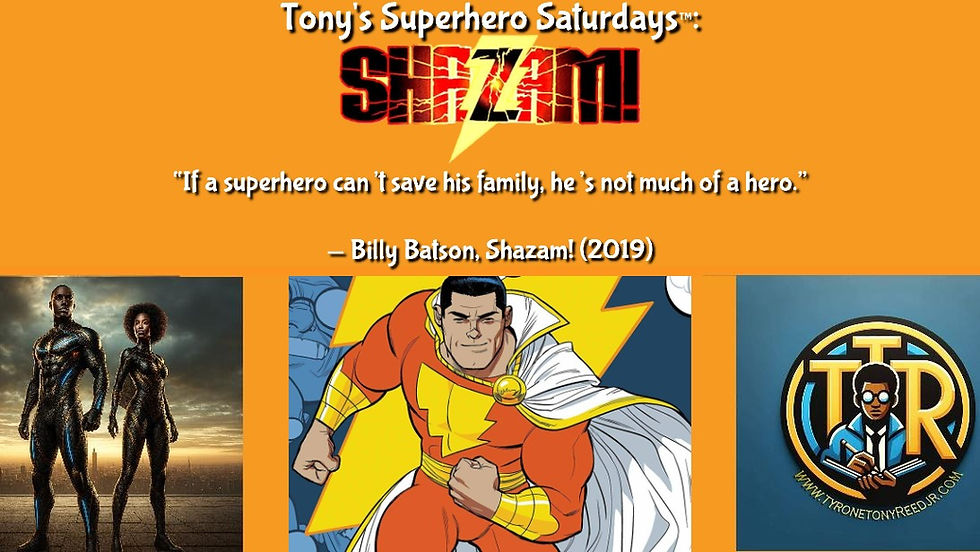
Tony’s Superhero Saturdays™: Shazam: The Boy Who Became the World’s Mightiest Mortal

Some heroes are born into greatness. Some train for years. Some come from other planets, inherit fortunes, build armor, carry shields, wear rings, study magic or survive tragedies that reshape the rest of their lives.
And then there is Billy Batson. A boy. A child. A kid with pain in his past, questions in his heart, and more responsibility waiting for him than anyone his age should have to carry. Billy does not become a hero because he is the strongest person in the room. He becomes a hero because a wizard looks past his size, age, wounds and rough edges, and sees something in him that power can trust.
That is what makes Shazam one of the most joyful and meaningful superheroes ever created. He is childhood wonder wrapped in lightning. He is magic with a heartbeat. He is the fantasy every kid understands immediately: What if one word could transform you from ordinary to extraordinary? What if the frightened child inside you could stand tall? What if the world saw weakness, but heaven saw a champion?
For Tony’s Superhero Saturdays™, Shazam deserves the spotlight because his story reminds us that power by itself is not enough. Muscles are not enough. Lightning is not enough. Flight, speed, invulnerability and strength are not enough. The real question is not whether someone can hold power.
The real question is whether their heart is ready for it.

Who Is Shazam?
Shazam is Billy Batson, a young boy who is chosen by the ancient wizard Shazam to become Earth’s Mightiest Mortal. By speaking the wizard’s name, Billy is struck by magical lightning and transformed into an adult champion with incredible powers.
For many years, the character was known as Captain Marvel. Today, most audiences know him as Shazam, but that naming history is part of what makes him such an interesting figure in superhero culture. He began as one of the biggest heroes of the Golden Age, a bright and imaginative champion whose adventures mixed magic, morality, humor, fantasy and action in a way that captured readers’ imaginations.
His first appearance goes back to Whiz Comics #2 in 1940, published by Fawcett Comics. The character was created by writer Bill Parker and artist C.C. Beck, who introduced him to the world as Captain Marvel before modern audiences came to know him more commonly as Shazam. His core idea remains one of the cleanest superhero concepts ever created: a child says a magic word and becomes a mighty adult hero. That is simple, but it is not shallow. In fact, the simplicity is part of the brilliance.
Billy Batson represents the child who feels small in a world full of danger. Shazam represents the strength that child discovers when he is trusted with purpose. The transformation is exciting because it is not only physical. It is emotional. It is spiritual. It is the moment when a child who has felt powerless learns that he has been chosen for something greater.
That is why the character still works.
Every generation has children who feel overlooked. Every generation has children who dream of being stronger. Every generation needs to hear that greatness is not only for the people who already look powerful.

The Magic Word
The magic word is the center of everything. Shazam. One word changes Billy’s life. One word turns fear into courage, weakness into strength, uncertainty into action and a lonely child into a champion. That word is not just a command. It is a calling.
The name Shazam also carries the gifts Billy receives: the wisdom of Solomon, the strength of Hercules, the stamina of Atlas, the power of Zeus, the courage of Achilles and the speed of Mercury. Those names give the hero mythological weight, but they also show that Shazam is not supposed to be powered by strength alone.
Wisdom comes first. That matters. Power without wisdom becomes dangerous. Strength without courage becomes incomplete. Speed without purpose becomes chaos. Stamina without discipline becomes stubbornness. Magic without morality becomes corruption.
Billy Batson is not chosen simply to become strong. He is chosen to become responsible with strength. That is one of the most important lessons in the entire Shazam mythology. The magic word does not exist so Billy can escape childhood forever. It exists so he can learn what power means before the world teaches him to misuse it.
That gives the character his heart. Shazam is wish fulfillment, but it is also moral formation.

Captain Marvel, Shazam and the Name That Changed
The name history around Shazam can confuse newer fans, but it is part of the character’s legacy.
For decades, Billy Batson’s superhero identity was Captain Marvel. He was known as the World’s Mightiest Mortal, a hero whose powers and innocence made him one of the most beloved figures of the Golden Age. Over time, legal and publishing realities changed how the character was marketed, and DC eventually leaned into the name Shazam as the identity most modern audiences recognize.
That shift did not erase the old legacy. It added another layer to it. Older fans may still lovingly refer to him as Captain Marvel, the Big Red Cheese, or Earth’s Mightiest Mortal. Newer fans may know him from the movies as Shazam. Both names point back to the same core idea: Billy Batson, the child chosen to carry magical power.
That history is worth remembering because it shows how characters evolve. A hero can survive name changes, company changes, tone changes, costume changes and different eras if the heart of the character remains strong.
For Shazam, the heart has always been Billy. Not the trademark. Not the debate. Not the lightning bolt alone. Billy Batson is the soul of the story.

The Boy, the Champion and the Power Between Them
One of the most interesting things about Shazam’s long history is that the relationship between Billy Batson and Captain Marvel has not always been handled the same way.
In many older stories, Billy Batson and Captain Marvel could feel almost like separate personalities connected by magic. Billy was the young boy who spoke the word, while Captain Marvel often carried himself with the confidence, maturity and authority of an adult champion. That version gave the character a mythic quality, as if the magic word did not simply make Billy bigger, but called forth a mighty protector through him.
In many modern versions, the idea has shifted. Billy remains more clearly himself after the transformation, only now he is inside the body of a powerful adult superhero. That approach creates much of the humor, wonder and emotional charm audiences recognize from newer comics and films. The adult hero may have the strength of Hercules and the power of Zeus, but the heart and perspective inside still belong to a boy learning what responsibility means.
Both versions reveal something valuable. The older approach emphasizes the mystery of magic and the dignity of a champion. The modern approach emphasizes childhood wonder, growth and the emotional truth that power does not erase who Billy is underneath it.
Either way, the heart of the story remains powerful: Billy Batson is trusted with something bigger than himself, and the magic of Shazam asks whether innocence, courage and a good heart can carry the weight of godlike power.

Family Is the Real Power
One of the strongest parts of the modern Shazam mythology is the Shazam Family. Billy’s foster siblings are not just supporting characters. They are part of what makes the story emotionally rich. Freddy Freeman, Mary Bromfield, Darla Dudley, Eugene Choi and Pedro Peña help turn Shazam from one boy’s power fantasy into a story about found family, shared responsibility and the healing that comes when children who have been hurt discover they do not have to stand alone.
That matters because Billy’s story begins with loneliness. He is often portrayed as a child who has lost family, searched for family, resisted family or struggled to trust family. The Shazam Family gives him something the lightning alone cannot provide: belonging.
That is why the 2019 Shazam! movie connected with so many people. Beneath the jokes, superhero action and wish-fulfillment comedy was a story about foster children becoming a family in the truest sense. The big emotional breakthrough was not simply Billy learning to fly or punch hard. It was Billy learning to share power.
That is a beautiful message. Some people think power makes them bigger when they keep it to themselves. Shazam teaches the opposite. Sometimes power becomes greater when it is shared with the people who love you, stand with you and help you become better than you would have been alone.
The Shazam Family turns lightning into love.

Freddy Freeman, Mary Marvel and the Marvel Family Legacy
Freddy Freeman and Mary Marvel are essential to Shazam’s long history. Freddy, known for years as Captain Marvel Jr. and later Shazam Jr. in some versions, brings a powerful emotional layer because his story often includes injury, disability, friendship and courage. Freddy is not simply Billy’s sidekick. He is a hero whose own pain and resilience matter. His connection to Billy shows that power can be shared not out of pity, but out of trust and love.
Mary Marvel is one of the most important female heroes connected to the Shazam mythos. She has carried the magic with grace, strength and maturity across generations. In many ways, Mary brings balance to the family because she often understands responsibility more quickly than Billy does. That is part of her strength. She reminds readers that the power of Shazam is not limited to one boy or one kind of hero.
The broader Marvel Family, or Shazam Family as many modern fans know them, gives the mythology warmth. It makes the power feel communal instead of isolated. Billy’s greatest lesson is not that he can become mighty.
It is that mightiness does not have to be lonely. That is a word for more than comic books. Many people are powerful in isolation but stronger in family. They can survive alone, but they flourish when they are loved, challenged, corrected and supported. Shazam’s family reminds us that even the World’s Mightiest Mortal still needs people.

The Wizard and the Rock of Eternity
The wizard Shazam gives the story its ancient power. He is the gatekeeper between childhood and destiny, the mysterious figure who sees Billy not only as a boy, but as a possible champion. His presence connects Billy’s modern life to myth, magic and eternity. The Rock of Eternity, where the wizard often dwells, feels like one of those great comic-book locations where history, heaven, myth and danger all meet.
The Rock of Eternity is not just a headquarters. It is a crossroads. It represents the idea that Billy’s calling is bigger than his neighborhood, bigger than his age and bigger than his understanding. When he steps into that world, he is not simply putting on a costume. He is stepping into a legacy of magic that carries consequences.
That matters because magic in superhero stories should feel wondrous and dangerous. The Rock of Eternity gives Shazam’s mythology that scale. It reminds us that Billy’s power does not come from technology or training. It comes from something ancient. Something sacred. Something that must be respected.
The wizard’s choice also says something important about children. Adults often underestimate what young people can carry. The wizard does not. He sees Billy’s potential before Billy fully sees it himself. That is mentorship at its best: not giving a young person power for entertainment, but calling out the greatness already hidden inside them.

Doctor Sivana: Intelligence Without Innocence
Doctor Sivana is one of Shazam’s oldest enemies, and his role in the mythology is important because he represents a different kind of power.
Billy has magic.
Sivana has intellect.
Billy has wonder.
Sivana has bitterness.
Billy learns to share power.
Sivana often tries to control it.
That contrast gives their conflict meaning. Sivana is not dangerous because he is physically stronger than Shazam. He is dangerous because his mind is brilliant and his heart is corrupted by resentment, pride and obsession. He shows what happens when intelligence loses humility.
That kind of villain works beautifully against Billy Batson. A child with a pure heart facing a genius with a damaged one creates a strong moral contrast. Sivana’s mind should have been used to help the world. Instead, it becomes a weapon against it.
This is one of the reasons Shazam stories can feel timeless. They are not only about strength beating weakness. They are about purity confronting corruption. They are about joy confronting bitterness. They are about magic confronting cynicism.
Billy’s power may come from lightning, but Sivana’s danger comes from something quieter: a heart that refuses to heal and a mind that refuses to bow to wisdom.

Black Adam: Power Without the Same Heart
Black Adam is one of the most important figures in Shazam’s mythology because he represents what happens when similar power is carried by a very different heart.
Like Billy, Adam is connected to ancient magic. Like Billy, he has enormous strength, speed, stamina and supernatural power. But Adam’s relationship to justice, vengeance, rulership and mercy is far more complicated.
That makes him more than a simple villain. Black Adam often sees himself as protector, king, judge and weapon. He believes in order, but his order can be brutal. He believes in justice, but his justice can become vengeance. He believes in protecting his people, but he is willing to cross lines Billy would not cross.
That contrast helps define Shazam. Billy is not the greatest champion because he is the strongest. Black Adam may rival him in power. Billy is special because his heart still matters. His innocence, mercy, humor, compassion and willingness to grow all separate him from champions who believe power gives them the right to decide everything alone.
Black Adam asks what happens when magic serves control. Billy Batson answers with a different truth. Power should protect. Not dominate.

The Golden Age and the Big Red Cheese
Shazam’s Golden Age history is full of imagination, humor and scale. As Captain Marvel, Billy Batson became one of the most popular superheroes of his era. His adventures were bright, strange, energetic and filled with colorful enemies, magical concepts, science-fiction ideas and the kind of storytelling that did not apologize for being fun.
That joy matters. Modern superhero stories often lean heavily into darkness, trauma and realism. Those can be powerful when used well, but Shazam reminds us that wonder has its own strength. Not every hero has to be grim to be meaningful. Not every story has to be covered in shadows to have weight.
The old nickname “the Big Red Cheese” captures part of that charm. It is playful. It is affectionate. It understands that Shazam can be mighty without being miserable. He can be powerful and still silly. He can be heroic and still fun. He can fight evil without losing the sense that being a superhero should feel amazing.
That balance is rare. Shazam gives readers and viewers permission to enjoy the impossible again.

The First Superhero on the Movie Screen
Shazam also has a major place in superhero movie history. In 1941, Adventures of Captain Marvel brought the character to live-action serials and became one of the earliest major superhero screen adaptations. That matters because it places Captain Marvel/Shazam near the foundation of comic-book cinema itself.
Long before modern superhero blockbusters, long before cinematic universes, computer-generated battles and billion-dollar box offices, there was a boy saying a magic word and becoming a hero on the movie screen.
That history deserves respect. Shazam is sometimes treated as a secondary DC character by modern audiences, but his screen legacy runs deep. He was there early. He helped prove that comic-book heroes could make the jump to live action. He carried magic, flight and heroism into theaters at a time when the superhero genre was still learning what it could become.
The modern superhero film landscape owes more to those early serials than many casual fans realize. Shazam was not late to the party. He helped build the house.

The 1970s Live-Action Series
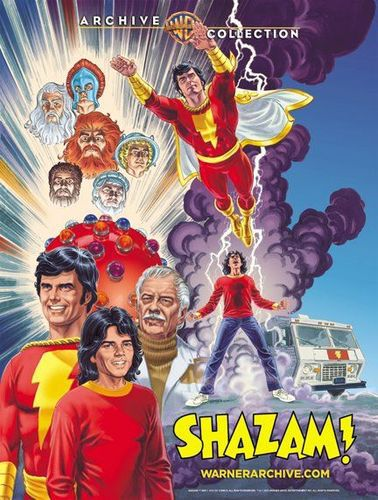
In the 1970s, Shazam returned to live action through the Shazam! television series produced by Filmation. That series carried a very different tone from modern superhero television. It was gentler, moral-centered and built around lessons for young viewers.
Billy Batson traveled with Mentor, encountered people in trouble, learned lessons and transformed into Captain Marvel when action demanded it. The format reflected the era’s approach to children’s programming, where adventure and morality often walked together.
That may feel old-fashioned now, but there is something valuable in it. The 1970s series understood that Shazam was a character for young hearts. It treated heroism as something connected to choices, behavior, wisdom and character. It was not only about stopping villains. It was about teaching children how to think about right and wrong.
That part of Shazam should never be lost. The character works best when he remembers that children are not just an audience segment. They are part of the soul of the story.
Shazam in Animation
Shazam has also had a strong life in animation. He appeared in animated projects such as The Kid Super Power Hour with Shazam!, Justice League Unlimited, Batman: The Brave and the Bold, Young Justice, Justice League Action and several animated films. Animation suits him because his world is colorful, magical and big enough to bend reality without needing to explain every piece of it like a science lecture.
One of the best modern animated spotlights is Superman/Shazam!: The Return of Black Adam. That story works because it places Billy beside Superman and shows why the character is special even when standing next to DC’s greatest icon. Superman may be the Man of Steel, but Billy is still a child learning how to stand in a godlike body.
That contrast is powerful. Superman sees Billy’s potential, but he also sees his youth. The story reminds us that Shazam is not just another powerhouse who can punch at Superman’s level. He is a boy learning what it means to be trusted with terrifying strength.
Animation also allows the Shazam Family, Tawky Tawny, Mister Mind, the Seven Deadly Sins, the Rock of Eternity and other magical elements to come alive with the right sense of wonder. Shazam should feel a little impossible. Animation lets him feel that way naturally.

Action Figures and Toys: Holding the Lightning
Shazam has always been toy-ready. The red suit, white cape, gold lightning bolt and transformation fantasy make him instantly appealing. A child does not need a complicated explanation to understand the figure. This is the hero who says the word and becomes powerful. That is action-figure magic.
Shazam has appeared in many toy lines over the years, from classic DC figures to modern collectibles, movie-based figures and premium statues. The character looks great on a shelf because the design is bold and clean. Red, gold and white are strong visual colors, and the lightning bolt is one of the simplest and most effective superhero symbols ever created.
But the deeper toy appeal is emotional. A Shazam figure lets a child hold the dream of transformation. It says that the small can become strong. The overlooked can become mighty. The kid can become the hero.
That is why toys matter in superhero culture. They are not only products. They are imagination in physical form. They let children create stories, battles, rescues, team-ups and moments of courage before they even know how to put those ideas into words.
Shazam belongs in toy aisles because his whole story begins with the imagination of a child.

The 2019 Movie and Zachary Levi’s Shazam
The 2019 Shazam! movie brought Billy Batson back to mainstream audiences with humor, heart and a strong found-family message. Asher Angel played young Billy, while Zachary Levi played his adult superhero form. The film understood that the comedy of Shazam comes from the child inside the adult body, but it also understood that Billy’s emotional wound mattered.
Billy was not just a goofy kid excited about powers. He was a foster child searching for his mother, struggling to trust people, resisting the family already in front of him because he was still chasing the one he lost. That gave the film emotional weight beneath the jokes.
Zachary Levi’s performance leaned into the joy and awkwardness of a child suddenly living inside superhero power. The best moments came when Billy and Freddy tried to figure out what he could do: flight, strength, lightning, bullet resistance and the thrill of discovery. That made the movie feel different from many superhero films because it remembered something essential.
Getting powers would be amazing. It would also be confusing, funny, scary and immature at first. The film’s strongest idea came when Billy learned to share power with his foster siblings. That turned the final act into more than a superhero battle. It became a statement about family. Billy’s real victory was not simply defeating Sivana. It was accepting that he did not have to be alone.

Fury of the Gods and Growing Up With Power
Shazam! Fury of the Gods continued the story by showing Billy and his family trying to function as a superhero team. The film leaned into bigger mythological threats, magical creatures and the challenge of young people carrying adult-level responsibility before fully understanding who they are.
That idea is important, even if the film received mixed reactions. The Shazam Family concept naturally raises questions about maturity. What happens when teenagers have godlike powers? What happens when family members share power but do not always share focus? What happens when Billy is afraid of losing the people who finally became his home?
Those are good Shazam questions. Billy’s insecurity in Fury of the Gods makes sense because beneath the muscles and lightning is still a kid scared of abandonment. He wants to keep the family together because he knows what it feels like to be without one. That emotional fear drives him as much as any villain does.
Shazam’s movie journey reminds us that growing up is not only about gaining power.
It is about learning how to carry it without fear controlling you.

Shazam and Superman
Shazam has often been compared to Superman because both are incredibly strong, fast, durable and visually bright heroes. But the comparison becomes more interesting when we focus on their differences.
Superman is an adult who learned goodness from the Kents and chose to use his alien power to serve humanity. Shazam is a child who is given adult power before he has fully grown into himself. Superman represents mature responsibility. Shazam represents responsibility in training.
That is why their interactions can be so meaningful. Superman may look at Billy and see potential, innocence and danger all at once. Billy may look at Superman and see the kind of hero he hopes to become. They are both symbols of hope, but they arrive there differently.
Shazam’s magic also gives him a unique place in DC’s power structure. He is not merely a Superman copy with a lightning bolt. He is powered by myth, magic and ancient gifts. That makes him part of a different corner of DC’s universe.
The best Shazam stories do not try to make him darker to prove he matters. They let him be what he is. A magical champion with a child’s heart.

Why Shazam Still Matters
Shazam still matters because the world keeps trying to make children grow up too fast. Billy Batson’s story speaks to that pain. He is a child given enormous responsibility, but the best versions of the character never forget that he is still a child. He needs family. He needs guidance. He needs correction. He needs laughter. He needs room to grow.
That makes him incredibly relevant. Too many young people are forced to carry adult burdens before they have adult tools. They deal with loss, instability, fear, abandonment, pressure and uncertainty while the world expects them to simply figure it out. Shazam turns that struggle into superhero mythology.
Billy is trusted with power, but he is not meant to carry it alone. That is the lesson. Power still needs love. Power still needs wisdom. Power still needs family. Power still needs humility. Power still needs a pure heart.
Shazam reminds us that strength is not the opposite of innocence. When guided properly, innocence can protect strength from becoming cruel.

Final Reflection: Say the Word
Shazam’s legacy is built on one of the most powerful ideas in superhero history. A child says a word and becomes mighty.
That idea has lasted for generations because it speaks to something deep inside people. We all know what it feels like to want to be stronger than we are. We all know what it feels like to wish one word could change everything. We all know what it feels like to stand in a world that seems too big and hope there is more power inside us than anyone can see.
Billy Batson reminds us that greatness can hide in unexpected places.
The next hero may not look ready.
The next champion may still be healing.
The next leader may still be learning.
The next mighty person may still be a child in need of love.
That is why Shazam belongs in the superhero conversation. He brings joy where other stories bring gloom. He brings magic where others bring machinery. He brings family where others bring isolation. He brings wonder where the world has grown too cynical.
He is the boy who became the World’s Mightiest Mortal. But the real power was never only in the lightning. It was in the heart trusted to carry it.
And when the moment comes, when darkness rises, when fear tries to speak louder than faith, and when ordinary people need to remember that power can still be used for good, the answer is still one word:
Shazam.



Comments