
Tony’s Superhero Saturdays™: War Machine: The Soldier Who Proved He Was More Than Iron Man’s Backup


When the world sees War Machine, it sees enough military hardware to take on an army. The black-and-silver armor, shoulder-mounted cannons, missile launchers and unmistakable firepower announce that this is not a superhero interested in subtlety. He is prepared for battle, and anyone foolish enough to underestimate him is about to discover why that is a terrible decision.
But the most important thing about War Machine has never been the weapons. It is the man operating them.
James “Rhodey” Rhodes was a soldier before he became a superhero, a friend before he became a partner and a man of courage long before anyone handed him a billion-dollar suit of armor. While Tony Stark became famous as Iron Man, Rhodey earned something that could not be manufactured in a laboratory or purchased with Stark Industries money: the trust of those who knew he would stand beside them when everything went wrong.
For this week's Tony’s Superhero Saturdays™, we're celebrating War Machine, a hero whose legacy is built on loyalty, military service, sacrifice, friendship and the determination to establish his own identity. And today gives us a special reason to honor him: the anniversary of James Rhodes' first appearance in Marvel Comics.
Because the man who once stood beside Iron Man eventually proved he was more than capable of standing on his own.

Today's Milestone: Celebrating James Rhodes' Comic Book Debut
Tuesday, October 24, 1978, Marvel Comics released Iron Man #118, introducing readers to James Rhodes, a character who would eventually become one of the most important figures in Tony Stark's life. The issue, which carries a January 1979 cover date, featured work by writers David Michelinie and Bob Layton, with art by John Byrne and Layton.
Rhodey's introduction was modest compared with the explosive reputation he would later develop. He wasn't introduced wearing the War Machine armor or making grand declarations about saving the world. Instead, he entered Marvel's universe as a military pilot whose connection to Tony Stark would grow into one of the company's most enduring friendships.
That friendship changed superhero history. James Rhodes would become a trusted partner, wear the Iron Man armor himself, help defend the world alongside the Avengers and eventually establish the heavily armed identity that millions of fans recognize today.
Nearly five decades after his debut, Rhodey's story offers a reminder that a character introduced in someone else's comic book can eventually develop a legacy every bit as meaningful as the hero whose name appears on the cover.

The Soldier Who Became Iron Man
Rhodey's military background is essential to understanding him. He brings discipline, aviation experience, battlefield judgment and a sense of duty to situations where Tony Stark's genius and personality sometimes create as many problems as they solve.
Their differences make their friendship fascinating. Tony is brilliant, wealthy, inventive and frequently impulsive. Rhodey is practical, disciplined and willing to challenge his friend when necessary. They don't always agree, but their relationship survives disagreements, danger and the enormous responsibility of possessing technology capable of changing the world.
One of Rhodey's defining moments came in Iron Man #170 in 1983, when Tony was unable to continue as Iron Man during his struggle with alcoholism. Rhodey stepped into the armor and assumed responsibility for a role associated with one of Marvel's most recognizable heroes.
Consider the importance of that moment. A Black superhero was carrying the Iron Man identity during an era when representation in mainstream comics was still expanding. Rhodey's story demonstrated that heroism was not the exclusive property of the man who invented the suit.
He didn't become capable because he put on the armor. He was already capable, and the crisis gave readers an opportunity to see it.

Becoming War Machine: His Own Armor, His Own Identity
Rhodey's evolution into War Machine gave him something he needed: a superhero identity that belonged to him.
In the early 1990s, Marvel introduced the heavily armed armor that would become synonymous with War Machine. Tony Stark initially used the specialized battle suit before Rhodey eventually took possession of it. The transformation continued through subsequent comics as Rhodey established himself under the War Machine name.
His new armor reflected his military experience. Unlike Iron Man's frequently sleek technological designs, War Machine's equipment emphasized combat readiness, heavy weapons and battlefield versatility. It was a formidable collection of advanced technology, but Rhodey's judgment determined how that power would be used.
The distinction matters because War Machine was never supposed to remain simply another version of Iron Man. Tony Stark's inventions supplied the machinery, but Rhodey's service, personality, principles and experiences gave the identity its character.
His adventures eventually expanded into his own comic series, beginning with War Machine #1 in 1994, placing Rhodey at the center of stories where his decisions, responsibilities and conflicts drove the action.
He no longer needed to borrow Iron Man's name to prove he belonged among Marvel's heroes.

Brotherhood Beyond the Armor
One of the strongest parts of Rhodey's story is his friendship with Tony Stark.
Their bond is not based on blind agreement. Rhodey has seen Tony at his most brilliant and at his most vulnerable. He knows the man behind the wealth, the confidence, the inventions and the public reputation. He has also seen the destructive consequences of Tony's mistakes.
Yet Rhodey remains willing to help his friend confront those mistakes, even when doing so creates tension between them.
That is what makes their relationship so important. True friendship is not merely celebrating someone's victories. It is having the courage to speak honestly when that person is heading toward disaster. Rhodey understands that loyalty without accountability can become enabling, especially when the person being protected possesses extraordinary power.
Their friendship also challenges the idea that supporting another person's success somehow diminishes your own accomplishments. Rhodey can admire Tony without surrendering his individuality, and Tony can depend on Rhodey without being the sole hero in their partnership.
Their brotherhood is built on something stronger than technology: trust earned through years of standing together.
War Machine on the Big Screen
War Machine's journey from comics to cinema helped introduce Rhodey to an enormous new audience.
Terrence Howard portrayed James Rhodes in Iron Man (2008), establishing Rhodey as Tony Stark's longtime friend and military connection. Don Cheadle took over the role beginning with Iron Man 2 (2010), where audiences finally witnessed Rhodey become War Machine.

Cheadle's portrayal brought a combination of military professionalism, dry humor, loyalty and frustration to the character. Rhodey could challenge Tony's reckless behavior while remaining deeply committed to his friend, and their exchanges frequently provided welcome humor amid the increasingly dangerous threats facing the Marvel Cinematic Universe.
In Iron Man 3, Rhodey's armor temporarily became the Iron Patriot, reflecting his position as a government-associated superhero. He later fought alongside the Avengers in Avengers: Age of Ultron, Captain America: Civil War, Avengers: Infinity War and Avengers: Endgame.

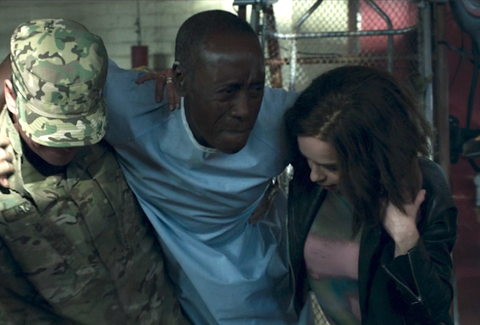
One of his most consequential moments came in Civil War, when Rhodey suffered a devastating spinal injury after falling from the sky during the airport battle. Although Tony developed technology to help him walk, the injury revealed the vulnerability beneath Rhodey's powerful armor.
His friendship with Nebula in Endgame added another meaningful dimension. Both understood what it meant to live with bodies altered by technology, giving them a connection beyond the battlefield.

Rhodey's MCU story also took a troubling turn in Secret Invasion, which revealed that a Skrull had impersonated him for an unspecified period. That development raised questions about his experiences and identity, adding further complications to the character's screen history.
The Cost of Being the Man Who Always Shows Up
War Machine's courage does not mean he is invulnerable. His comic-book history includes severe injuries, devastating battles, death and resurrection, while his cinematic counterpart has endured permanent consequences from fighting alongside the Avengers.
Those experiences reveal a difficult truth about service: being dependable can carry an enormous personal cost.
Rhodey is frequently the person others rely on when the situation becomes dangerous. He is a soldier accustomed to responsibility, but wearing advanced armor does not eliminate the emotional burden of risking his life or watching people he cares about suffer.
His story invites us to recognize the people who consistently answer the call without demanding attention. Military personnel, first responders, caregivers, mentors and trusted friends often carry responsibilities others rarely see. Their willingness to serve deserves appreciation, but their strength should never become an excuse to overlook their humanity.
Even the dependable person needs support. Even the experienced soldier carries wounds. Even War Machine needs someone willing to stand beside him.

Why War Machine Still Matters
War Machine represents the importance of establishing your own identity without forgetting the people who helped you along the way.
Rhodey could have remained a supporting character defined entirely by Tony Stark's achievements. Instead, he developed his own reputation through service, sacrifice and decisions that demonstrated his independence.
His journey is especially meaningful when viewed through the history of Black superheroes in mainstream comics. Rhodey helped expand representation not merely by wearing impressive armor, but by occupying positions of leadership, responsibility and trust in a universe filled with larger-than-life personalities.
He also reminds us that heroism is not always about being the loudest, wealthiest or most celebrated person in the room. A disciplined individual who understands responsibility can make an enormous difference, particularly when others are tempted to confuse power with wisdom.
The armor may attract attention, but the choices made inside it determine whether that power protects or destroys.

Final Reflection: More Than the Man Beside Iron Man
James Rhodes began as a military pilot connected to Tony Stark's adventures. Over time, he became Iron Man, War Machine, an Avenger and a superhero whose courage and service earned him a permanent place in Marvel Comics history.
But his greatest accomplishment may be something that cannot be measured by weapons, armor upgrades or victories over supervillains.
He learned to stand on his own without abandoning the people he loved.
Rhodey's journey challenges us to examine our own lives. Are we comfortable being known only through someone else's accomplishments? Have we mistaken loyalty for surrendering our individuality? Are we willing to serve faithfully while also recognizing that our talents, convictions and purpose deserve room to grow?
War Machine reminds us that helping another person become successful does not prevent us from building something meaningful ourselves. We can honor those who opened doors for us while still having the courage to walk through doors of our own.
On this anniversary of James Rhodes' Marvel Comics debut, we celebrate the soldier, the friend, the warrior and the man whose legacy extends far beyond the shadow of Iron Man.
Tony Stark may have helped build the armor, but James Rhodes built the reputation.
And that is why War Machine will always be more than Iron Man's backup.
Order autographed copies of S.O.L.A.D.™: Soldiers of Light Against Darkness™ at www.tyronetonyreedjr.com/the-shop — because true heroes are not defined by the weapons they carry or the people they stand beside, but by the courage, loyalty and purpose they demonstrate when the world needs them most.


Comments