
Tony’s Timeless Thursdays™: Daywalker Legacy: How Blade Changed Cinema Forever


🩸 Introduction: Before There Was Iron Man, There Was Blade
Family, before Robert Downey Jr.'s Iron Man suited up, before Tobey Mcguire's Spider-Man swung across New York, before the Avengers assembled to save the world — one man stood alone in the shadows, fighting monsters that walked in daylight and hunted by night.
That man was Blade, the Daywalker.
When Blade hit theaters on August 21, 1998, the world didn’t know it was about to witness a revolution. This wasn’t just another comic book adaptation — it was the film that saved Marvel, redefined the superhero genre, and proved that a Black hero could dominate the box office with style, power, and soul.

The late Stan Lee once said,
“The success of Blade opened the door for all the Marvel films that followed. It showed Hollywood that our stories could work on the big screen.”
Without Blade, there would be no X-Men (2000). No Spider-Man (2002). No Iron Man (2008) and no Avengers (2012).
Blade was the spark that lit the fire.
⚔️ The Origins of the Daywalker
Before he became the leather-clad, sword-wielding vampire hunter we know today, Blade was born from tragedy, forged in blood, and destined to walk between two worlds.
Created by Marv Wolfman and Gene Colan, Blade made his first appearance in Marvel’s Tomb of Dracula #10 in July 1973 — a horror comic series that followed the adventures of a group of vampire hunters tracking Marvel’s version of Count Dracula.


In his earliest incarnation, Blade wasn’t yet the half-vampire superhero audiences would later meet. He was human — a man gifted with immunity to vampire bites due to a supernatural twist of fate. His mother, Tara Brooks, was bitten by the vampire Deacon Frost while giving birth. That attack passed on certain vampiric enzymes to her unborn child. The baby survived, but his mother didn’t — leaving young Eric Brooks an orphan with the unique ability to resist vampirism and age more slowly than normal humans.
Trained on the streets of London by the seasoned vampire hunter Jamal Afari, Eric grew up with a deep hatred for the creatures of the night. Armed with wooden knives, iron will, and street-born discipline, he became a relentless tracker of the undead. To the world, he was a man hunting monsters. To the monsters, he was something worse — a reminder that even among humans, darkness could learn to fight back.
However, the version of Blade that comic fans met in the 1970s was still mostly human. It wasn’t until decades later — in 1998’s Blade film, written by David S. Goyer and starring Wesley Snipes — that the character evolved into what fans now know as the Daywalker, or Dhampir (a being born of both human and vampire blood).

In this cinematic reinvention, Blade’s hybrid physiology gave him:
The strength, speed, agility, and healing of vampires.
Their heightened senses and regenerative powers.
But none of their weaknesses — no thirst for human blood (thanks to a serum), no vulnerability to sunlight, and no control by vampiric instinct.
That balance between curse and gift made him the ultimate weapon — the hunter who could walk in sunlight while his enemies burned. The term Daywalker became synonymous with Blade, forever fusing his mythos to the idea of a being caught between two worlds — light and dark, human and monster, vengeance and justice.
It was this transformation that elevated Blade from a niche comic hero to a cinematic icon. He wasn’t just fighting vampires — he was what they feared most: one of their own who chose humanity over hunger.
By the late 1990s, the world of superhero cinema was gasping for life. The genre had stumbled hard after Batman & Robin (1997), a colorful disaster that nearly killed comic book adaptations for good. Marvel itself was bankrupt, its characters scattered across different studios in licensing deals born of desperation. Hollywood executives were skeptical. Comic book movies, they believed, were dead.
Then came Wesley Snipes — martial artist, producer, visionary, and comic book fan — determined to change the narrative. Snipes had long wanted to bring a Black superhero to the screen (he’d even pursued Black Panther years earlier), but when Blade crossed his desk, he saw potential.

He didn’t just see a vampire hunter — he saw a Black action hero with depth, style, and supernatural strength. He saw a story about a man wrestling with identity, legacy, and destiny. And he knew that, with the right blend of horror, martial arts, and cool, Blade could do more than kill vampires — he could resurrect a genre.
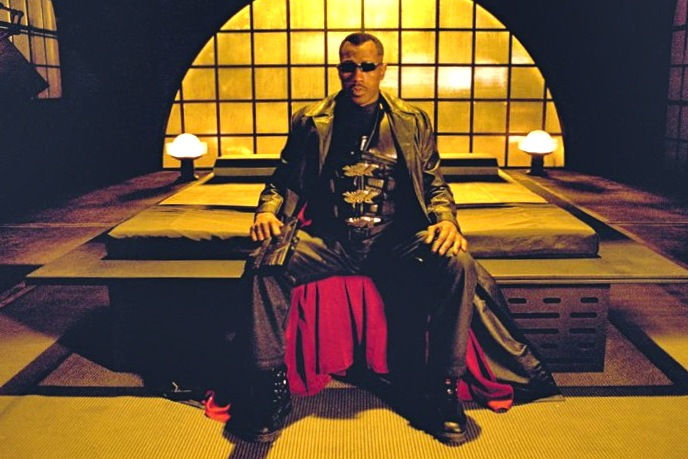
Snipes’ Blade was more than comic-accurate — he was mythic. Part samurai, part preacher, part executioner. Every swing of his sword carried purpose. Every line dripped with poise and power.
That was the moment the Daywalker stepped out of the shadows — and superhero cinema would never be the same again.
🩸 BLADE (1998)
Release Date: August 21, 1998
Director: Stephen Norrington
Writer: David S. Goyer
Box Office: $131 million worldwide on a $45 million budget

Cast:
Wesley Snipes as Eric Brooks / Blade
Kris Kristofferson as Abraham Whistler
Stephen Dorff as Deacon Frost
N’Bushe Wright as Dr. Karen Jenson
Donal Logue as Quinn
Udo Kier as Dragonetti
Traci Lords as Racquel
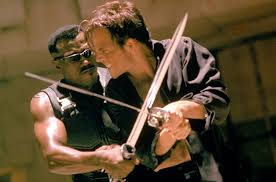
Synopsis: In a world where vampires secretly control much of society, Blade walks between two worlds — born human but with the powers of a vampire. Trained and armed by his mentor Whistler, Blade wages a one-man war against the undead.
When the ambitious vampire Deacon Frost seeks to become “La Magra,” the blood god, Blade must stop him before humanity is enslaved. Along the way, Blade forms an uneasy alliance with Dr. Karen Jenson, a hematologist he saves from turning into a vampire.
Blade’s Role: Wesley Snipes delivered a stoic, commanding performance — a blend of cold vengeance and righteous fury. His Blade wasn’t a talker; he was a force. Snipes fused martial arts precision, trench-coat style, and supernatural power to create a superhero unlike any before him.
Impact: Blade broke barriers as one of the first successful Black-led superhero films. Its R rating, techno soundtrack, and visual style defined late-90s action cinema. It set the tone for every superhero film that followed.
🗡️ Iconic Quote:
“Some mother******s are always trying to ice skate uphill.” — Blade
🗡️ BLADE II (2002)
Release Date: March 22, 2002
Director: Guillermo del Toro
Writer: David S. Goyer
Box Office: $155 million worldwide

Cast:
Wesley Snipes as Blade
Kris Kristofferson as Abraham Whistler
Ron Perlman as Reinhardt
Leonor Varela as Nyssa Damaskinos
Norman Reedus as Scud
Luke Goss as Nomak
Thomas Kretschmann as Eli Damaskinos
Donnie Yen as Snowman
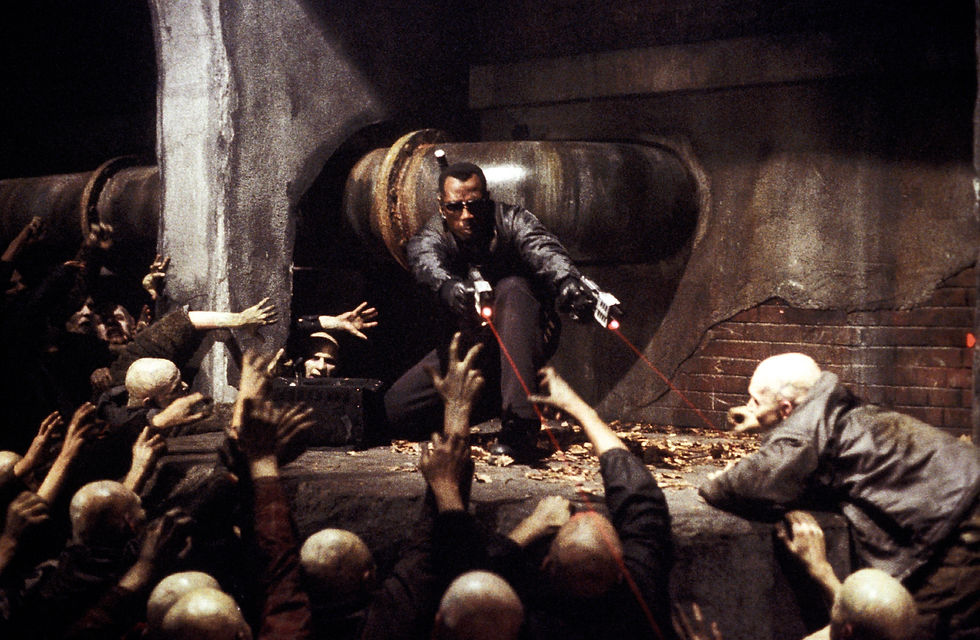
Synopsis: Two years after destroying Frost, Blade continues his crusade against vampires — only to discover a new breed of predator: the Reapers, mutated vampires who feed on their own kind and humans alike.
When the vampire council’s leader, Damaskinos, realizes the Reapers threaten everyone, he offers Blade a truce. Blade reluctantly teams up with the Bloodpack, a group of elite vampire assassins trained to kill him, to hunt down the Reapers in the sewers of Prague.
Blade’s Role: This time, Blade becomes a commander — balancing his distrust of vampires with his mission to protect humanity. Snipes deepened the character’s emotional core, exploring loyalty, loss, and identity as Blade’s partnership with Nyssa blurs the line between enemy and ally.
Impact: Director Guillermo del Toro infused gothic beauty and monstrous elegance, pushing the action-horror genre to new heights. Blade II remains a fan favorite and one of the best-reviewed Marvel films before the MCU.
🗡️ Memorable Quotes:
“I’m expecting company.”
“You obviously do not know who you’re messing with.”

🔥 BLADE: TRINITY (2004)
Release Date: December 8, 2004
Director: David S. Goyer
Box Office: $132 million worldwide

Cast:
Wesley Snipes as Blade
Jessica Biel as Abigail Whistler
Ryan Reynolds as Hannibal King
Dominic Purcell as Drake (Dracula)
Parker Posey as Danica Talos
Kris Kristofferson as Abraham Whistler
Triple H (Paul Levesque) as Jarko Grimwood
Natasha Lyonne as Sommerfield
Synopsis: Framed for murder by a vampire-controlled media, Blade becomes a fugitive hunted by the FBI. Meanwhile, a powerful vampire clan resurrects Dracula himself — known as Drake — to lead their final war on humanity.
Blade teams up with the Nightstalkers, a young team of hunters led by Abigail Whistler (Whistler’s daughter) and Hannibal King. Together, they develop a bioweapon capable of wiping out vampires once and for all — even if it costs Blade his life.
Blade’s Role: This film shows Blade as a weary warrior — burdened by loss, mistrust, and endless war. He’s a mentor now, passing his mission to a new generation. Despite behind-the-scenes challenges, Snipes’ charisma and physicality never faltered.
Impact: Though divisive, Blade: Trinity introduced Ryan Reynolds to the Marvel universe — paving his path to Deadpool. It also pushed the boundaries of hero team-ups long before The Avengers.
🩸 Quote:
“I was born ready, mother******.”

⚡ Blade’s Influence and the MCU’s Birth
After Blade: Trinity, the Daywalker’s shadow loomed large. The trilogy grossed over $418 million worldwide and revived Hollywood’s faith in comic book heroes.
When X-Men (2000) and Spider-Man (2002) became blockbusters, Marvel executives openly acknowledged Blade’s success as the proof-of-concept that made them possible.
Stan Lee often reminded fans that while he didn’t create Blade, the character’s success “saved Marvel’s reputation in Hollywood.”
Blade was the prototype of everything we now associate with Marvel:
A flawed, complex hero.
Grounded yet supernatural storytelling.
Stylish, choreographed action sequences.
Representation and cultural power.
🕶️ Blade’s Return in Deadpool & Wolverine (2024)
When fans saw Wesley Snipes’ Blade appear in Deadpool & Wolverine (2024), theaters exploded.
His return wasn’t just a cameo — it was redemption. The film marked the first time Blade, Deadpool, and Wolverine shared the screen in a Marvel property — a moment that broke records for audience reactions and online engagement.

Why It Mattered:
It honored Blade’s legacy as the first modern Marvel hero.
It connected pre-MCU history to the multiverse era.
It gave fans closure, showing Blade still fighting, still cool, still the Daywalker.
Snipes on Returning:
“Still sharp. Still got the glow.”
His appearance bridged generations — a salute to where Marvel came from and where it’s headed.
🗡️ The Blade Reboot and the Future of the Daywalker
Marvel Studios has officially confirmed a Blade reboot starring Mahershala Ali. Announced at San Diego Comic-Con 2019, the project instantly electrified fans when Ali appeared onstage wearing a Blade-branded cap — signaling the return of the Daywalker after more than 20 years.
Ali, a two-time Academy Award winner, has described Wesley Snipes’ portrayal as “untouchable,” promising to honor that legacy while forging a new path for a modern era.

Work is still being done on the film according to news reports and we'll just have to sit and wait to see if it will ever come to fruition.
💬 Famous Quotes from the Trilogy
Blade (1998):
“Some mother******s are always trying to ice skate uphill.”
“You better wake up. The world you live in is just a sugar-coated topping. There’s another world beneath it.”

Blade II (2002):
“I’m expecting company.”
“You obviously do not know who you’re messing with.”
Blade: Trinity (2004):
“I was born ready, mother******.”
“You have a nice night.”

Each line is iconic — delivered with that cold-blooded cool only Wesley Snipes could pull off.
🌍 Cultural Legacy: Blade as a Black Superhero Icon
Before Black Panther, Blade was already there — the original cinematic Black Marvel hero leading his own franchise.
He wasn’t comic relief. He wasn’t sidekick. He was the story.
Snipes’ portrayal gave Black audiences a hero who embodied pride, discipline, and confidence. His Blade was sleek, smart, and unrelenting — proof that representation and excellence can coexist with edge and grit.

✨ Final Thoughts: Light in the Dark
Blade is more than a vampire hunter — he’s a metaphor for perseverance. Half human, half cursed, fully committed to his purpose.
He was Marvel’s first modern savior — the Daywalker who proved that heroes don’t need the sun to shine.
In a world of endless reboots, Blade’s story endures because it’s about more than blood and bullets — it’s about redemption, purpose, and power.
⚡ From the Daywalker to the Soldiers of Light Against Darkness™
If you love stories where good battles darkness, where the fight is as spiritual as it is physical, you’ll find that same fire in my S.O.L.A.D.™: Soldiers of Light Against Darkness™ series.
✨ Order your autographed copies today at www.tyronetonyreedjr.com/the-shop and step into a world where faith, light, and courage are the ultimate weapons — and darkness never has the final word.


Comments