
Tony’s Timeless Thursdays™: The Boy Who Could Fly: The 1980s Fantasy Drama That Made Grief, Kindness and Wonder Feel Like Flight


Some movies become timeless because everybody saw them. Other movies become timeless because the people who did see them never forgot how they made them feel.
For me, The Boy Who Could Fly is one of those movies.
I have seen this film many times over the years, and I have enjoyed it every time because there is something so gentle, strange, emotional and unforgettable about it. It is not one of the loudest 1980s movies. It is not the biggest fantasy film of its era. It did not become a giant franchise, even though part of me wishes it had. But this 1986 fantasy drama has the kind of heart that stays with you. It whispers instead of shouts, but that whisper lasts.
This is not a movie about flying in the superhero sense, but you already know me. I am always going to find the superhero angle when a story gives me one, and The Boy Who Could Fly gives me plenty. Eric Gibb may not wear a costume, carry a secret identity or fight villains in the sky, but the idea of a lonely, misunderstood boy with an impossible gift still feels like superhero storytelling wrapped inside a tender coming-of-age drama. He is different. He is watched. He is misunderstood. He has a power the world cannot explain. And somewhere inside all that silence, pain and mystery is the possibility of something extraordinary.
That is why this movie fits beautifully into Tony’s Timeless Thursdays™. Because sometimes the most powerful heroes are not the ones announcing themselves to the world.
Sometimes they are the ones standing quietly at a window with their arms stretched out, believing they were made to rise.
A Fantasy Movie With Its Feet on the Ground
The title The Boy Who Could Fly sounds like pure fantasy, but one of the film’s most interesting qualities is how grounded much of it feels. The story follows Milly Michaelson, a teenage girl who moves with her mother and younger brother after the death of her father. This is already a heavy emotional starting point. Milly is not simply moving into a new neighborhood. She is entering a new life while still carrying the pain of what her family has lost.
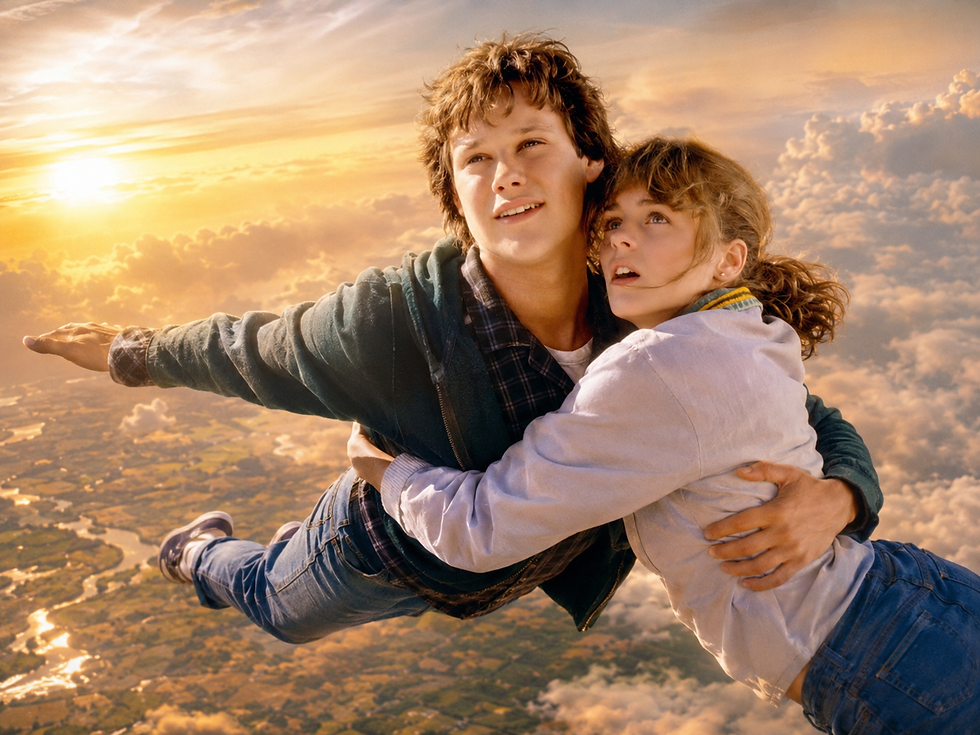
Next door lives Eric Gibb, a quiet boy who spends his days perched near his window with his arms stretched out as if he is preparing to fly. Eric does not speak, and the people around him often treat him like a mystery, a problem or a diagnosis before they treat him like a person. Milly, however, begins to see him differently. She notices him. She wonders about him. She tries to understand him. And that act of seeing becomes the emotional doorway into the film.
That is what makes the movie special. The fantasy is there, but it does not rush to explain itself. It lets wonder sit beside grief. It lets mystery sit beside everyday teenage life. It lets the possibility of flight become both a literal question and an emotional metaphor.
Can Eric fly? Can Milly heal? Can a family move forward after loss? Can kindness lift someone who has spent too long trapped inside silence?
Those questions give the movie its heart.

Milly and Eric Are the Emotional Soul of the Film
One of the reasons I have always enjoyed this movie so much is because the relationship between Milly and Eric feels tender without being forced. Their connection is built slowly through attention, compassion and trust. Milly does not treat Eric like a spectacle. She does not treat him like a problem to solve. She sees him as a person, and that simple decision changes the emotional direction of the story.
Lucy Deakins gives Milly warmth, vulnerability and strength. Milly is grieving, adjusting and trying to find her footing in a new place, but she still has enough heart to look beyond herself and notice someone else’s pain. That matters because grief can make people close inward. Milly’s grief does not make her cold. It makes her more aware of what loneliness looks like when she sees it in someone else.
Jay Underwood makes Eric mysterious, fragile and memorable. It is a difficult role because Eric does not communicate like the other characters, which means Underwood has to tell much of the story through stillness, movement, expression and presence. Eric spends so much of the movie being watched, studied, discussed or misunderstood, but Underwood keeps him from becoming just an idea. He makes Eric feel like a young man carrying something too heavy for the world around him to understand.
Together, Milly and Eric create the emotional beauty of the film. She is not simply fascinated by his gift. She is moved by his humanity. He is not simply a magical boy next door. He is someone who needs to be seen, trusted and loved beyond the labels people have placed on him. That is powerful.

Jay Underwood’s Real Superhero History Makes Eric Even More Fascinating
One of the reasons The Boy Who Could Fly feels so easy to view through a superhero lens is because Jay Underwood did not just play a mysterious boy with an impossible gift. He actually became part of superhero history more than once.
Years after playing Eric Gibb, Underwood portrayed Johnny Storm, also known as the Human Torch, in Roger Corman’s famously low-budget 1994 version of The Fantastic Four. That film was completed but never officially released, which helped turn it into one of the most talked-about “lost” superhero movies in comic book history. For fans who know about that film, there is something fascinating about realizing that the quiet boy who seemed born to fly in The Boy Who Could Fly later played one of Marvel’s most famous flying heroes.

Underwood also stepped into the DC universe when he played Mike Walker, also known as the Kryptonite Kid, in a 1991 episode of the Superboy television series. That role gave him another direct connection to superhero storytelling, this time as a character tied to one of Superman’s greatest weaknesses. So when I say The Boy Who Could Fly has a superhero spirit, Jay Underwood’s career almost seems to agree.

And the connection did not end there. Decades later, Underwood returned to the Fantastic Four legacy with a small cameo as a power plant worker in Marvel Studios’ The Fantastic Four: First Steps. Even better, he appeared alongside several of his 1994 Fantastic Four castmates, giving longtime fans a beautiful full-circle moment. It is the kind of Easter egg that rewards people who know comic book movie history beyond the mainstream hits.

That makes Eric Gibb feel even more special in hindsight. Before Jay Underwood played the Human Torch, before he entered Superboy’s world as the Kryptonite Kid and before he returned to the Fantastic Four universe decades later, he played a boy whose gift was flight. Maybe Eric was not officially a superhero, but the ingredients were already there: isolation, mystery, misunderstanding, power, wonder and the possibility that what made him different could also become what made him extraordinary.
The Sequel I Still Wish We Had Received
I have always wished The Boy Who Could Fly had received a sequel.
Not just a sequel for the sake of cashing in on a title, but a real continuation of Eric and Milly’s story. The ending leaves you with wonder, ache and possibility, and part of me has always wanted to know what happened next. I would have loved to see Eric come back for Milly. I would have loved to see them begin a life together far away from the people who tried to define, study or contain him. I would have loved to see him use his gift to help others.
That is where the superhero angle comes in.
Imagine Eric as someone who learns that his ability is not just a mystery, but a calling. Not in a flashy, comic-book blockbuster way, but in a quiet, emotional, character-driven way. He could help people in danger. He could become a symbol of hope to those who feel trapped. He could use flight not to escape the world forever, but to return to it with purpose.
And Milly would be the one who keeps him connected to humanity.
That would have been a beautiful continuation because the first movie is not really about power. It is about connection. A sequel could have explored what happens when someone with an impossible gift chooses to use it for love, healing and service instead of simply disappearing into the sky.
Maybe that is why the movie still lingers. It leaves enough room for our imagination to keep flying after the credits end.
Nick Castle Directed Something Gentle After Playing Something Terrifying
One of the fascinating facts about The Boy Who Could Fly is that it was written and directed by Nick Castle, the filmmaker who also played the original masked Michael Myers, also known as The Shape, in John Carpenter’s 1978 horror classic Halloween. That is one of those Hollywood details that almost sounds made up because the emotional contrast is so strong.

How does someone associated with one of horror’s most terrifying silent figures go on to make a tender fantasy drama about childhood grief, friendship and hope?
That contrast actually makes Castle’s work here even more interesting. In Halloween, Castle used silence and body language to create fear. In The Boy Who Could Fly, he builds a story around silence and body language again, but this time he uses them to create mystery, tenderness and emotional connection. Eric’s silence is not treated as empty. It becomes part of the way the film asks viewers to pay attention differently.
That matters because not every emotion needs a speech. Sometimes a look says enough. Sometimes a gesture carries more weight than dialogue. Sometimes the most important communication in a story happens when characters stop talking long enough to truly see each other.
Fred Savage Brings 1980s Kid Energy
Fred Savage (Kevin Arnold of The Wonder Years) plays Louis, Milly’s younger brother, and he brings a burst of rowdy 1980s kid energy to a movie that could have otherwise become very quiet and heavy. Louis is grieving too, but his grief comes out differently. He is angry, mischievous, funny, reactive and constantly caught up in neighborhood kid chaos.
His subplot with the local bullies gives the film some of its most memorable childhood mischief. It also adds a different kind of survival story. Milly is trying to understand emotional pain. Eric is trying to exist in a world that misunderstands him. Louis is trying to prove he is not weak in a neighborhood that tests him.
That is part of what makes the family dynamic work. Everybody in the Michaelson household is dealing with the father’s death in a different way. Their mother is trying to keep going. Milly is trying to feel again. Louis is trying to fight back against a world that suddenly feels unsafe.
The movie understands that grief does not look the same on everybody. Sometimes grief cries. Sometimes grief works too much.Sometimes grief becomes anger. Sometimes grief rides a bike straight into trouble because being still hurts too much.

Bonnie Bedelia Shows the Weight of a Grieving Mother
Bonnie Bedelia plays Charlene Michaelson, Milly and Louis’ mother, and her presence gives the movie an adult emotional weight. Charlene is a widow trying to hold her family together while also rebuilding her own life. She has to parent through pain, work through exhaustion and move forward before she fully feels ready.
That is a reality many family films avoid. They show children grieving, but they do not always give enough attention to the parent who is trying to be strong while barely standing. Charlene’s story matters because she represents the silent pressure adults often carry after tragedy. The children need stability. The bills still exist. The house still has to function. Life keeps demanding movement even when the heart is still sitting in the wreckage.
Bedelia gives Charlene dignity and tenderness. She is not perfect, but she is trying. That makes her feel real.

The Supporting Cast Gives the Movie Texture
The supporting cast is full of familiar and talented faces. Colleen Dewhurst brings wisdom and compassion as Mrs. Sherman, a teacher who helps give the story some of its moral grounding. Fred Gwynne, beloved by many for his work in The Munsters and later remembered by other audiences for My Cousin Vinny, plays Uncle Hugo, Eric’s troubled guardian. His role adds another layer of sadness to Eric’s world because it shows how pain can spread through a household when adults are not whole.
Mindy Cohn (Natalie Green in The Facts of Life) appears as Geneva, giving the film another recognizable young presence. Louise Fletcher, known for her Oscar-winning performance in One Flew Over the Cuckoo’s Nest, appears as a psychiatrist, which adds weight because viewers familiar with her work immediately understand that she brings seriousness to any scene.

There is even early-career energy in the cast from actors such as Jason Priestley before he became widely known through Beverly Hills, 90210. That gives the movie a time-capsule feeling. Watching it now is like opening a quiet corner of 1980s Hollywood and seeing several careers at different stages.
The Soundtrack Helped the Movie Take Flight
One of the things I have always loved about The Boy Who Could Fly is the music.
Bruce Broughton’s score gives the film a soft emotional lift. It does not overpower the story, but it helps the movie feel tender, wistful and magical. The music understands that this is not a loud fantasy adventure. It is a story about grief, wonder and hope rising slowly inside wounded people.
Then there is “Walkin’ on Air” by Stephen Bishop.
That song is such a beautiful part of the film’s identity. It has that gentle 1980s movie-magic feeling that immediately pulls you back into the emotional atmosphere of the story. It sounds like hope trying to stand up again. It sounds like the feeling of being young, hurt, unsure and still willing to believe something wonderful might be possible.
The title alone fits the movie perfectly. “Walkin’ on Air” captures the strange emotional space the film lives in. These characters are not fully free from pain, but they are not trapped in despair either. They are somewhere between heaviness and lift, between grief and healing, between earth and sky.
That is why the music matters. It helps the film float.
The Flying Is Really About Healing
The most obvious question in the movie is whether Eric can actually fly.
But the deeper question is why flight matters at all.
Flight in this movie is not just spectacle. It is not there simply because audiences want to see a boy defy gravity. Flight represents freedom. It represents escape. It represents trust. It represents the impossible thing that wounded people secretly hope might still be possible.
For Eric, flying seems connected to his longing for release from a world that has trapped, studied and misunderstood him. For Milly, the idea of flight becomes connected to grief, hope and emotional rebirth. She has lost her father. Her family has been uprooted. Her life feels heavier than it should. Eric’s impossible belief in flight challenges her to imagine that heaviness does not have to be the end of her story.
That is what good fantasy can do. It takes something impossible and uses it to tell the truth about something deeply human.

A Movie About Kindness Before Kindness Became a Hashtag
One of the strongest messages in The Boy Who Could Fly is kindness.
Not shallow kindness. Not performative kindness. Not the kind of kindness people post about but do not practice. This movie is about the kind of kindness that notices the lonely person. The kind that pays attention to the misunderstood person. The kind that asks better questions. The kind that sits beside someone without demanding they explain their pain on your schedule.
Milly’s connection with Eric grows because she does not treat him like a spectacle. She treats him like someone worthy of patience. That is a simple idea, but it is powerful.
The world often wants people to be easy to understand before it decides they are worth loving. This movie pushes against that. It says some people need time. Some people need gentleness. Some people need somebody who will stop staring and start caring. That message has not aged out.

Watching It Today Requires Heart and Context
Because The Boy Who Could Fly was made in 1986, modern viewers should watch it with both appreciation and discernment. Its emotional sincerity is real. Its compassion is real. Its desire to show kindness toward a misunderstood young person is real. At the same time, some of its handling of autism and disability may feel dated today.
That does not mean the movie has no value. It means we should engage it honestly.
Classic films do not have to be perfect to be meaningful. They can move us, teach us, challenge us and still reveal the limitations of their time. Watching older movies with context allows us to appreciate what they did well while also recognizing how storytelling, language and understanding have grown.
For this film, the heart is clear: Eric deserves to be seen as human, not dismissed as strange. Milly’s family deserves healing. Grief deserves tenderness. Kindness matters. Wonder matters. Hope matters. Those truths still fly.

Why The Boy Who Could Fly Still Matters
The Boy Who Could Fly still matters because it reminds us that people are often carrying more than we know. Milly is carrying grief. Louis is carrying anger. Charlene is carrying the burden of single motherhood after loss. Eric is carrying silence, isolation and the weight of being misunderstood.
Every major character is dealing with something. That is why the movie’s fantasy works. The flying is not just a gimmick. It becomes a picture of what everyone secretly needs: release, healing, freedom, lift.
We all know what it feels like to be weighed down by something. We all know what it feels like to wish life could rise above pain for just a moment.
This movie gives that longing a shape. A boy at a window. Arms stretched out. Believing in the impossible.

The Spiritual Bridge to S.O.L.A.D.™: Soldiers of Light Against Darkness™
One reason The Boy Who Could Fly connects beautifully to S.O.L.A.D.™: Soldiers of Light Against Darkness™ is because both stories understand that people can be carrying hidden battles long before anybody sees them as heroes.
In The Boy Who Could Fly, Eric is misunderstood, Milly is grieving and their connection becomes a reminder that compassion can lift people out of emotional darkness. The story is not about physical strength. It is about trust, courage, healing and believing there is more to someone than what the world sees on the surface.
That same kind of truth lives inside S.O.L.A.D.™. Ordinary people are called into extraordinary battles, but before they can stand against darkness, they have to face fear, pain, grief, identity, purpose and the wounds that try to keep them grounded. Angelo™ and Angeline™ do not simply represent power. They represent calling, courage and the responsibility to rise when darkness says stay down.
That is why stories like this matter. They remind us that flight is not always about leaving the ground. Sometimes flight is about rising above grief. Rising above fear. Rising above labels. Rising above what tried to break you. And choosing to believe light still has the power to lift.

Final Thoughts: Some Stories Whisper and Still Stay With You
At the end of the day, The Boy Who Could Fly remains a fascinating and heartfelt 1980s movie because it does not need to shout to be remembered.
It whispers. It reaches. It aches. It believes in the impossible without completely abandoning the pain of real life.
That is a rare balance.
This is a movie about grief, but also hope. Silence, but also connection. Fear, but also courage. Difference, but also dignity. It asks viewers to slow down, look closer and remember that the person everybody else overlooks may be carrying a story worth understanding.
That is timeless.
Because in a world quick to judge, quick to label and quick to dismiss, The Boy Who Could Fly still reminds us that kindness can be a kind of lift.
And sometimes, when someone finally feels seen, their spirit can rise higher than anyone ever expected.




Comments