
Tony’s Timeless Thursdays™: The Enduring Legend of The Karate Kid: From Crane Kicks to Cobra Kai to Legends, a Legacy That Still Strikes🥋


When The Karate Kid first hit theaters in 1984, no one could have predicted it would spark a cultural phenomenon that would still be striking nearly four decades later. What seemed like a simple underdog tale became a multigenerational epic that spanned films, sequels, cartoons, a reboot, a global Netflix series, action figures, video games, a stage musical, and, most recently, The Karate Kid: Legends — a bold effort to unite every era of the franchise into one shared continuity.
At its heart, The Karate Kid has always been more than about karate. It’s about mentorship, resilience, discipline, and learning to find balance in life. With each installment, the story evolved — sometimes leaning into melodrama, sometimes reinventing itself for new audiences — but always staying rooted in the universal truth Mr. Miyagi taught: “Karate here [points to head]. Karate here [points to heart]. Karate never here [points to fist].”
This series is one of the main reasons that I decided to take karate lessons as third grader and really miss it and wish i was still active (I only got to a yellow belt). My karate name was "The Incredible Hulk" and I won my first class fight using Daniel LaRusso's legendary crane kick.
Let’s step back onto the dojo mat and explore the legacy that began with a crane kick and grew into one of pop culture’s most enduring sagas.

🥋 The Original Classic — The Karate Kid (1984)
Directed by John G. Avildsen, who also helmed Rocky, the first Karate Kid film is widely regarded as one of the greatest sports dramas of all time.
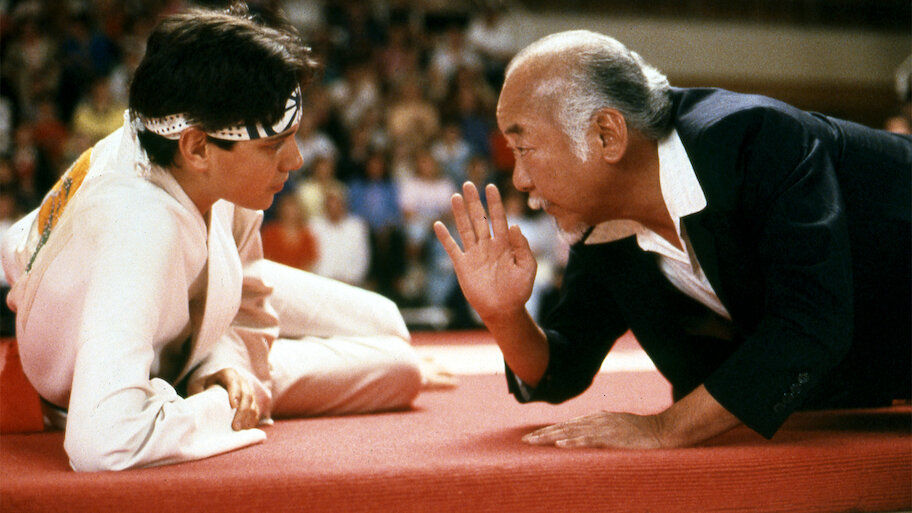
Plot & Themes: Daniel LaRusso (Ralph Macchio) relocates with his mother Lucille (Randee Heller) to Reseda, California. Struggling to adjust, he becomes the target of Cobra Kai students led by Johnny Lawrence (William Zabka), all trained under merciless sensei John Kreese (Martin Kove).
Daniel’s fortunes change when Mr. Miyagi (Pat Morita), his apartment’s maintenance man, defends him from bullies and agrees to train him. Through unorthodox tasks — waxing cars, sanding floors, painting fences — Daniel unknowingly builds reflexes, discipline, and patience.
The story crescendos at the All Valley Karate Tournament, where Daniel faces Cobra Kai’s best. In the unforgettable climax, Daniel defeats Johnny with the legendary crane kick.
Key Cast:
Ralph Macchio as Daniel LaRusso
Pat Morita as Mr. Miyagi
William Zabka as Johnny Lawrence
Elisabeth Shue as Ali Mills
Martin Kove as John Kreese
Randee Heller as Lucille LaRusso
Legacy:
Grossed $130 million worldwide on an $8 million budget.
Pat Morita received an Oscar nomination for Best Supporting Actor.
“You’re the Best Around” by Joe Esposito became a motivational anthem.
The crane kick became one of the most iconic moments in cinema history.
At its heart, The Karate Kid was never about fighting — it was about resilience, respect, and the power of mentorship.
🥋 The Karate Kid Part II (1986)
Sequels often stumble, but Part II enriched the mythology by taking the story global and digging deeper into Miyagi’s history.
Plot & Themes: Mr. Miyagi learns his father is dying, prompting a return to Okinawa. Daniel accompanies him, encountering a culture rich with history and tradition. Miyagi confronts his old rival Sato (Danny Kamekona) and rekindles his bond with Yukie (Nobu McCarthy).
Daniel falls in love with Kumiko (Tamlyn Tomita) and clashes with Chozen (Yuji Okumoto), Sato’s hot-tempered nephew. Unlike the first film, the climax is not a tournament but a fight for life at a village festival, where Daniel defeats Chozen yet chooses mercy, sparing him.

Key Cast:
Ralph Macchio as Daniel LaRusso
Pat Morita as Mr. Miyagi
Tamlyn Tomita as Kumiko
Yuji Okumoto as Chozen
Danny Kamekona as Sato
Nobu McCarthy as Yukie
Legacy:
Explored themes of forgiveness, legacy, and cultural roots.
Peter Cetera’s “Glory of Love” topped charts and earned Oscar and Golden Globe nominations.
Grossed $115 million, proving the sequel could stand tall.
🥋 The Karate Kid Part III (1989)
Though often considered the weakest of the trilogy, Part III amplified the villains and tested Daniel’s loyalty.
Plot & Themes: Cobra Kai is reeling after Kreese’s humiliation, but his friend Terry Silver (Thomas Ian Griffith), a wealthy businessman, concocts a revenge scheme. Silver manipulates Daniel, grooming him toward anger and aggression, while hiring Mike Barnes (Sean Kanan), the “bad boy of karate,” to torment him.
Miyagi refuses to train Daniel under such corrupted influences, only stepping in once Daniel realizes Silver’s deceit. At the All Valley Tournament, Daniel overcomes Barnes, reaffirming Miyagi’s philosophy of balance and restraint.

Key Cast:
Ralph Macchio as Daniel LaRusso
Pat Morita as Mr. Miyagi
Thomas Ian Griffith as Terry Silver
Sean Kanan as Mike Barnes
Martin Kove as John Kreese
Legacy: Though critically weaker, Part III has enjoyed cult status thanks to Silver’s over-the-top villainy and Barnes’s intensity. These characters would later return in Cobra Kai, earning new appreciation.
🥋 The Karate Kid Animated Series (1989)
By 1989, The Karate Kid had become such a cultural phenomenon that it leapt off the big screen and onto Saturday morning television. Originally intended for daily syndication with 65 episodes, the show was scaled back to a 13-episode order for NBC. Produced by DIC Enterprises, Saban Entertainment, and Columbia Pictures Television, The Karate Kid animated series debuted on NBC’s Saturday lineup, offering fans a fresh, globe-trotting spin on the franchise.
Key Cast:
Joey Dedio as Daniel LaRuss
Robert Ito as Mr. Miyagi
Janice Kawaye as Taki Tamurai
Pat Morita reprised his role as Mr. Miyagi by narrating the opening sequence of each episode (with the exception of Episode 8, where he directly explained the plot).
Plot & Themes: Unlike the films, which focused on karate tournaments and personal rivalries, the cartoon embraced a fantasy-adventure format. The story begins when a miniature shrine with mystical powers is stolen from Okinawa. Mr. Miyagi, Daniel, and their new ally Taki Tamurai embark on a quest across the globe to recover it.
Their journey takes them to exotic locales where they encounter villains, natural disasters, and supernatural elements — a significant departure from the grounded realism of the movies. Along the way, Miyagi’s wisdom, Daniel’s courage, and Taki’s ingenuity carry them through countless adventures.

Episode Formula: Each episode followed a consistent pattern:
Mr. Miyagi learns of a possible lead on the missing shrine.
The team travels to a new location, often encountering locals and learning about different cultures.
Villains — usually seeking to exploit the shrine’s powers — confront the group.
Daniel and Taki battle their way through with karate action sequences.
Daniel nearly recovers the shrine, only for fate to snatch it away (drifting away with balloons, swept into the ocean, etc.), ensuring the adventure continues into the next week.
Legacy: While short-lived, the series proved how popular The Karate Kid brand had become in the late ’80s. It offered kids a way to engage with Daniel and Miyagi outside of the theaters, keeping the franchise alive during a time when martial arts cartoons and toy lines were at their peak.
Today, the animated series stands as a curious but charming footnote in the saga’s history, remembered fondly by fans who grew up watching it during Saturday morning TV marathons.

🥋 The Next Karate Kid (1994)
This film attempted to pass Miyagi’s wisdom to a new generation.
Plot & Themes: Julie Pierce (Hilary Swank), a troubled teenager mourning her parents, comes under Mr. Miyagi’s wing. Through karate, Julie learns discipline, inner peace, and courage to stand against bullies — this time, a paramilitary-style school gang called the Alpha Elite.

Key Cast:
Hilary Swank as Julie Pierce
Pat Morita as Mr. Miyagi
Michael Ironside as Colonel Dugan
Legacy: The film was a commercial disappointment, but Hilary Swank’s later Oscar-winning career made this entry a historical curiosity. It also showed Miyagi’s teachings could extend beyond Daniel, emphasizing that the heart of The Karate Kid lay in mentorship.
🥋 The 2010 Reboot
The franchise found new life with a modern retelling set in China.
Plot & Themes: Dre Parker (Jaden Smith), a Detroit youth, relocates to Beijing with his mother (Taraji P. Henson). Facing bullying, Dre finds an unlikely teacher in Mr. Han (Jackie Chan), a humble maintenance worker hiding a tragic past.
The story echoes Daniel and Miyagi but adapts it to kung fu traditions, rich in Chinese culture and philosophy. The final showdown mirrors the tournament arc, with Dre triumphing through perseverance and discipline.

Key Cast:
Jaden Smith as Dre Parker
Jackie Chan as Mr. Han
Zhenwei Wang as Cheng
Taraji P. Henson as Sherry Parker
Legacy:
Grossed $359 million worldwide.
Sparked debate over “kung fu vs. karate,” but expanded the franchise globally.
Introduced a younger generation to the themes of resilience and respect.
🥋 Cobra Kai (2018–present)
The franchise’s revival series reignited global passion.
Plot & Themes: Initially a YouTube series, Cobra Kai exploded after moving to Netflix. The series shifts perspective to Johnny Lawrence, reimagined as a flawed anti-hero trying to redeem himself by reopening Cobra Kai dojo. His rivalry with Daniel reignites, but the series slowly steers them toward uneasy alliance.

Key Cast (New & Legacy):
William Zabka as Johnny Lawrence
Ralph Macchio as Daniel LaRusso
Martin Kove as John Kreese
Thomas Ian Griffith as Terry Silver
Yuji Okumoto as Chozen
Xolo Maridueña as Miguel Diaz
Mary Mouser as Samantha LaRusso
Jacob Bertrand as Hawk
Peyton List as Tory Nichols
Legacy:
Earned multiple Emmy nominations.
Blended nostalgia with modern teen drama.
Revived legacy characters while elevating new heroes and villains.
Cobra Kai proved The Karate Kid is not just an ’80s memory — it’s a living, evolving saga.
🎭 The Karate Kid: The Musical (2022)
The saga even took to the stage.
Plot & Style: The musical reimagined the 1984 story, blending Broadway-style show tunes with martial arts choreography. Directed by Amon Miyamoto and featuring music by Drew Gasparini, it retained the emotional beats of Daniel, Miyagi, and the All Valley Tournament, but with stylized fight-dance numbers and power ballads.

Legacy:
Premiered in St. Louis before Broadway plans.
Praised for innovative staging, though some critics called it overly nostalgic.
Proved the franchise’s adaptability to any medium — from screen to stage.
🥋 The Karate Kid Legends (2025)
This film finally merged the original saga with the 2010 reboot into one unified timeline.
Plot & Themes:The Karate Kid: Legends united the original films with the 2010 reboot. Daniel LaRusso (Ralph Macchio) and Mr. Han (Jackie Chan) meet when Li Fong (Ben Wang), a troubled teen, seeks guidance. Initially clashing, Daniel and Han realize their philosophies can coexist — Miyagi-Do and Han’s kung fu working side by side.
This film acknowledges Kreese’s shadow, Daniel’s legacy, and Han’s wisdom, creating a true generational handoff. It canonically merges both eras, ensuring the franchise is one continuous universe.

Key Cast:
Ralph Macchio as Daniel LaRusso
Jackie Chan as Mr. Han
Ben Wang as Li Fong
Appearances from Cobra Kai cast members
Legacy: For the first time, fans of both the originals and the reboot could share a unified timeline. Legends honored the past while positioning the franchise for future storytelling.
🎶 Soundtracks That Stuck
You’re the Best Around — iconic tournament anthem. (One of my go to motivational songs)
Glory of Love — Part II’s love theme, Oscar-nominated. (One of my favorite love songs.)
Cruel Summer — perfectly captured ’80s teen angst.
Cobra Kai soundtrack — modern synth blended with retro flair.
🎮 Video Games
The Karate Kid (NES, 1987) Loosely based on The Karate Kid (1984) and The Karate Kid Part II (1986), this side-scrolling action game put players in control of Daniel LaRusso. The game starts with the All Valley Tournament before moving to Okinawa, echoing the films’ stories. It was primitive by today’s standards, but for kids of the ’80s, it was the first chance to “be Daniel-san” and crane kick their way to victory.
Cobra Kai: The Karate Kid Saga Continues (2020) Released for PlayStation 4, Xbox One, Nintendo Switch, and PC, this side-scrolling beat ’em up let fans play as Daniel, Johnny, Miguel, Hawk, and others. With light RPG mechanics, upgrade systems, and branching dojo paths (Miyagi-Do vs. Cobra Kai), it gave players a nostalgic yet modern arcade-style experience while expanding the Cobra Kai story.
Cobra Kai: Card Fighter (Mobile, 2021) Launched on iOS and Android, this spin-off took the universe into collectible card game territory. Players battled by building decks featuring iconic characters, using special moves, and strategizing in fast-paced fights. It tapped into the mobile gaming boom and broadened the brand’s reach.
Cobra Kai 2: Dojos Rising (2022) Expanding on the 2020 brawler, Dojos Rising focused on dojo-building and territory control. Players could recruit students, challenge rival dojos, and build their reputation across the Valley. With an expanded roster, multiple game modes, and the ability to shape your dojo’s destiny, it added depth to the franchise’s video game library.
The Karate Kid: Street Rumble (2024) The newest entry, released on September 20, 2024, for PS4/PS5, Xbox Series X|S, Nintendo Switch, and PC. A retro-inspired 2D pixel-art beat ’em up, Street Rumble takes players through 12 levels spanning the original trilogy’s iconic locations — West Valley High, Cobra Kai Dojo, All Valley Tournament, Okinawa, and more. Featuring local co-op play, stylized art, and a heavy dose of nostalgia, it’s the modern fan’s chance to relive Daniel’s journey in arcade fashion.

🧸 Action Figures & Merchandise
Remco Figures (1986): Daniel, Johnny, Miyagi with karate “action features.”
Playsets: All Valley Tournament ring an Hernd training equipment.
Modern Collectibles: Funko Pops, Icon Heroes, NECA figures, Halloween costumes, and headbands.

Merchandise ensured that kids could crane-kick their way through living rooms everywhere.
🌟 Cultural Impact & Legacy
Redefined martial arts in American cinema.
Cemented Mr. Miyagi as one of cinema’s greatest mentors.
Showed nostalgia’s power when Cobra Kai revived interest.
Expanded into stage, video games, and collectibles, proving adaptability.
✨ Final Thoughts
The Karate Kid is no longer just a film — it’s a multi-platform legacy. From Daniel’s crane kick to Cobra Kai’s redemption arcs, from Miyagi’s wisdom to Han’s kung fu, from silver-screen tournaments to Broadway stages, this saga continues to teach that true strength comes from balance, humility, and perseverance.
“Man who catch fly with chopstick… can accomplish anything.”— Mr. Miyagi
Over 40 years later, audiences are still learning from his wisdom. And the story? Still striking first.



Comments