
Tony’s Superhero Saturdays™: Blade: The Daywalker Who Made Darkness Afraid

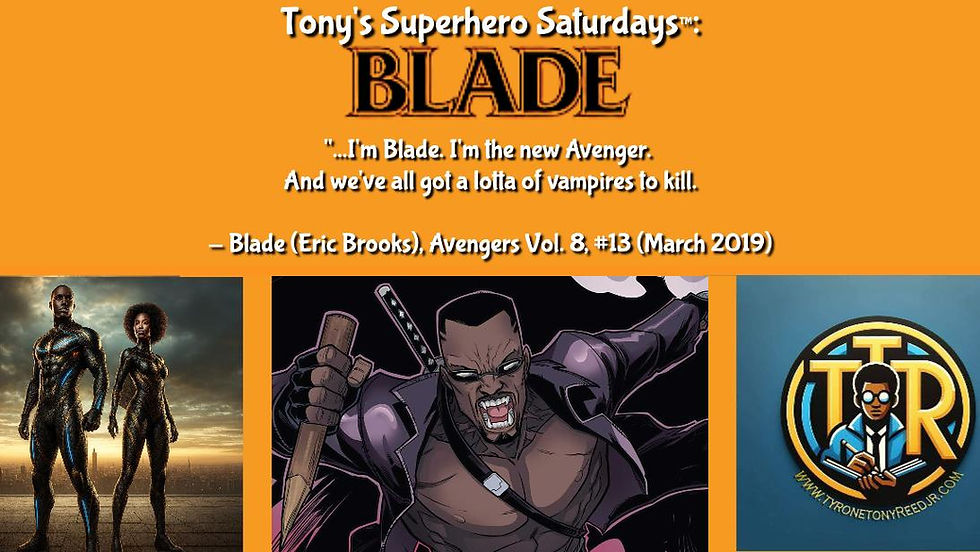
On a birthday weekend, it feels right to spotlight a hero who does not just survive darkness, but learns how to hunt it.
Blade is one of the coolest superheroes ever created, but his coolness is not shallow. The shades, the sword, the leather, the swagger, the martial arts, the vampire-slaying confidence — all of that is unforgettable. But underneath the style is a deeper truth: Blade is a man born into darkness who refused to belong to it. He carries the blood of the thing he fights, but he does not let that blood define his soul.
That is what makes him powerful.
Blade is not just Marvel’s vampire hunter. He is the Daywalker, the one who can move through the night without being consumed by it. He is the monster’s nightmare, the shadow inside the shadows, the man who proves that your origin does not have to become your destiny. Marvel describes Blade as “the Daywalker,” a hunter with vampire strengths and few of their weaknesses, driven by the mission of destroying the undead who prey on innocent life.
For Tony’s Superhero Saturdays™, Blade is a perfect spotlight because his story connects directly to something bigger than horror and action. It is about identity. It is about discipline. It is about fighting darkness with purpose. It is about becoming dangerous to the very thing that tried to claim you.

Who Is Blade?
Blade, whose real name is Eric Brooks, first appeared in Tomb of Dracula #10 in 1973. He was created by writer Marv Wolfman and artist Gene Colan, and from the beginning, he was different from most heroes in the Marvel Universe. He was not wearing a bright costume. He was not chasing fame. He was not trying to be accepted by the world. Blade entered the story as a vampire hunter, a man with a mission sharpened by pain, purpose and survival. Marvel’s own history notes that Blade debuted in Tomb of Dracula #10 by Wolfman and Colan.
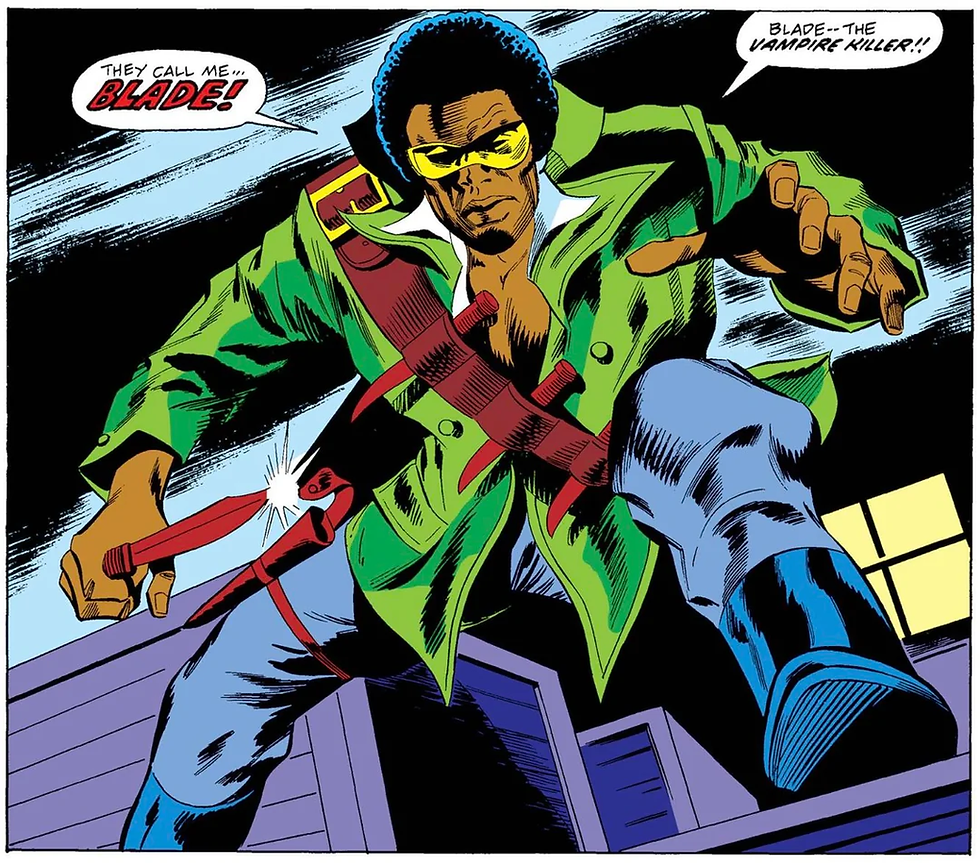
His origin is tragic and unforgettable. Eric Brooks’ mother was attacked by a vampire while giving birth to him, and that attack changed him forever. In many versions, this left Blade with unusual abilities and a lifelong connection to the vampire world. Later stories expanded his powers, especially after an encounter with Morbius the Living Vampire, giving him more of the vampire strengths that made him the Daywalker fans know today.
That origin matters because Blade’s life begins with violation, loss and darkness. He does not choose the world he is born into. He does not choose the pain that shapes him. But he does choose what he becomes. He could have surrendered to bitterness. He could have become what he hated. Instead, he turned his pain into precision and his curse into a calling.
Blade is powerful because he is a walking contradiction. He is part vampire, but he hunts vampires. He is tied to darkness, but he protects humanity. He lives on the edge of monsterhood, but he refuses to let the monster win. That tension is what makes him more than a cool character. It makes him a symbol.
The Daywalker: A Hero Between Two Worlds
The name Daywalker carries weight because it speaks to Blade’s unique place in the Marvel Universe. Vampires are creatures of the night, bound by hunger, secrecy and weakness to sunlight. Blade breaks that rule. He can stand where they cannot. He can move in the daylight and still enter the darkness when the mission demands it.
That makes him more than a vampire hunter. It makes him a bridge between worlds.
Blade understands the monsters because part of their world lives in him. He knows their hunger, their arrogance, their cruelty and their systems. But he also understands humanity because that is the side he chooses to defend. That choice is everything. Blade’s heroism is not clean or comfortable. It is forged in the tension between what he is and what he refuses to become.

That is why Blade’s story connects so strongly to themes of identity. Many people know what it feels like to carry something painful, something inherited, something they did not ask for. Blade says that what you carry does not have to control where you go. He is proof that a person can be born into darkness and still become a weapon of light.
Blade in the Comics: Marvel’s Monster Hunter With a Mission
Blade’s comic book history begins in horror, and that is important. Before he became a major movie icon, Blade was part of Marvel’s supernatural corner. He fought vampires, crossed paths with Dracula and moved through stories where the threats were not just criminals or aliens, but creatures tied to fear, blood, death and the unseen.
That horror foundation gave Blade a different flavor from many Marvel heroes. Spider-Man swings through the city. Captain America stands as a symbol of national ideals. Iron Man builds armor to face impossible threats. Blade walks into crypts, clubs, alleys, temples and vampire nests with one goal: end the evil feeding on innocent people.
Over time, Blade became connected to Marvel’s larger supernatural world, including characters like Morbius, Doctor Strange, Ghost Rider, Werewolf by Night and other heroes who deal with things that crawl out of nightmares. That makes Blade essential because every universe needs someone willing to fight what others do not even want to acknowledge exists.
Marvel has continued to keep Blade relevant in major comic events, including vampire-centered stories such as Blood Hunt, where the world faces a terrifying undead threat. Marvel promoted Blood Hunt as a story that would push Blade and his allies to their limits against a united vampire threat.

That is Blade’s lane. He is not just fighting one villain. He is fighting an infection of darkness.
Wesley Snipes and the Movie That Changed Everything
For a generation of fans, Blade is Wesley Snipes.
When Blade hit theaters in 1998, it did more than introduce audiences to a darker Marvel hero. It changed the trajectory of comic book movies. Directed by Stephen Norrington and starring Wesley Snipes as Eric Brooks, Blade gave audiences a stylish, martial arts-driven, vampire-slaying action film that felt unlike anything Marvel had put on the big screen before.
The impact cannot be overstated. Before the MCU, before X-Men, before Sam Raimi’s Spider-Man, before Marvel Studios became a global machine, there was Blade. Marvel itself has described Blade as “the first of this modern age of comic book movies,” noting that the 1998 film earned more than $130 million at the box office and led to two sequels.
That matters, especially for Black superhero history.
Wesley Snipes did not just play Blade. He embodied him. He brought martial arts skill, cool restraint, intensity, physical confidence and a presence that made audiences believe vampires should be afraid. He made Blade feel lethal without making him empty. He gave the character weight, style and cultural force.

The opening blood rave scene alone became iconic. The vampires are partying in darkness, drenched in arrogance and blood, thinking they own the night. Then Blade walks in. No panic. No fear. No wasted motion. Just a man entering a room full of monsters like he already knows the ending.
That is superhero cinema.
Why Blade Was a Black Superhero Milestone
Blade’s success matters because Black superheroes have not always been given the same opportunities to lead, dominate or define popular culture. In 1998, Wesley Snipes gave audiences a Black Marvel hero who was not a sidekick, not comic relief and not simply part of an ensemble. He was the lead. He was the center. He was the reason people bought the ticket.
That representation hit differently.
Blade was cool without apology. Dangerous without being reduced to stereotype. Stylish without being shallow. He was not asking permission to exist in the superhero space. He kicked the door open wearing black leather and carrying a sword.
For Black superhero fans, that matters. Long before many mainstream conversations about representation became common, Blade had already shown that a Black-led comic book movie could work. It could be profitable. It could be stylish. It could be influential. It could change the game.

And it did.
The fact that Marvel’s modern film success owes part of its foundation to Blade should never be forgotten. The Daywalker helped prove that audiences were ready for comic book movies with edge, mythology and attitude. He helped clear the path others would later walk.
Blade II: Bigger Monsters, Bigger Mythology
Blade II, directed by Guillermo del Toro and released in 2002, expanded the world in a major way. It brought Blade into an uneasy alliance with vampires to fight the Reapers, a more dangerous mutation that threatened both humans and vampires. That setup worked because it forced Blade into an uncomfortable position: cooperating with the very creatures he was born to destroy.
That kind of tension is exactly what makes Blade interesting. He does not trust easily. He does not forget what vampires are capable of. But he is also strategic enough to recognize when a greater threat requires temporary cooperation. That is not weakness. That is discipline.
The sequel also deepened the monster-movie energy. Del Toro’s visual style brought grotesque beauty, creature horror and gothic action to the franchise. The Reapers were not glamorous vampires. They were hunger unleashed. They made the vampire world feel vulnerable, which made Blade’s role even more important.

Blade was no longer just hunting monsters. He was navigating a war inside the darkness.
Blade: Trinity and the Franchise’s Complicated Turn
Blade: Trinity arrived in 2004 and took the franchise in a different direction, introducing the Nightstalkers and bringing Dracula, also called Drake, into the story. The film starred Wesley Snipes alongside Ryan Reynolds and Jessica Biel, and while it has developed a complicated reputation, it still added to the larger Blade mythology on screen.
The idea behind the film had potential. Blade facing Dracula should feel monumental because Dracula represents the ancient source of vampire terror, while Blade represents the modern weapon created to end that terror. That conflict should be mythic: the first great vampire against the Daywalker.
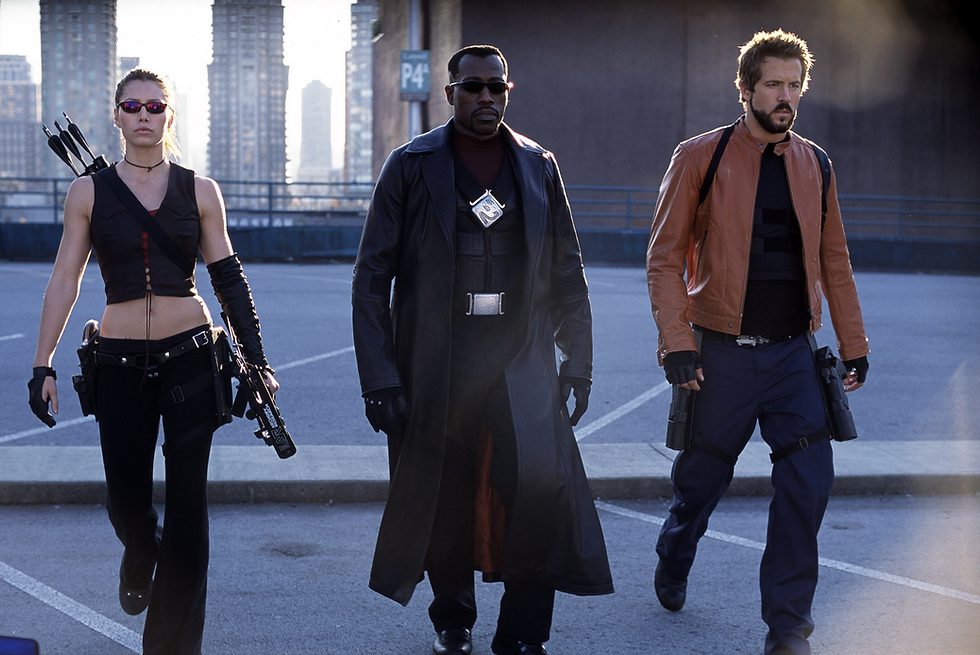
Even with its flaws, Trinity still reminds us why Blade works. He does not need a perfect movie to remain compelling. He is compelling because his mission is clear. The world is full of monsters. Somebody has to hunt them. Blade is the one who does.
Wesley Snipes Returns in Deadpool & Wolverine
Nearly 20 years after Blade: Trinity, Wesley Snipes shocked fans by returning as Blade in Deadpool & Wolverine. His appearance was more than a cameo. It was a celebration, a reminder and a victory lap for the man who helped prove Marvel characters could dominate the big screen before the MCU even existed.
That return mattered because Snipes did not simply come back as a familiar face. He came back as the Blade. The swagger was still there. The shades were still there. The confidence was still there. And for fans who understood what his version of Blade meant to superhero cinema, seeing him step back into the role felt like history walking through the door with a sword in its hand.
His return also made real-world history. Guinness World Records recognized Snipes for the longest career as a live-action Marvel character at 25 years and 340 days, measured from his first appearance as Blade in 1998 to Deadpool & Wolverine in 2024. Guinness also reported that his return set a record for the longest gap between character appearances in Marvel films, coming 19 years and 231 days after Blade: Trinity.

That moment reinforced what fans already knew: Wesley Snipes’ Blade is not just part of Marvel history. He is one of the pillars that helped build it. Even in a movie full of multiverse surprises, his return carried special weight because Blade was never just another cameo. He was the Daywalker coming back to remind everyone who made the darkness afraid first.
Blade on Television: The Spike Series
Blade also made the jump to live-action television with Blade: The Series, which aired on Spike in 2006 and starred Kirk “Sticky Fingaz” Jones as Blade. The series continued the vampire-hunting concept while exploring vampire houses, underground power structures and the idea that the war against vampires was more organized and political than ordinary people realized.
Sticky Fingaz brought a different energy to the character. His Blade was colder, rougher and more street-edged. The series did not last long, but it deserves recognition because it showed that Blade’s world could support ongoing storytelling. The vampire underworld has enough politics, betrayal, history and danger to work beyond film.

That is one of the reasons Blade remains such a strong character. His mythology is not limited to one villain or one setting. Wherever darkness organizes itself, Blade has a reason to appear.
Blade in Animation and Anime
Blade has also appeared in animation, including Marvel animated projects where he crosses paths with other heroes and supernatural threats. One of the most notable animated projects was Marvel Anime: Blade, produced by Madhouse and released in 2011. The series followed Blade through a vampire-hunting story with anime style, global stakes and a darker tone. It was the first animated series focused specifically on Blade.

That anime version is important because Blade’s style naturally fits animation. His speed, swordplay, monster battles and supernatural atmosphere all translate well into a visual medium that can exaggerate motion and mood. Anime also allows Blade’s world to feel more international, showing that vampire evil is not confined to one city or one country.
Blade has also appeared in animated series connected to Spider-Man and other Marvel heroes, reinforcing his place in the wider Marvel Universe. Those appearances matter because they introduce younger viewers to a hero who operates in the shadows but still belongs in the same universe as the Avengers, the X-Men and other major Marvel icons.

Blade may work best at night, but his legacy does not stay hidden.
The MCU Reboot and Mahershala Ali
The long-discussed Marvel Studios Blade reboot has become one of the most watched development stories in modern superhero film. Mahershala Ali was announced as Blade in 2019, and fans immediately understood why that casting mattered. Ali is an Oscar-winning actor with the presence, restraint and intensity to bring a new kind of depth to Eric Brooks.
But the reboot has faced delays, creative changes and uncertainty. Reporting has noted that the project was removed from Marvel’s release calendar, while Marvel leadership has also indicated continued interest in the character. More recent reports have suggested ongoing uncertainty around the solo reboot’s future, though those reports remain unconfirmed unless Marvel officially announces a change.
That uncertainty does not weaken Blade’s legacy. If anything, it proves how difficult the character is to get right. Blade cannot simply be dropped into a generic superhero formula. He needs atmosphere. He needs horror. He needs style. He needs danger. He needs a world where darkness feels real enough for his mission to matter.
Mahershala Ali could still be a powerful Blade if Marvel finds the right vision. But whether the reboot arrives soon or later, Wesley Snipes’ legacy remains untouchable, and the character’s importance remains secure.

Blade does not need permission to matter. He already changed the game.
Blade and the Midnight Sons Energy
One of the most exciting possibilities for Blade’s future is his connection to Marvel’s supernatural heroes. Fans have long imagined him as part of a larger supernatural team, often connected to the Midnight Sons concept. That kind of direction makes sense because Blade is most powerful when surrounded by threats that feel ancient, cursed and spiritually dangerous.
A Marvel supernatural corner featuring Blade, Ghost Rider, Moon Knight, Werewolf by Night, Elsa Bloodstone, Man-Thing, Doctor Strange or other dark-side Marvel characters could open the door to a different kind of superhero storytelling. Not every Marvel story needs to be bright, cosmic or comedic. Some stories need moonlight, blood, haunted history and heroes who know what it means to fight things that do not stay dead.

Blade belongs there.
He is the character who can walk into that darkness without flinching. He does not need to be convinced monsters are real. He has been killing them his whole life.
Blade’s Weapons, Style and Discipline
Blade’s weapons are part of his identity, but what makes them work is his discipline. The sword, the firearms, the stakes, the silver, the martial arts and the tactical gear all communicate one thing: Blade prepares. He does not stumble into the fight. He trains for it. He studies it. He sharpens himself for it.
That discipline is one of his most heroic qualities.
Many heroes react when danger appears. Blade hunts danger before it reaches innocent people. He understands that darkness is organized, patient and hungry, so he becomes even more disciplined. That is why he is terrifying to vampires. He is not just strong. He is focused.

There is a lesson in that. You do not defeat darkness by being casual. You defeat it by preparing your mind, strengthening your body, sharpening your spirit and refusing to let fear make your decisions. Blade is cool because he is controlled. He is dangerous because he is disciplined.
What Blade Represents
Blade represents the refusal to be claimed by darkness. That is the heart of him.
He could have become what he hunts. He could have let his origin define him. He could have surrendered to the hunger, rage and isolation that follow him. But he chooses the fight. Again and again, he chooses humanity, even when he does not fully feel accepted by it.
That is powerful because many people know what it means to feel caught between worlds. Blade is not fully human in the way others are, but he is not willing to be a monster either. He lives in the tension, and that tension becomes his mission.
He also represents the power of turning pain into protection. The wound that shaped him becomes the reason he fights for others. That does not make the wound good. It means Blade refuses to let evil have the final word.

That is heroic.
The Birthday Connection: Another Year, Another Battle Won
On a birthday, it is easy to think only about celebration, but birthdays also carry reflection. They remind us of what we have survived, what we have learned and what we are still fighting to become.
That is why Blade fits this moment.
He is a survivor. He is a fighter. He is a man who knows darkness personally and still refuses to bow to it. He reminds us that another year of life is not just another number. It is another victory over everything that tried to stop you, drain you, discourage you or pull you into the dark.
At 44, this spotlight lands with purpose. It says the fight is not over, but neither is the mission. There are still stories to write. There is still light to carry. There is still darkness to confront. There is still purpose in the blade God placed in your hand.
Blade teaches us that you can come from pain and still become powerful. You can walk through darkness and still not belong to it. You can be marked by the fight and still keep fighting for something bigger than yourself.

That is birthday energy.
Final Reflection: Make Darkness Afraid
Blade’s legacy is bigger than vampires. His legacy is about what happens when someone born into darkness refuses to become darkness.
He is one of Marvel’s coolest heroes, one of Black superhero cinema’s most important figures and one of the characters who helped prove that comic book movies could dominate the modern box office. But beyond the shades, the sword and the action scenes is a deeper truth: Blade is a protector.
He fights the things that hunt in secret. He confronts evil that hides behind glamour, power and fear. He walks into rooms full of monsters and reminds them that the night does not belong only to them.
That is why Blade still matters.
Because every generation needs heroes who can face darkness without being swallowed by it. Every generation needs warriors who know the enemy but refuse to become the enemy. Every generation needs somebody willing to stand at the edge of the night and say, “Not today.”

Blade is that hero. The Daywalker. The vampire hunter. The Black Marvel icon. The man who made darkness afraid.
Order autographed copies of S.O.L.A.D.: Soldiers of Light Against Darkness™ at www.tyronetonyreedjr.com/the-shop — because the greatest heroes do not just survive darkness… they become light sharp enough to cut through it.


Comments