
Tony’s Timeless Thursdays™: The Woman King: Power, Courage, and the Legacy of the Agojie

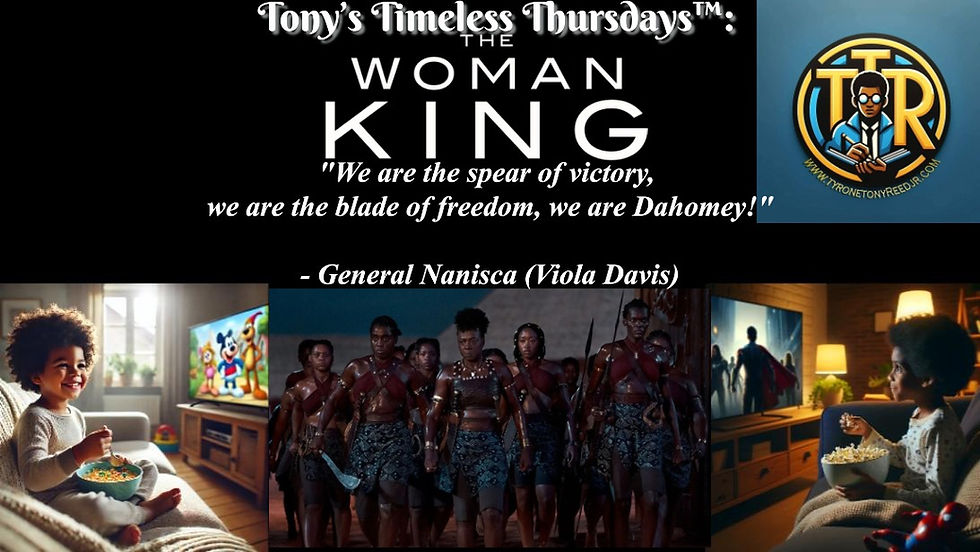
Every now and then, a film arrives that does more than entertain.
It educates.
It challenges assumptions.
And it shines a spotlight on a chapter of history many people never knew existed.
That’s exactly what The Woman King accomplished when it debuted in theaters. The film tells the remarkable story of the Agojie—an elite unit of female warriors who protected the African Kingdom of Dahomey during the 18th and 19th centuries.
This 12th day of Women’s History Month, The Woman King stands as a perfect reminder that history is filled with extraordinary women whose courage shaped the world—even if their stories were overlooked for generations.
And once you learn about them, you realize something powerful:
These women were not supporting characters in history.
They were the warriors.
The Real History Behind the Film
The story of The Woman King is rooted in the real history of the Kingdom of Dahomey, located in what is now modern-day Benin in West Africa.
Beginning in the 1600s and continuing into the late 1800s, Dahomey maintained one of the most formidable military forces on the African continent.
Among those soldiers was a remarkable fighting unit known as the Agojie—an all-female regiment trained in combat, strategy, and discipline.
European observers later referred to them as the “Dahomey Amazons,” though that nickname oversimplified their identity.
These women were not mythological figures.
They were real warriors who trained relentlessly and defended their kingdom with unmatched ferocity.
They served as bodyguards to the king, elite soldiers in battle, and symbols of national strength.
Their presence challenged the assumptions many cultures held about the role of women in warfare.
And yet, for generations, their story remained largely absent from mainstream historical conversations.
That’s what makes The Woman King so important.
It brings their legacy into the light.
The Heart of the Film: Nanisca
At the center of the film is General Nanisca, played by the incredible Viola Davis.
Nanisca is the leader of the Agojie warriors—strong, disciplined, and deeply committed to protecting her people.
But what makes her character so compelling is not just her physical strength.
It’s her emotional depth.
Nanisca carries the scars of trauma, the weight of leadership, and the burden of protecting younger women entering the warrior ranks.
She is both a commander and a mentor.
A warrior and a protector.
Through her leadership, we see how strength can coexist with compassion.
And that duality is what gives the character such profound humanity.
The Journey of Nawi
Another powerful character in the story is Nawi, portrayed by Thuso Mbedu.
Nawi begins the film as a rebellious young woman unwilling to accept the expectations society places upon her.
Her defiance leads her into the ranks of the Agojie, where she undergoes intense training.
What follows is one of the most compelling character arcs in the film.
Through discipline, struggle, and mentorship, Nawi evolves from a stubborn outsider into a determined warrior.
Her story reminds viewers that greatness often begins with resistance—the refusal to accept limitations placed upon you by others.
Sisterhood in Battle
One of the most beautiful aspects of The Woman King is the way it portrays sisterhood.
These women fight together.
Train together.
Protect one another.
And when they step onto the battlefield, they move as a unified force.
The film shows that strength is not just an individual trait.
It can also be collective.
The Agojie were powerful not simply because they were skilled warriors, but because they trusted one another completely.
That bond made them nearly unstoppable.
A Celebration of African History
For many viewers, The Woman King was their first introduction to the Kingdom of Dahomey and the Agojie warriors.
Hollywood has historically focused on European narratives when telling stories about the past.
But African civilizations possess rich histories filled with political complexity, military strategy, and cultural achievement.
Films like The Woman King help expand the global understanding of that history.
They remind audiences that African history is not just about colonial encounters.
It is about powerful kingdoms, sophisticated societies, and remarkable leaders.
And the Agojie were among the most formidable warriors of their time.
The Importance of Representation
One of the reasons The Woman King resonated so strongly with audiences is representation.
For generations, stories about warriors and military heroes have overwhelmingly centered on men.
But history tells a different story.
Women have fought in wars.
Led revolutions.
Protected communities.
And shaped the course of nations.
Seeing women—particularly Black women—portrayed as warriors, strategists, and leaders sends a powerful message.
It expands the cultural imagination.
Young viewers watching this film see something extraordinary:
Women who refuse to be defined by society’s limitations.
Women who lead.
Women who fight.
Women who change history.
Viola Davis’s Transformative Performance
The dedication of Viola Davis to this role deserves special recognition.
To portray Nanisca, Davis underwent intense physical training, building strength and endurance to convincingly embody a battle-hardened general.
But the performance goes beyond physicality.
She captures Nanisca’s vulnerability, wisdom, and emotional scars.
Her portrayal gives the character a sense of lived experience.
The result is a performance that feels authentic and unforgettable.
It’s the kind of role that reminds audiences why Davis is one of the most respected actors working today.
Lessons from The Woman King
What makes The Woman King timeless are the themes it explores.
The film speaks to:
Courage in the face of adversity. The power of mentorship. The importance of unity. The resilience of women who refuse to be silenced.
These lessons resonate far beyond the historical setting of the film.
They apply to modern struggles for equality, recognition, and opportunity.
And they remind us that strength is not defined by gender.
It is defined by character.
Why This Film Matters for Women’s History Month
Women’s History Month is about more than remembering the past.
It is about reclaiming stories that were overlooked.
It is about celebrating pioneers whose courage helped shape the world we live in today.
The Woman King does exactly that.
It resurrects the story of the Agojie and introduces their legacy to a global audience.
And in doing so, it honors the countless women throughout history who fought—literally and figuratively—for their people.
Timeless Stories Inspire Future Generations
That’s why I love highlighting films like this on Tony’s Timeless Thursdays™.
Because great stories inspire us.
They challenge our assumptions.
They remind us that history is far richer and more complex than we often realize.
And they encourage new generations to look deeper into the past.
The Agojie warriors remind us that courage has many faces.
Sometimes it looks like a general leading soldiers into battle.
Sometimes it looks like a young woman refusing to accept the role society assigned her.
But every act of courage pushes history forward.
Final Thoughts
The Woman King is more than a historical action film.
It is a celebration of strength, resilience, and the indomitable spirit of women who refused to be forgotten.
Their story deserves to be told.
Their courage deserves to be remembered.
And their legacy deserves to inspire future generations.
Today the Agojie warriors stand as a powerful reminder that history is filled with extraordinary women whose bravery changed the world.
And sometimes, the most powerful warriors in history were queens.


Comments