Tony’s Timeless Thursdays™: The Matrix Revolutions — The Cost of Peace, The Power of Sacrifice
- Tyrone Tony Reed Jr.

- Apr 23
- 13 min read

Most finales promise answers.
The Matrix Revolutions does something far more unsettling—it forces you to confront the cost of those answers. Because by the time this story reaches its end, the question is no longer who wins the war. The question is what it takes to end it… and whether that ending is something anyone is truly ready for.
By this point, the illusion has already been shattered. The prophecy has been exposed. Control has revealed itself in ways no one expected. And yet, the conflict remains. Not just between humans and machines, but between purpose and choice, logic and emotion, sacrifice and survival. Revolutions doesn’t rush to resolve these tensions—it leans into them, stripping everything down to one final truth: peace is never free, and the deeper the war, the greater the price required to end it.
🎬 The Plot — Two Wars, One Choice
The Matrix Revolutions unfolds across two battlefields that mirror one another in intensity, urgency, and consequence. In the real world, Zion stands on the brink of total annihilation as wave after wave of sentinels descend upon the last human city. This is no longer a distant threat whispered about in strategy rooms—it is immediate, violent, and unavoidable. The machines are no longer calculating from afar; they are at the gates, relentless and overwhelming, forcing humanity into a fight that cannot be won through strength, firepower, or sheer will alone. Every moment in Zion carries weight, because every moment could be its last.
At the same time, within the Matrix, a different kind of war is being waged—one that is far more dangerous because it threatens the very fabric of the system itself. Agent Smith has evolved beyond his original purpose, no longer functioning as an agent of order but as a force of unchecked chaos. He spreads without limitation, copying himself endlessly, consuming everything in his path until identity, control, and structure begin to collapse under the weight of his existence. What once was a tool of the system has now become its greatest threat, blurring the line between enemy and necessity.
Caught between these two collapsing worlds, Neo becomes something more than a hero—he becomes the connection between them. Physically blinded yet spiritually awakened, he begins to see beyond what others can perceive, recognizing that the war cannot be won through destruction alone. His journey to the Machine City is not one of conquest, but of confrontation. He does not go to defeat the machines in the traditional sense; he goes to face the truth at its source and offer something neither side has been able to achieve on its own: resolution.
And that is where the story shifts.
Because the final battle is not about who is stronger. It is about who is willing to give more.
And the solution that emerges is not built on power…but on sacrifice.
🎭 The Cast — Final Transformations, Final Truths
By the time The Matrix Revolutions begins, the performances are no longer rooted in discovery—they are grounded in resolution. The questions that once defined these characters have already been asked, and now each of them must live with the answers. What makes this final chapter so compelling is not just what these characters do, but what they understand. The uncertainty that once drove them has been replaced with clarity, and that clarity carries weight. Because knowing your purpose is one thing… accepting the cost of it is something else entirely.
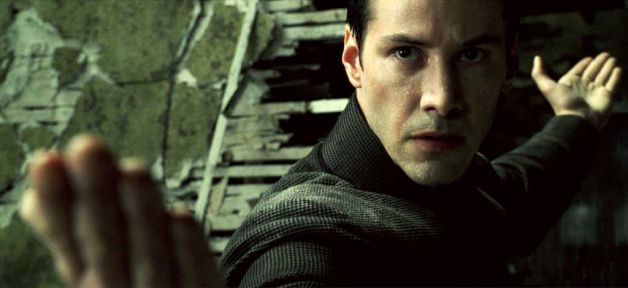
Keanu Reeves carries Neo with a quiet, almost solemn acceptance that stands in stark contrast to the searching, uncertain man introduced in the first film. He is no longer wrestling with identity or questioning whether he is “The One.” That internal battle has been resolved. What remains is something heavier—the responsibility that comes with that truth. Reeves plays Neo not as a man empowered by destiny, but as one burdened by it. Every movement feels intentional, every word measured, as if he understands that the end is approaching and that his role in it cannot be avoided.
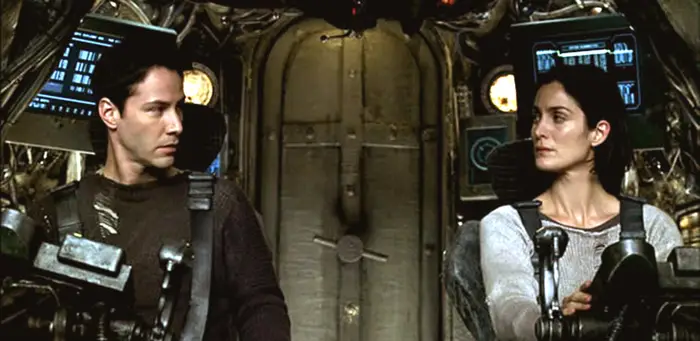
Carrie-Anne Moss brings Trinity’s journey to its emotional peak, grounding the film in something the machines cannot replicate or fully comprehend: genuine human connection. Her performance is not defined by spectacle, but by presence. Even in the midst of chaos, she remains centered, unwavering, and deeply committed—not just to the mission, but to Neo. What she represents in this final chapter is more than love; it is devotion, trust, and the willingness to stand firm even when the outcome is uncertain. In a story driven by systems and control, Trinity reminds us what it means to be human.
Laurence Fishburne allows Morpheus to evolve into something quieter, but no less powerful. The man who once spoke with absolute certainty now carries a more reflective presence. His belief has not disappeared, but it has been refined. It has been tested by truth, challenged by revelation, and reshaped by experience. What remains is not blind faith, but a deeper, more grounded conviction. Morpheus becomes a symbol of what it means to continue believing, even when the journey does not unfold the way it was expected to.
Hugo Weaving completes Agent Smith’s transformation into something far more dangerous than a traditional antagonist. He is no longer a servant of the system—he is its contradiction. His endless replication, his detachment from purpose, and his growing obsession with Neo elevate him beyond the role of villain and into something symbolic. Smith becomes inevitability personified, a force that exists not to enforce order, but to expose the limits of it. In many ways, he represents the consequence of a system that can no longer contain its own design.

And then there is the presence behind it all—the Deus Ex Machina—the embodiment of the machine consciousness itself. Unlike Smith, it is not driven by chaos or emotion. It is measured, calculated, and entirely focused on preservation. What makes this presence so compelling is not its power, but its adaptability. It does not change out of compassion; it changes out of necessity. And in that distinction lies its significance. When it ultimately accepts Neo’s offer, it is not an act of mercy—it is a recognition that even the most controlled system must evolve to survive.

Together, these performances bring the trilogy to a place of completion that feels earned rather than forced. Each character stands at the intersection of what they once believed and what they now understand, and in that space, their final choices carry meaning that extends far beyond the screen.
🧿 Symbolism — Light, Darkness, and Transformation
If The Matrix Reloaded explored the idea of control through layered systems, The Matrix Revolutions shifts its focus toward something more profound—transformation through surrender. The symbolism in this final chapter moves away from questioning illusion and leans fully into illumination. By this point, the audience is no longer being asked to decide what is real. That question has already been answered. Now, the focus turns to what that truth requires. What does it mean to carry it? To act on it? To be changed by it?
Neo’s blindness stands as one of the most powerful visual metaphors in the entire trilogy. On the surface, it appears to be a loss, a limitation placed on a character who once saw more clearly than anyone else. But as the story unfolds, it becomes clear that this is not a weakening—it is a refinement. Stripped of physical sight, Neo begins to perceive the world in a way that transcends the visual. He sees energy, essence, truth in its purest form. The glow of the machines, the presence of the system, the connection between all things—these are no longer hidden from him. In losing one form of vision, he gains another that is deeper, more intuitive, and more aligned with the reality he has been chosen to confront.
Light, in Revolutions, is no longer something external that guides the characters forward—it becomes internal, almost spiritual in nature. It is not found in the sky or reflected in the environment; it exists within Neo himself. This shift reinforces the idea that true understanding does not come from what we observe around us, but from what we are able to recognize within. The journey is no longer about seeing the world differently—it is about becoming someone who understands it on a deeper level.
The Machine City represents another critical layer of symbolism. Vast, mechanical, and seemingly impenetrable, it stands as the physical embodiment of the system’s core—cold, efficient, and devoid of human emotion. It is the place no human was meant to reach, the center of control that exists beyond the illusion of the Matrix itself. And yet, it is here, in the heart of what feels most inhuman, that the possibility of peace emerges. That contrast is intentional. It challenges the assumption that resolution must come from destruction, that victory must be achieved through force. Instead, the film presents a different idea: that even the most rigid systems contain the potential for change when confronted in the right way.
That idea is further reinforced through the contrast between Zion and Neo’s final journey. In Zion, the battle is chaotic, loud, and desperate. It is a fight driven by survival, fueled by fear, courage, and sheer determination. Every explosion, every sacrifice, every stand taken represents humanity’s refusal to disappear. But at the same time, Neo’s path unfolds in near silence. His confrontation with the machines is not marked by chaos, but by stillness. There is no army behind him, no weapons, no spectacle—only presence, purpose, and understanding.
This contrast speaks to one of the film’s deepest truths: not all battles are meant to be fought the same way. Some require resistance. Others require reflection. And the most important ones often require a willingness to step beyond force and into something far more difficult—surrender.
Not surrender as defeat, but surrender as transformation.
Because in The Matrix Revolutions, change does not come from overpowering the system.
It comes from understanding it…confronting it…and ultimately becoming something it did not anticipate.
⛓️ Control, Balance, and the Reality of Peace
What The Matrix Revolutions ultimately reveals is something far more complex than a simple victory or defeat—it reveals that the system itself was never designed to be destroyed. It was designed to endure. To adapt. To correct itself when imbalance threatens its existence. And once that truth comes into focus, the entire narrative shifts. The war between humans and machines is no longer framed as something that can be won through domination. Instead, it becomes something that must be understood—something that has to be resolved at its root rather than overpowered at its surface.
Both sides, for all their differences, are trapped in cycles they cannot break on their own. Humanity fights for freedom, but remains dependent on systems it does not fully control. The machines enforce order, but find themselves vulnerable to anomalies they cannot eliminate without destabilizing everything they have built. What once appeared to be a clear division between oppressor and oppressed begins to blur, revealing something more uncomfortable: both sides are sustaining a conflict that neither can truly end alone.
Neo’s realization is not loud or dramatic—it is quiet, but profound. He understands that the war cannot be solved through strength, because strength only reinforces the cycle. Every act of resistance is met with greater force. Every attempt at control creates new fractures. And so, instead of escalating the conflict, Neo does something the system cannot fully anticipate—he changes the terms of it.
By offering to stop Smith, Neo introduces something the machines cannot calculate with precision: cooperation rooted in mutual survival. This is not an act of surrender, nor is it a strategic manipulation. It is a recognition that survival itself has become a shared interest. Smith is no longer just a human problem or a machine problem—he is a threat to the entire system. And in that shared vulnerability, an opportunity emerges.

This moment shifts the narrative in a way that redefines everything that came before it. The goal is no longer to destroy the system, but to stabilize it. The idea of victory gives way to something more sustainable—coexistence. And that shift forces a deeper understanding of what peace actually means.
Because in The Matrix Revolutions, peace is not presented as a clean resolution or a permanent state of harmony. It is not the absence of conflict, nor is it the elimination of tension. Instead, it is the presence of balance—an ongoing, fragile equilibrium that must be maintained. It is an agreement, not a guarantee. A condition, not a conclusion.
And that may be the film’s most honest message.
Because real peace—whether in systems, relationships, or within ourselves—is rarely final. It is something that must be protected, adjusted, and chosen repeatedly. It requires awareness, humility, and the willingness to recognize when control must give way to understanding.
In the end, The Matrix Revolutions doesn’t offer a perfect solution.
It offers something far more realistic. A balance that holds…as long as those within it are willing to honor it.
⚔️ The Final Battle — Strength Meets Purpose
The final confrontation between Neo and Smith is not simply the climax of The Matrix Revolutions—it is the culmination of every idea, every question, and every conflict that has been building since the beginning of the trilogy. By the time these two forces meet, the stakes have moved beyond survival. This is no longer about winning a fight. It is about resolving a system that has begun to collapse under the weight of its own contradictions.
The setting itself reflects that shift. Rain pours relentlessly, the sky darkens to an almost unnatural stillness, and the world around them feels suspended in anticipation. There is no audience cheering, no allies standing beside them—only two opposing forces locked in a moment that feels both inevitable and final. Smith, multiplied beyond control, represents chaos unchecked, a system that can no longer contain what it created. Neo, standing alone, represents something different—not just resistance, but understanding.
As the battle unfolds, it becomes clear that this is not a contest of strength in the traditional sense. Neo is powerful, but so is Smith. Every strike is met with resistance, every advantage neutralized. What once defined victory—speed, force, dominance—no longer applies. Instead, the fight exposes a deeper truth: neither side can truly win within the rules that brought them here.
And that realization is where everything changes.
What makes this moment unforgettable is not how the battle is fought, but how Neo chooses to end it. Instead of continuing a cycle that cannot resolve itself, he does something the system cannot anticipate. He stops resisting in the way he always has. He allows himself to become part of the equation, offering his connection to the machines as a pathway to eliminate Smith from within.
It is a decision that defies expectation, because it is not rooted in power—it is rooted in purpose.
In that moment, Neo understands something that neither Smith nor the system fully grasped: that true resolution does not always come from defeating an opponent. Sometimes, it comes from breaking the cycle that makes the conflict possible in the first place.
And that is where the meaning of the battle shifts completely.
This is not victory through dominance. It is not triumph through strength. It is not the conquering of one force by another.
It is something far more profound. It is victory through sacrifice. It is the willingness to give what cannot be taken. To choose an ending that costs everything, but changes everything. And in that choice, the war does not explode into a final act of destruction. It dissolves.
❤️ Sacrifice — The Power That Changes Everything
Neo’s final act reshapes what it truly means to be “The One.” Up to this point, that title has been tied to power, prophecy, and the expectation of victory. But in the end, it is not his strength that defines him—it is his willingness to give himself for something greater than himself. He does not save the world by defeating an enemy. He saves it by choosing a path that costs him everything. In doing so, the narrative shifts from rebellion to redemption, from resistance to resolution.
That decision changes the nature of the conflict itself. The system is no longer locked in a cycle of escalation. The war, which once seemed endless, finally reaches a point of stillness. A new balance is established—not because one side has been eliminated, but because something has been offered that neither side could take by force.
And that is where the weight of the moment settles.
Because sacrifice, when it is real, is never symbolic. It is not convenient. It is not easy. It requires surrendering control, releasing certainty, and stepping into an outcome that cannot be guaranteed. Neo’s choice reflects that reality. It is not about knowing what will happen—it is about believing that the act itself has meaning.
And that is why it resonates.
Because true change—whether in systems, in relationships, or within ourselves—rarely comes without cost. It demands something. It asks for something. And in many cases, it requires giving up what feels essential in order to create something greater.
That is the power of sacrifice.
Not that it ends everything…but that it makes something new possible.
🌍 Why The Matrix Revolutions Still Matters Today
In a world still wrestling with division, control, and the ongoing search for truth, The Matrix Revolutions feels less like a conclusion and more like a reflection. Its message hasn’t aged—it’s sharpened. Because the questions it raises about power, balance, and understanding are the same ones society continues to face in different forms.
What the film ultimately reminds us is that not every problem can be solved through force. Resistance has its place, but so does understanding. And sometimes, the most difficult step forward is letting go of the outcome we thought we wanted in order to embrace the one that actually creates stability.
It challenges us to move beyond the idea of winning and losing, and instead consider what it means to build something that lasts. Something balanced. Something intentional. Because real progress isn’t always about defeating an opponent—it’s about creating a future where the conflict no longer needs to exist in the same way.
✨ The Spiritual Bridge to S.O.L.A.D.™
What The Matrix Revolutions ultimately leaves behind is not just a story about machines, war, or even sacrifice—it leaves behind a framework for understanding battles that exist beyond what can be seen. And that is where the connection to S.O.L.A.D.™: Soldiers of Light Against Darkness™ becomes unmistakable.
Within S.O.L.A.D.™, the conflict between light and darkness carries that same weight of purpose, transformation, and cost. Just as Neo’s journey leads him to a place where strength alone is no longer enough, Kevin and Juanita are called into battles that demand something deeper. Their fight is not defined solely by power or ability, but by faith, discernment, and the willingness to step into purpose even when the path is unclear and the outcome uncertain.
Because the most important battles are not always physical. They are spiritual. Internal. Unseen. They challenge identity, test belief, and force choices that cannot be undone. And just like Neo, these characters must come to terms with a truth that is not always comfortable—that being chosen is not about recognition, but responsibility.
That is where both stories align.
They remind us that transformation requires more than awareness. It requires action. It requires sacrifice. And it requires a willingness to trust that what is being built, even through loss, carries meaning beyond the moment itself.
Because the greatest victories are not always the loudest.
Sometimes, they are the ones that shift everything beneath the surface…quietly, intentionally, and permanently.
💥 Final Thought
The Matrix Revolutions doesn’t end with celebration or finality. It doesn’t offer the kind of resolution that neatly ties everything together and allows the audience to walk away without reflection.
Instead, it closes on something far more honest—a question that lingers long after the story is over.
Not a question about whether the war has ended, but about what comes next. About whether the balance that has been created can actually be sustained. Because the film makes it clear that peace is not a permanent state. It is not something that, once achieved, simply remains in place without effort or intention.
Peace requires awareness. It requires understanding. And more than anything, it requires choice.
The kind of choice that isn’t made once, but repeatedly. The kind that demands attention, humility, and a willingness to recognize when things begin to shift out of alignment.
And that may be the most lasting message the film leaves behind.
That the end of conflict is not the end of responsibility…it is the beginning of it.


Comments